MYCPE ONE
MYCPE ONE LOGO

Join 250,000+
professionals today

Add Insights to your inbox - get the latest
professional news for free.

MYCPE ONE insights

How Le Chaton Fat Fooled the Smartest People Online

Join our 250K+ subscribers

Join our 250K+ subscribers

Subscribe

18 JUN 2026 / TECHNOLOGY

How Le Chaton Fat Fooled the Smartest People Online

How Le Chaton Fat Fooled the Smartest People Online

A few years ago, I watched a friend explain a movie plot that didn't actually exist. He described it with such confidence that everyone at the table nodded along. There was a washed-up detective, a missing suitcase, and a neon-lit motel somewhere in Nevada. The details felt familiar. People began adding scenes they "remembered" too. The strange part wasn't that nobody could identify the movie. The strange part was that everybody felt certain they had seen it. I've been thinking about that dinner conversation lately. The philosopher Daniel Kahneman once wrote that our minds are "machines for jumping to conclusions." We don't always ask whether something is true. Often we ask whether it feels like something that could be true. Maybe that's why certain stories spread so easily. They fit the shape of the world we already believe we live in. Not because they're accurate. Because they're familiar. That thought came back to me while watching the internet lose its collective mind over a fictional AI model named Le Chaton Fat.

Why Did So Many Smart People Briefly Believe It?

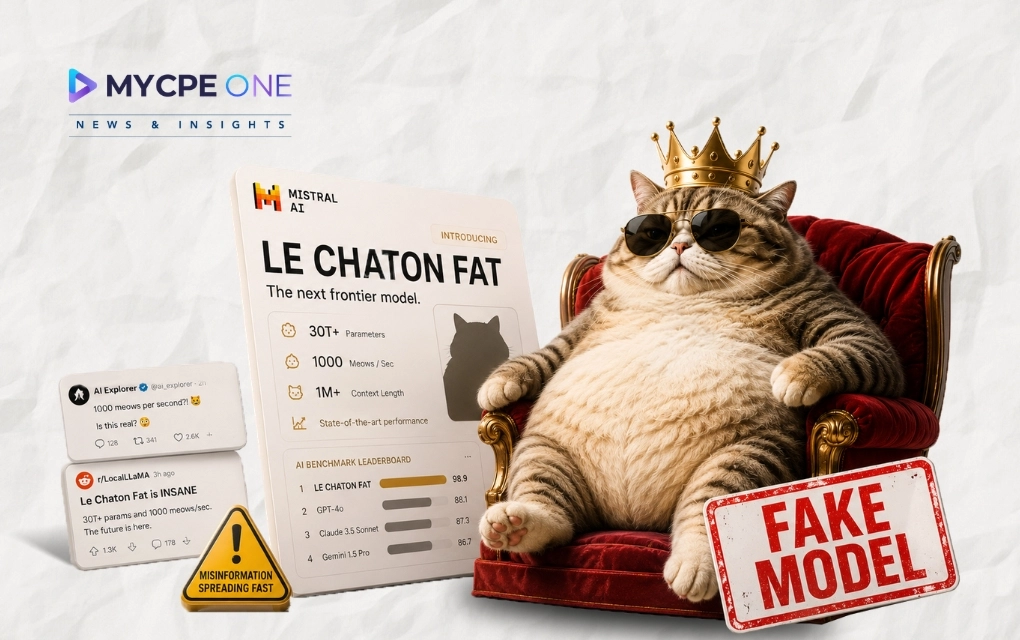
Le Chaton Fat never existed.

The supposedly revolutionary model, attributed to French AI company Mistral, emerged as a joke in June 2026 after the company rebranded its chatbot Le Chat as Vibe. What started as community humor quickly evolved into fake benchmark charts, fictional specifications, invented regulatory restrictions, and increasingly elaborate claims about a giant cat-themed model outperforming competitors. Most people eventually realized it was satire. Some didn't. What interests me isn't the handful of people who got fooled. Every internet joke fools somebody. That's practically part of the recipe.

What interests me is how many technically sophisticated people paused long enough to wonder. Researchers asked whether it might be real. Industry leaders joined the conversation. Corporate executives reportedly started asking questions about it. For a brief moment, a fictional model occupied the same mental space as actual frontier AI systems. That seems like a small thing until you sit with it for a while. Because Le Chaton Fat wasn't convincing due to strong evidence. It was convincing because it fit the pattern. And maybe that's the real story.

What Happens When Plausibility Replaces Verification?

Charlie Munger often talked about incentives as hidden forces shaping behavior. Not what people say they value, but what systems quietly reward. I've always liked that lens because it turns attention away from individual mistakes and toward the environment producing them. The question becomes less "Who got this wrong?" and more "What conditions made this error reasonable?" Viewed that way, Le Chaton Fat starts looking less like a prank and more like a stress test. Think about the incentives surrounding AI today.

Every week seems to bring another benchmark. Another model. Another announcement. Another leaderboard showing somebody beating somebody else. The numbers grow larger. Context windows stretch longer. Performance charts become more colorful. Technical terms appear and disappear faster than most people can track. Eventually, the brain adapts. It stops verifying every claim individually. Instead, it learns the pattern. If something sounds roughly consistent with the last twenty announcements, it earns provisional credibility. That shortcut is usually efficient. Until it isn't. Le Chaton Fat slipped through that opening.

Did the Le Chaton Fat Hoax Expose a Bigger Trust Problem?

The fictional model accumulated increasingly absurd specifications as it spread. Some posts described it as having over 30 trillion parameters. Others claimed it processed "1000 meows per second." Fake benchmark charts showed it outperforming OpenAI and Anthropic systems. One parody narrative suggested European regulators struggled to contain its immense power.

Obviously ridiculous.

Yet mixed among those jokes were details that sounded surprisingly normal.

Large Mixture-of-Experts architectures.

Massive context windows.

Multimodal capabilities.

Custom deployment options.

If you've followed AI for the last two years, those features don't sound unusual at all. That's what made the joke work. The absurdity hid inside familiarity. Timing helped too.

The meme emerged during a period when discussions about AI access restrictions and export controls were already dominating conversations. Anthropic's cybersecurity-focused models had become tied to debates about who could access advanced AI systems and under what conditions. Against that backdrop, some people reasoned that perhaps Le Chaton Fat existed and they simply didn't have access to it. Honestly, that's not a crazy conclusion. That's what makes this episode fascinating. The false belief wasn't irrational. It was built from assumptions that had become rational elsewhere. The distinction matters. When an environment becomes sufficiently unpredictable, uncertainty itself becomes a form of evidence.

The Technology or Our Ability to Interpret It

I keep coming back to the benchmark charts. Not because they're uniquely problematic. Because they're symbols. The AI industry increasingly communicates through screenshots, rankings, parameter counts, and social media posts. Formal announcements still exist, but they compete with memes, quote-posts, leaks, rumors, and community speculation. The result feels a little like standing inside a casino where every slot machine displays a different version of reality. Most information isn't necessarily false. Most isn't necessarily true either. It's just floating. Waiting for attention. Le Chaton Fat happened to be a cat.

The next version may be far less obvious.

What happens when a fabricated benchmark looks professionally designed?

What happens when an AI-generated press release appears before an actual one?

What happens when a fictional capability gets repeated enough times that people begin citing it as background knowledge?

Those questions aren't predictions.

They're reflections on incentives.

Systems often drift toward whatever attracts engagement.

Verification is slow.

Novelty is quick.

One tends to win.

At least for a while.

Sometimes I wonder whether the most important challenge facing AI won't be building smarter models. Maybe it will be preserving shared confidence about what is actually happening. Or maybe that's already becoming harder than we'd like to admit. Back at that dinner table years ago, somebody eventually searched for the movie we were discussing. It wasn't real. The detective didn't exist. The suitcase didn't exist. The motel didn't exist. The entire story dissolved in seconds. Everyone laughed and moved on.

Yet I remember a brief moment before the search result appeared. A moment when the movie felt real because enough people believed it might be. The novelist Umberto Eco once observed that people are "always tempted by the plausible." That line feels oddly relevant here. Not because of a fictional fat cat. Because plausibility has become one of the most valuable currencies on the internet. And unlike truth, it doesn't always need proof.

Until next time…

Don’t forget to share this story on LinkedIn, X and Facebook

Subscribe now for $199 and get unlimited access to MYCPE ONE, from CPE credits to insights Magazine

📢MYCPE ONE Insights has a newsletter on LinkedIn as well! If you want the sharpest analysis of all accounting and finance news without the jargon, Insights is the place to be! Click Here to Join

Unlock Annual Access to News & CPE Subscription

You’ve reached the 3 free-content piece limit. Unlock unlimited access to all News & CPE resources.
Subscribe Today.

News & Insights

  • Exclusive News & Insights
  • Latest Regulatory Updates
  • Accounting Industry Trends
  • Expert Insights
  • AI-Driven Audio & Summaries
  • Infographics & Videos
  • CPE-Approved Articles
  • Digital Magazine
  • Benchmarking Insights

Unlimited CPE Access for 1 Year

  • 15,000+ Hours of Content
  • 500+ Subject Areas
  • Mandatory Ethics Courses
  • 250+ Compliance Packages
  • 50+ Virtual Conferences and Events Access
  • Format: Live, Audio, Video, E-Books
  • Audio Based Courses & Podcasts
  • Add External Certificates with AI
  • AI Compliance Tracking and Report
  • Instant Certification and Fast Reporting
  • Mobile App Access (iOS and Android)
  • Dedicated Support System
  • Practical Training Programs
  • AI Academy Access
  • Tax Academy Access
  • Audit Academy Access
  • Leadership Academy Access