MYCPE ONE
MYCPE ONE LOGO

Join 250,000+
professionals today

Add Insights to your inbox - get the latest
professional news for free.

MYCPE ONE insights

The CPA Licensure Shift Taking Hold in New Jersey

Join our 250K+ subscribers

Join our 250K+ subscribers

Subscribe

21 JAN 2026 / CPA STATE BOARD UPDATES

The CPA Licensure Shift Taking Hold in New Jersey

The CPA Licensure Shift Taking Hold in New Jersey

For decades, the 150-credit rule has been treated like a rite of passage. Not because it made anyone a better accountant, but because it was simply “the way it’s done.” In New Jersey, that mindset has officially shifted. With Governor Phil Murphy signing a new CPA licensure law, the state is adding an alternative pathway that quietly but meaningfully changes how future CPAs can enter the profession. For professionals already practicing in New Jersey, this is not just a pipeline story. It has implications for staffing, mobility, firm strategy, and how the profession adapts to a talent market that has been flashing warning signs for years. 

Why the Old Model Cracked 

New Jersey, like most states, adopted the 150-credit requirement decades ago with good intentions. More education was supposed to mean higher quality. Over time, it also meant higher costs, delayed careers, and a shrinking pool of candidates willing to take on an extra year of tuition before earning real income. 

By the early 2020s, the cracks were obvious. Enrollment dipped nationally, firms struggled to hire, and younger professionals questioned why an additional academic year mattered more than real experience. Ironically, New Jersey was an early innovator through its work for credit pilot programs, pairing universities and firms to let students earn experience toward CPA eligibility. That experiment helped spark national momentum, even as other states moved faster to codify change. 

What the New Law actually changes 

Effective February 11, 2026, New Jersey will operate with two parallel CPA licensure pathways, marking a structural shift in how candidates can qualify while preserving existing standards.

  • Traditional pathway remains unchanged: Candidates may still complete 150 credit hours, obtain one year of relevant experience, and pass the CPA Exam.
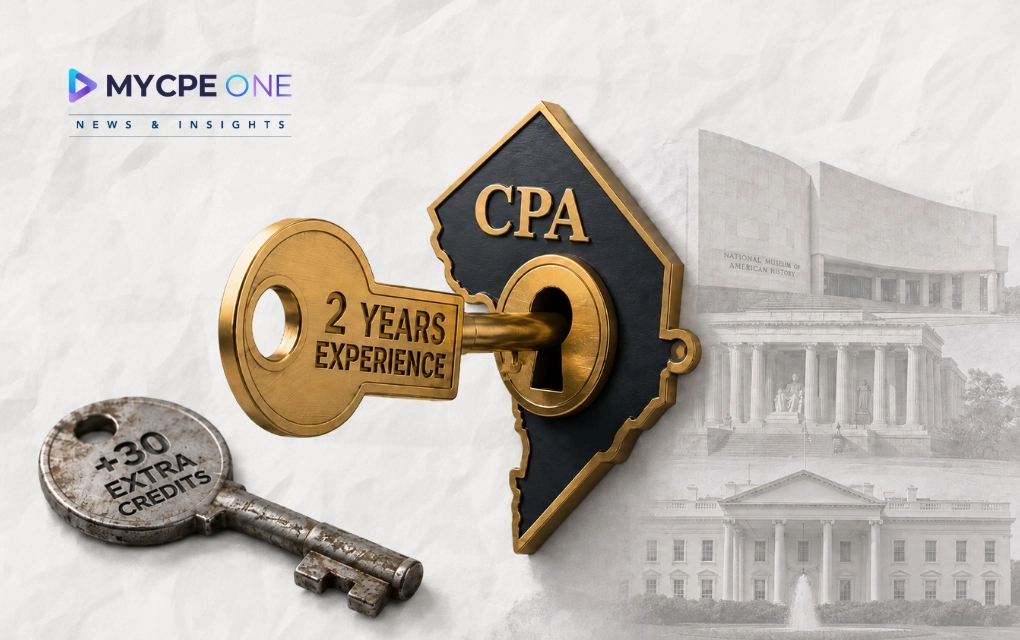
  • New alternative pathway introduced: Candidates may qualify with a bachelor’s degree, two years of relevant work experience, and a passed CPA Exam, with no additional academic credits required.
  • National alignment: This model mirrors reforms adopted in more than 20 states, making New Jersey the 25th state to formally expand CPA licensure pathways.

The law also modernizes practice mobility and reciprocity rules, reducing friction for interstate practice.

  • Updated mobility standard: Out of state CPAs may practice in New Jersey if they hold a bachelor’s or higher degree, have passed the CPA Exam, and have at least one year of licensed experience.
  • Key shift in language: The threshold moves from substantially equivalent to comparable, lowering administrative barriers without eliminating core competency requirements.
  • Safe harbor protection: CPAs licensed in New Jersey before February 11, 2026 automatically retain their credentials, with no action required.

How does this fit into the National Shift? 

New Jersey’s move does not happen in isolation. States across the country are rethinking licensure in response to the same pressures. We have already seen similar reforms take hold in New York Lights Up a New Route for CPA Candidates, where alternative pathways were framed as a way to keep talent local and competitive. California has taken a parallel approach, highlighted in California Opens New Fast Track to CPA Licensure, reinforcing that experience is no longer being treated as a second-class substitute for extra classroom time.  At the national level, both the AICPA and NASBA have updated the model accountancy law to recognize bachelor’s-plus-experience pathways. What once felt radical now feels inevitable. 

What this means for Professionals practicing in New Jersey 

For firms across New Jersey, the change expands the hiring funnel almost immediately. Candidates who previously stopped at a bachelor’s degree can now see a clearer return on investment, particularly those balancing work, family obligations, and student debt in a high-cost state. At the same time, the shift forces firms to think more intentionally about how early career experience is structured and supervised, because experience now carries more weight in the licensure equation. 

  • The bachelor’s plus experience pathway broadens the candidate pool without lowering the CPA Exam standard. 
  • Firms will need stronger training, supervision, and development frameworks to support two years of qualifying experience. 
  • Experience becomes a key differentiator, not just academic credentials or credit hours. 
  • Updated mobility rules give multi-state firms more flexibility in staffing New Jersey engagements. 
  • Clearer reciprocity supports growth, client continuity, and long-term retention. 
  • While concerns about lowering standards surface with every reform, the exam remains unchanged, and the experience requirement actually increases, signaling a shift in emphasis rather than a drop in rigor. 

What Next

For firms across New Jersey, the new CPA licensure pathway expands the hiring funnel almost immediately while also raising expectations around early career development. Candidates who previously stopped at a bachelor’s degree now have a clearer return on investment, particularly those balancing work, family obligations, and student debt in a high-cost state. At the same time, firms will need to be more deliberate about training, supervision, and documentation, since experience now carries greater weight in the licensure equation. The CPA Exam standard remains unchanged, but experience becomes the differentiator rather than extra credit hours. Updated mobility and reciprocity rules also give multi-state firms more flexibility in staffing New Jersey engagements, supporting growth, continuity, and retention. While concerns about lowering standards surface with every reform, the structure here reflects a shift in emphasis toward practical competence, not a reduction in rigor. 

Until next time…

Don’t forget to share this story on LinkedIn, X and Facebook

Subscribe now for $199 and get unlimited access to MYCPE ONE, from CPE credits to insights Magazine

📢MYCPE ONE Insights has a newsletter on LinkedIn as well! If you want the sharpest analysis of all accounting and finance news without the jargon, Insights is the place to be! Click Here to Join

Unlock Annual Access to News & CPE Subscription

You’ve reached the 3 free-content piece limit. Unlock unlimited access to all News & CPE resources.
Subscribe Today.

News & Updates

  • Exclusive News & Insights
  • Latest Regulatory Updates
  • Accounting Industry Trends
  • Expert Insights
  • AI-Driven Audio & Summaries
  • Infographics & Videos
  • CPE-Approved Articles
  • Digital Magazine
  • Benchmarking Blogs

Unlimited CPE Access for 1 Year

  • 15,000+ Hours of Content
  • 500+ Subject Areas
  • Mandatory Ethics Courses
  • 250+ Compliance Packages
  • 50+ Virtual Conferences and Events Access
  • Format: Live, Audio, Video, E-Books
  • Audio Based Courses & Podcasts
  • Add External Certificates with AI
  • AI Compliance Tracking and Report
  • Instant Certification and Fast Reporting
  • Mobile App Access (iOS and Android)
  • Dedicated Support System
  • Practical Training Programs
  • AI Academy Access
  • Tax Academy Access
  • Audit Academy Access
  • Leadership Academy Access