

Join 250,000+
professionals today
Add Insights to your inbox - get the latest
professional news for free.
Join our 250K+ subscribers
Subscribe01 OCT 2025 / ACCOUNTING & TAXES
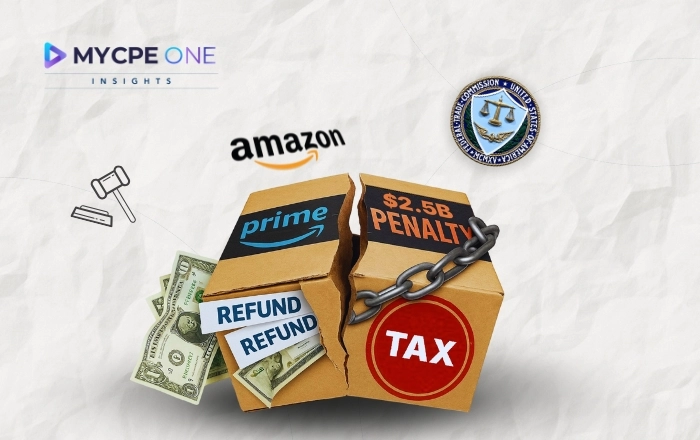
The Federal Trade Commission (FTC) has reached a record $2.5 billion settlement with Amazon, following allegations of deceptive subscription practices. Despite the ongoing US government shutdown, the fine includes $1 billion in non-tax-deductible penalties and $1.5 billion in restitution to consumers which can be written off as a business expense, ultimately reducing Amazon's tax bill by approximately $315 million.
Washington may have hit pause on paying federal workers, but regulators are still writing record checks. As the U.S. government enters its first shutdown since 2018, after senators failed to strike a funding deal, the Federal Trade Commission pushed through a $2.5 billion settlement with Amazon. One branch of government is sending employees home without pay, while another is collecting billions from a tech giant. It raises a curious question: what does this clash between politics, penalties, and tax law really mean for Amazon, and for the rest of us watching?
Back in 2023, the FTC accused Amazon of being a little too “helpful” with its subscription buttons. Instead of offering a clean yes/no option, Amazon allegedly buried “decline” links in the fine print and nudged customers into Prime like a waiter sliding dessert onto your bill unasked. The real drama came with the cancellation. Amazon allegedly designed what insiders called the “Iliad Flow”, a six-click, four-page odyssey that made saying goodbye to Prime about as easy as cancelling a gym membership. FTC attorneys pulled up internal emails where execs admitted simpler exits meant lower revenue. By their math, over 35 million people got enrolled without true consent. The FTC finally had its “gotcha” moment in 2025, and Amazon agreed mid-trial to a record $2.5 billion settlement: $1 billion in penalties and $1.5 billion in restitution to consumers.
Here’s where Section 162(f) of the tax code enters the chat. The law is clear: fines and penalties paid to the government are not deductible. That means Amazon’s $1 billion penalty is dead weight on the income statement. No wiggle room. No clever structuring. Just pure expense. But restitution is different. Should $1.5 billion Amazon refund consumers? That’s considered restitution and, under the rules, is tax-deductible as a business expense. Translation: Amazon can write off those refunds like it’s handing out coupons. Let’s put it in plain numbers. If Amazon’s effective tax rate hovers near 21%, deducting $1.5 billion could lower its tax bill by roughly $315 million. So, while the FTC gets to wave around a “record-breaking” fine, the IRS essentially chips in part of the refund bill. Funny how two regulators can tug at the same corporate wallet in opposite directions.
Now for the part your clients might actually care about. Refunds roll out in two stages:
The max payout? $51 per customer. Not exactly a lottery win, but maybe enough to cover one bulk pack of paper towels. And a PSA: if anyone calls you claiming to be the FTC and offering to “help” you get your refund, for a fee, naturally, that’s a scam. The FTC doesn’t cold-call or demand payments. Report fraud at ReportFraud.ftc.gov.
The timing is key. Amazon doesn’t have to pay the second half of its $1 billion penalty until mid-2026, but it can start deducting the restitution once payments are made. That means the company’s 2025 taxable income could see a noticeable haircut thanks to those consumer refunds. Will Wall Street notice? Probably not much. A $315 million tax benefit is real money to us, but it’s a rounding error on Amazon’s $500 billion-plus revenue stream. Still, for accountants, it’s a reminder of how settlements can straddle two worlds: PR disasters for the public, tax manoeuvres behind the scenes.
The irony is rich: while government workers sit idle during a shutdown, regulators just forced one of America’s biggest employers to rethink how it sells subscriptions. For professionals in tax and accounting, the Amazon case is a fresh reminder that penalties and compliance costs don’t end at the courtroom door; they ripple into financial statements, tax returns, and investor calls. As Ben Franklin put it, “Nothing is certain except death and taxes.” If he were around today, he might add: “and at least six clicks to cancel Prime.”
Until next time…
Don’t forget to share this story on LinkedIn, X and Facebook
Subscribe now for $199 and get unlimited access to MYCPE ONE, from CPE credits to insights Magazine
📢MYCPE ONE Insights has a newsletter on LinkedIn as well! If you want the sharpest analysis of all accounting and finance news without the jargon, Insights is the place to be! Click Here to Join
Earn CPE Credits by Simply Reading Articles – Starting at Just $199/Year!
50 of the Top 200 Accounting Firms trust MYCPE ONE for their team’s learning-why not you? With 15,000+ approved content hours, 500+ emerging subject areas, and automated compliance tracking, staying ahead has never been easier.
We don’t just create boring tax, accounting, and audit content-our platform offers engaging, insightful, and trending material that your team will actually enjoy while earning CPE credits.
Sign up today, go through the comprehensive list of features and unlock unlimited learning!
You’ve reached the 3 free-content piece limit. Unlock unlimited access to all News & CPE resources.
Subscribe Today.
Already have an account?
Sign In