MYCPE ONE
MYCPE ONE LOGO

Join 250,000+
professionals today

Add Insights to your inbox - get the latest
professional news for free.

MYCPE ONE insights

How a $48B ETF Tax Loophole Became America’s Biggest Tax Escape Room

Join our 250K+ subscribers

Join our 250K+ subscribers

Subscribe

09 JUN 2026 / ACCOUNTING & TAXES

How a $48B ETF Tax Loophole Became America’s Biggest Tax Escape Room

How a $48B ETF Tax Loophole Became America’s Biggest Tax Escape Room

A tax loophole rarely walks into the room wearing a name tag. It usually shows up in the fine print, sits quietly for years, and then one day someone in wealth management figures out how to turn it into real money. That is roughly where the U.S. tax conversation now sits with ETFs, 351 conversions, qualified small business stock, stepped up basis, and the wider tax gap tied to pass-through income. None of these items works exactly the same way. Some involve legal deferral. Some involve permanent avoidance. Some reward risk-taking. Some look like Congress left the garage door open and Wall Street drove the truck through. For CPAs, tax advisors, auditors, and finance leaders, the issue is not just whether these strategies survive. The real question is sharper: when does legitimate tax planning become a revenue drain big enough to force lawmakers, Treasury, and the IRS to get serious?

Is the ETF tax break still a quiet little rule?

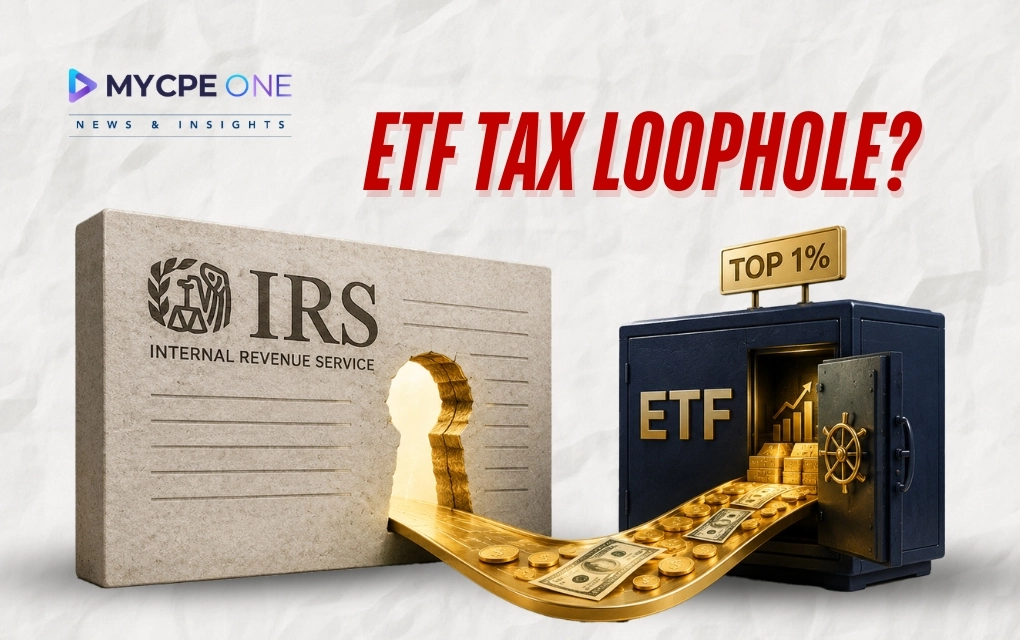
Not anymore. Bloomberg estimates that the ETF tax break now costs the U.S. Treasury about $48 billion a year. That figure puts it in the same conversation as major federal budget priorities, including NASA funding and health insurance subsidy cuts. The core rule goes back to 1969. It allows funds to use in-kind redemptions without triggering capital gains tax. That structure helps explain why ETFs look so tax-efficient compared with traditional mutual funds. Investors still may owe tax when they sell ETF shares, so the industry argues this mostly creates deferral, not avoidance. That point matters. It also does not end the discussion. The problem comes when ETFs use the rule not as ordinary plumbing, but as a tax cleanup machine. That is where heartbeat trades enter the chat.

Source: Bloomberg

Heartbeat trades involve a large inflow into an ETF, followed shortly by a matching outflow. The pattern looks like a blip on a medical chart, which gives the strategy its name. During that brief movement of assets, an ETF can move out appreciated securities without generating capital gains inside the fund. Bloomberg estimates that funds used heartbeats to shed about $293 billion of assets last year, and that heartbeats have grown faster than the ETF market itself. The ETF industry has exploded to nearly $15 trillion in assets. As markets rose, portfolios accumulated more embedded gains. That gave managers a stronger reason to use in-kind transactions to keep gains from surfacing. After the SEC’s 2019 rule change broadened access to custom baskets, more ETF managers gained the ability to choose which securities they handed out. Active ETFs, which need more portfolio flexibility, now rely more heavily on these tools than index funds.

Source: Bloomberg

This is where the fairness debate gets spicy. Bloomberg’s estimates show the top 1% of households receive about 39.6% of the ETF tax benefit, with average savings near $12,862. Middle-class households receive much less, roughly $23 on average. It means taxable ETF wealth is concentrated among high-income households, while many middle-income savers hold funds in retirement accounts that already defer tax.

Source: Bloomberg

Are Section 351 conversions for the new ETF tax machine?

Section 351 conversions let investors contribute appreciated securities to a corporation, including certain ETF structures, without immediate tax if the rules are met. In practice, an investor can move a gain-heavy portfolio into an ETF, then benefit from the ETF’s ability to use in-kind redemptions to remove appreciated holdings, gaining diversification without an immediate capital gains bill. Treasury is paying attention. The Investment Company Institute has requested guidance, and officials have reportedly considered restricting some 351 conversions or designating them as transactions of interest when tax avoidance concerns arise.

The industry argues many conversions serve legitimate purposes, including lower costs, better liquidity, operational simplicity, broader ETF access, and rebalancing direct indexing portfolios with large embedded gains. Critics focus on cases where investors appear to use the structure primarily for tax-free diversification. The 25% and 50% diversification tests are intended to prevent concentrated positions from being moved into ETFs too easily, though planning opportunities remain. For CPA firms, the key message is that these transactions are not automatically “tax-free.” They are tax-deferred, highly fact-dependent, and potentially subject to future scrutiny.

Did QSBS just leave Silicon Valley?

Qualified small business stock (QSBS) has long been a startup tax planning tool. Under Section 1202, eligible noncorporate taxpayers can exclude gains from qualifying C corporation stock sales. Before 2025, the benefit generally equaled the greater of $10 million or 10 times the basis after a five-year holding period. The One Big Beautiful Bill Act expanded QSBS for stock issued after July 4, 2025. The gross asset threshold increased from $50 million to $75 million, the exclusion cap rose from $10 million to $15 million per taxpayer, and new tiered exclusions allow 50% after three years, 75% after four years, and 100% after five years.

As a result, QSBS planning is spreading beyond Silicon Valley startups to manufacturers, logistics firms, IT companies, and consumer businesses. Supporters view the incentive as a way to encourage investment and business formation. Critics argue it allows wealthy founders and investors to exclude substantial gains unavailable to most wage earners. Another concern is “stacking,” where shares are gifted to trusts or family members so multiple taxpayers can claim separate exclusions. While generally permitted, aggressive structures could attract future scrutiny from lawmakers or the Treasury.

Is the stepped-up basis part of the same problem?

Stepped-up basis differs from ETF in kind redemptions, 351 conversions, and QSBS, but raises a similar concern: appreciated assets receive a fair market value basis at death, potentially eliminating income tax on gains accrued during life. Proposals such as the STEP Act and Biden-era plans sought to tax unrealized gains above certain thresholds at death, while generally exempting smaller estates, residences, family farms, and family businesses. Supporters say these measures target large concentrations of wealth without affecting most families. Critics point to valuation challenges, liquidity concerns, and administrative complexity, especially for closely held and illiquid assets.

The debate also ties into the broader tax gap. Treasury estimates the top 1% underpay nearly $175 billion in taxes annually, while the IRS projects a $696 billion gross tax gap for tax year 2022. Wage income is relatively easy to verify through third-party reporting, but pass-through income, partnerships, offshore structures, and private assets remain far harder to track. That is why these issues extend beyond politics. They highlight a tax system where the most transparent income is often the easiest to tax, while the most complex income offers the greatest planning opportunities.

What's next?

These strategies remain legal, but that does not mean they are risk-free or permanent. Treasury guidance on 351 conversions could be the first major development, especially if regulators target transactions viewed as primarily tax driven. Congress may also revisit ETF taxation, with heartbeat trades and related structures likely drawing more attention than a broad repeal of ETF tax benefits. QSBS deserves monitoring as well. Its expanded 2025 benefits will encourage more planning and likely more scrutiny of stacking, trusts, and eligibility requirements. For CPA and advisory firms, the takeaway is straightforward: document purpose, track basis, confirm eligibility, and clearly explain the difference between tax deferral and tax avoidance. The bigger question is whether lawmakers decide these strategies still reflect sound tax policy or have become too costly for the Treasury to ignore.

Until next time…

Don’t forget to share this story on LinkedIn, X and Facebook

Subscribe now for $199 and get unlimited access to MYCPE ONE, from CPE credits to insights Magazine

📢MYCPE ONE Insights has a newsletter on LinkedIn as well! If you want the sharpest analysis of all accounting and finance news without the jargon, Insights is the place to be! Click Here to Join

Unlock Annual Access to News & CPE Subscription

You’ve reached the 3 free-content piece limit. Unlock unlimited access to all News & CPE resources.
Subscribe Today.

News & Insights

  • Exclusive News & Insights
  • Latest Regulatory Updates
  • Accounting Industry Trends
  • Expert Insights
  • AI-Driven Audio & Summaries
  • Infographics & Videos
  • CPE-Approved Articles
  • Digital Magazine
  • Benchmarking Insights

Unlimited CPE Access for 1 Year

  • 15,000+ Hours of Content
  • 500+ Subject Areas
  • Mandatory Ethics Courses
  • 250+ Compliance Packages
  • 50+ Virtual Conferences and Events Access
  • Format: Live, Audio, Video, E-Books
  • Audio Based Courses & Podcasts
  • Add External Certificates with AI
  • AI Compliance Tracking and Report
  • Instant Certification and Fast Reporting
  • Mobile App Access (iOS and Android)
  • Dedicated Support System
  • Practical Training Programs
  • AI Academy Access
  • Tax Academy Access
  • Audit Academy Access
  • Leadership Academy Access