Join 250,000+
professionals today
Add Insights to your inbox - get the latest
professional news for free.
Join our 250K+ subscribers
Subscribe25 FEB 2026 / ACCOUNTING & TAXES
Scams targeting retirees in Michigan have resulted in losses ranging from thousands to over millions of dollars, highlighting a growing issue nationally with the Federal Trade Commission (FTC) reporting $1.16 billion lost to romance scams in the first nine months of 2025 alone. The article argues that financial institutions and professionals need to increase vigilance and take preventive measures, as these scams impact tax outcomes, retirement plans, estate strategies, and client trust.
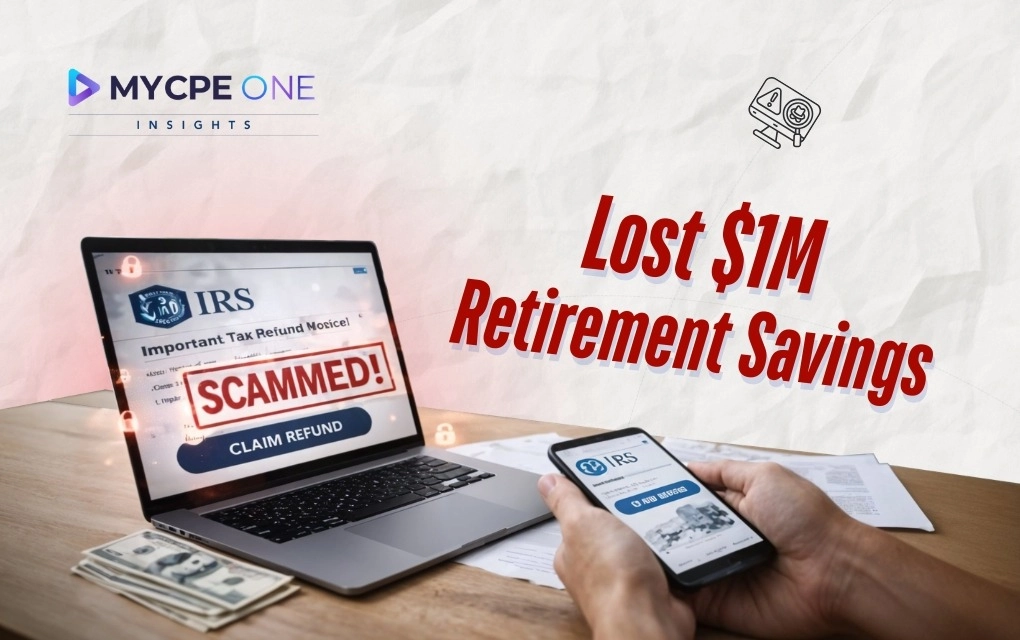
It always starts small. A pop-up. A text. A voice that sounds official enough. And then, just like that, someone’s retirement account is gone. In Kalamazoo County, Michigan, a man lost $1,051,000 after a fake IRS warning led him to liquidate his 401(k), IRA, and personal bank funds. In the same state, romance scam victims lost anywhere from a few thousand dollars in gift cards to six-figure nest eggs. Nationally, the FTC reports $1.16 billion lost to romance scams in the first nine months of 2025 alone, with $398 million disappearing in just the third quarter. This is not background noise anymore. This is a balance sheet problem. Let’s talk about what is actually happening and why accounting and finance professionals should care.
The Michigan case reads like a checklist of behavioural triggers. A fake warning claimed the victim’s information had leaked onto the “black web.” He called the number on the screen. The caller, posing as an IRS clerk, instructed him to move his money into a so-called “Federal IRS locker” for protection. The first withdrawal was $8,000 from an ATM at a beer store. Then came cashier’s checks. By the time the dust settled, more than $1 million was gone.
The IRS has repeatedly warned that it does not demand immediate payment by phone, threaten arrest, or instruct taxpayers to move assets into protective accounts. Yet in the heat of the moment, logic takes a back seat. As Daniel Kahneman wrote in Thinking, Fast and Slow, when System 1 kicks in, we act before we analyze. From a professional standpoint, this raises a practical question: where were the friction points? The bank reportedly did not flag the transactions as suspicious. An $8,000 ATM withdrawal followed by large cashier’s checks draining retirement funds should trigger conversation, if not escalation. We spend hours debating internal control deficiencies in audit engagements. Meanwhile, outside the four walls of financial reporting, retirees wire out life savings because a voice on the phone sounds official. That should give all of us pause.
The “wrong number” text has become the modern Trojan horse. “Are we still on for lunch?” You reply, “Wrong number.” They apologize. The chat continues. Weeks pass. You’re talking on Telegram or WhatsApp. Then crypto enters the picture. According to the FTC Consumer Sentinel Network, 55,604 romance scam reports came in during the first nine months of 2025, up 22% from the same period in 2024. Reported losses hit $1.16 billion. Adults 60 and older lost $2.4 billion to various scams in 2024, nearly quadruple the amount in 2020. Let that sink in.
These are not random amateurs. Moody’s financial crime experts describe highly organised scam centres overseas, some tied to human trafficking operations. Scripts vary by age, gender, and life situation. Some operations use AI-generated video or voice deepfakes. In 2024, a company employee wired $25 million after fraudsters impersonated executives with convincing audio and visuals. That is not small time. . We recently explored how AI is raising new red flags for professionals in Tax Season 2026, and the same technology is clearly fueling these scams.
For CPA firms, this is not just a consumer issue. It bleeds into advisory conversations. Estate planning. Retirement modeling. Fraud risk discussions. Client's mental capacity. Even engagement risk if clients liquidate assets based on misinformation and later seek blame. We have all had that client who insists they found a “guaranteed crypto strategy.” Now add a fictional romantic partner to the mix. It sounds absurd until it lands on your desk.
In the Michigan IRS impersonation case, the victim told law enforcement that his bank did not flag the activity as unusual. That fact should make compliance officers a little uncomfortable. Financial institutions face a difficult line. Over-intervention, and customers complain about access restrictions. Under intervene, and funds vanish into shell entities overseas. Moody’s research identified single addresses linked to tens of thousands of registered companies used to conceal activity. From a controls perspective, this looks like a classic risk management tension: friction versus customer experience.
Carma Peters, CEO of Michigan Legacy Credit Union, said institutions try to talk customers through suspicious withdrawals and document conversations. That is good practice. But here is the uncomfortable truth: many victims lie to their banks because the scammer coached them. They say they are buying carpeting. Paying off a car. Sending money to a contractor. Sound familiar? As accountants, we see the same behavioral override in internal fraud cases. Tone at the top does not matter if someone decides to bypass controls. Scammers exploit the human equivalent of control override. At the same time, enforcement is scaling. In fiscal year 2025, IRS Criminal Investigation identified $10.59 billion in financial crimes, a 15.7% increase from the prior year, as we detailed in How IRS-CI Tracked $10.6B in Financial Crime. The money is getting bigger. The investigations are getting more digital. So, what is the answer? More data analytics? AI transaction monitoring? Possibly. But the real battleground is behavioral.
You are not just filing a return. You are managing the aftermath of financial trauma. And as we covered in No Theft Loss Deduction for a Stolen Heart, the tax code may offer little relief if the loss was not tied to a transaction entered into for profit. The FTC reports that older adults are nearly twice as likely as younger adults to report losses of six figures or more from fraud. Many do not report at all. In Kalamazoo County, law enforcement estimates that only one in five victims comes forward. From a practice management perspective, this touches several areas:
The takeaway is simple, even if the issue is not. Scam losses are no longer isolated anecdotes. They are material financial events affecting retirement plans, tax outcomes, estate strategies, and client trust. As advisors, we sit in a unique position. We often know a client’s full financial picture better than anyone else. So, the next time a client mentions an urgent government call or a new online “investment opportunity” tied to someone they met on a messaging app, do not brush it off. Ask one more question. Slow it down. Be the speed bump. In this environment, boring skepticism might be the most valuable service we provide.
Until next time…
Don’t forget to share this story on LinkedIn, X and Facebook
Subscribe now for $199 and get unlimited access to MYCPE ONE, from CPE credits to insights Magazine
📢MYCPE ONE Insights has a newsletter on LinkedIn as well! If you want the sharpest analysis of all accounting and finance news without the jargon, Insights is the place to be! Click Here to Join
You’ve reached the 3 free-content piece limit. Unlock unlimited access to all News & CPE resources.
Subscribe Today.
Already have an account?
Sign In