
MYCPE ONE
MYCPE ONE LOGO

Join 250,000+
professionals today

Add Insights to your inbox - get the latest
professional news for free.

MYCPE ONE insights

Is the New Car Loan Tax Break Real or Just Smoke?

Join our 250K+ subscribers

Join our 250K+ subscribers

Subscribe

22 DEC 2025 / ACCOUNTING & TAXES

Is the New Car Loan Tax Break Real or Just Smoke?

Is the New Car Loan Tax Break Real or Just Smoke?

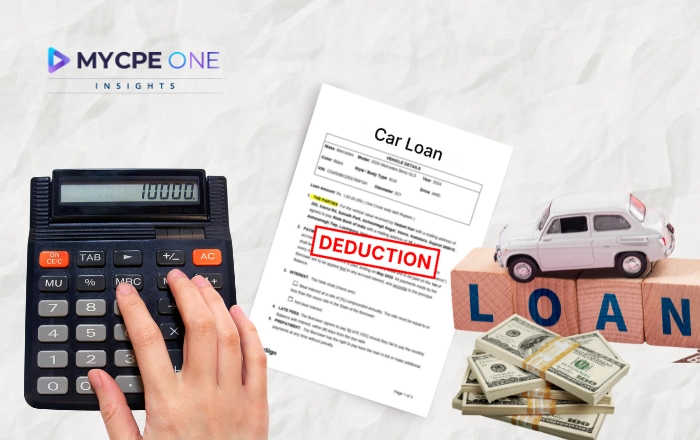
Washington just tossed drivers a headline that sounds like a pit crew miracle: “no tax on car loan interest.” Starting in tax year 2025, the One Big Beautiful Bill Act (OBBBA) lets eligible taxpayers deduct up to $10,000 a year in interest on a qualified car loan, as long as the vehicle is new, finally assembled in the U.S., and used personally. Sounds like relief for folks getting smacked by high rates and big monthly payments. But once you pop the hood, the policy looks less like broad middle-class help and more like a carefully tuned incentive for buying specific vehicles in a specific way. Let’s break down what this deduction actually is, how it works from 2025 through 2028, and who really qualifies.

The “No Tax” Claim?

Calling this “no tax on car loan interest” is marketing, not math. What the law actually does: it creates a temporary deduction for qualified passenger vehicle loan interest for 2025–2028, allowing eligible individuals to deduct some or all of the interest they pay, even if they take the standard deduction. So, it’s not a total exemption; it’s a deduction that reduces taxable income.

Key headline rules:

  • Deduction window: 2025, 2026, 2027, 2028 (temporary, then sunsets).
  • Annual cap: up to $10,000 of eligible interest per year.
  • Loan timing: the loan must be originated after December 31, 2024.
  • No itemizing required: available to itemizers and non-itemizers.

The catch: most taxpayers will not come anywhere near the $10,000 cap in real life. That cap is more of a political number than a typical outcome.

The Fine Print Runs the Show

To claim the deduction, you need to clear three hurdles: the taxpayer test, the vehicle test, and the loan test.

Taxpayer income limits (MAGI phaseout)

The deduction starts phasing out at:

  • $100,000 MAGI for single filers
  • $200,000 MAGI for married filing jointly

Phaseout mechanics:

  • Your deduction is reduced by $200 for every $1,000 of MAGI above the threshold.
  • Fully phased out at:
  • $150,000 MAGI (single)
  • $250,000 MAGI (married filing jointly)

Translation: high earners get nothing, and upper-middle earners may only get a partial benefit.

Vehicle rules (new + final assembly in the U.S.)

Your vehicle must be:

  • New, meaning the “original use” begins with you.
  • A passenger vehicle type such as a car, minivan, van, SUV, pickup, or motorcycle, generally under a 14,000-pound GVWR limit.
  • Finally assembled in the United States, and you must report the VIN on your return.

The law’s definition of final assembly is a mouthful, but here’s the key part in plain English: the vehicle must roll out of a U.S. plant as a complete, mechanically operable vehicle delivered to a dealer. The law itself describes it as: “Final assembly means the process by which a manufacturer produces a vehicle at, or through the use of, a plant, factory, or other place from which the vehicle is delivered to a dealer with all component parts necessary for the mechanical operation of the vehicle included…” That’s not “buy American” as a vibe, it’s “buy this specific VIN-verified vehicle” as a compliance requirement.

Loan rules (secured, first lien, personal use)

The loan must be:

  • A first lien secured by the vehicle.
  • Used for personal purposes.
  • Not a lease. Lease financing does not qualify.
  • Supported by lender reporting to the IRS (plus borrower documentation).

Also note:

  • Refinances can qualify, but only if the refinanced balance does not exceed the old loan’s ending balance, and it remains a first-lien secured loan.
  • Some loans are explicitly out, like fleet financing, salvage-title vehicles, and certain related-party loans.

Does It Actually Save Real Money?

Here’s the part most people care about: what does this do for my wallet?

Example math (typical scenario):

  • $40,000 loan
  • 7% interest
  • 5-year term

Year 1 interest is roughly $2,800. If you’re in the 22% tax bracket, the deduction’s value is about $616 for that year.

That’s not nothing, but it’s also not changing the entire car affordability equation. It’s a modest offset in a world where payments and depreciation do the heavy damage. So, the deduction functions less like “new affordability” and more like a softener for high-rate pain, especially for buyers already positioned to purchase a new vehicle.

Why the Rules Feel So Weird

This is where the “tax reform vs facade” argument gets interesting. The design nudges behavior in a very specific direction:

  • New cars over used cars.
  • Purchases over leases.
  • U.S.-final-assembly vehicles over imports.

That looks like consumer relief in the press release, but in practice, it also looks like industrial policy. If you make the benefit unavailable for used cars and leases, you effectively steer buyers toward higher sticker prices and traditional financing, which helps manufacturers and dealer inventory movement. It also expands reporting. The VIN on the tax return and lender information returns mean one more place where compliance mistakes can trigger headaches.

What Tax Professionals Should Tell Clients

If you’re advising clients, here’s the clean checklist that prevents “oops” moments:

  • Confirm the vehicle qualifies (new + U.S. final assembly).
  • Confirm personal-use status (business use changes the analysis).
  • Confirm the loan structure (first lien, secured, originated after 12/31/2024).
  • Run MAGI projections before they buy, not after they file.
  • Collect lender documentation for interest paid, and keep it with the file.
  • Enter VIN accurately. One character off and you invite a notice.

Practical note: Some consumer-facing guidance suggests the VIN and loan details may be entered on a dedicated line or schedule (for example, a Schedule 1 attachment). Expect IRS forms and instructions to evolve quickly in the first year, and expect confusion in the early filing season.

Bottom Line

OBBBA’s car loan interest deduction is real, but it’s not a universal “no tax” perk. It’s a temporary, tightly restricted deduction that benefits a specific slice of taxpayers: people buying new, buying U.S.-assembled, financing with a traditional secured loan, staying under MAGI limits, and using the car personally. If you qualify, you can absolutely shave your taxable income. Just don’t expect it to be a “revolution” unless your interest rate is unusually high.

Until next time…

Don’t forget to share this story on LinkedIn, X and Facebook

Subscribe now for $199 and get unlimited access to MYCPE ONE, from CPE credits to insights Magazine

📢MYCPE ONE Insights has a newsletter on LinkedIn as well! If you want the sharpest analysis of all accounting and finance news without the jargon, Insights is the place to be! Click Here to Join

The Only All-in-One CPE & Learning Platform for CPA & Accounting Firms

Get everything you need for team learning and CPE compliance-starting at just $199 per user/year!

  • 15,000+ hours of CPE-approved content
  • Learning Management Software to track & manage learning
  • CPE compliance tracking for all 50 states & 100+ designations
  • Mobile app access with audio-based courses
  • CPE-approved articles (like the one you're reading!)
  • Practical staff training & assessments
  • Learning & Development services

Learn more or schedule a no-obligation call!

Unlock Annual Access to News & CPE Subscription

You’ve reached the 3 free-content piece limit. Unlock unlimited access to all News & CPE resources.
Subscribe Today.

News & Updates

  • Exclusive News & Insights
  • Latest Regulatory Updates
  • Accounting Industry Trends
  • Expert Insights
  • AI-Driven Audio & Summaries
  • Infographics & Videos
  • CPE-Approved Articles
  • Digital Magazine
  • Benchmarking Blogs

Unlimited CPE Access for 1 Year

  • 15,000+ Hours of Content
  • 500+ Subject Areas
  • Mandatory Ethics Courses
  • 250+ Compliance Packages
  • 50+ Virtual Conferences and Events Access
  • Format: Live, Audio, Video, E-Books
  • Audio Based Courses & Podcasts
  • Add External Certificates with AI
  • AI Compliance Tracking and Report
  • Instant Certification and Fast Reporting
  • Mobile App Access (iOS and Android)
  • Dedicated Support System
  • Practical Training Programs
  • AI Academy Access
  • Tax Academy Access
  • Audit Academy Access
  • Leadership Academy Access