MYCPE ONE
MYCPE ONE LOGO

Join 250,000+
professionals today

Add Insights to your inbox - get the latest
professional news for free.

MYCPE ONE insights

Is Corporate Loyalty Now a Hidden Tax?

Join our 250K+ subscribers

Join our 250K+ subscribers

Subscribe

16 JUN 2026 / BUSINESS

Is Corporate Loyalty Now a Hidden Tax?

Is Corporate Loyalty Now a Hidden Tax?

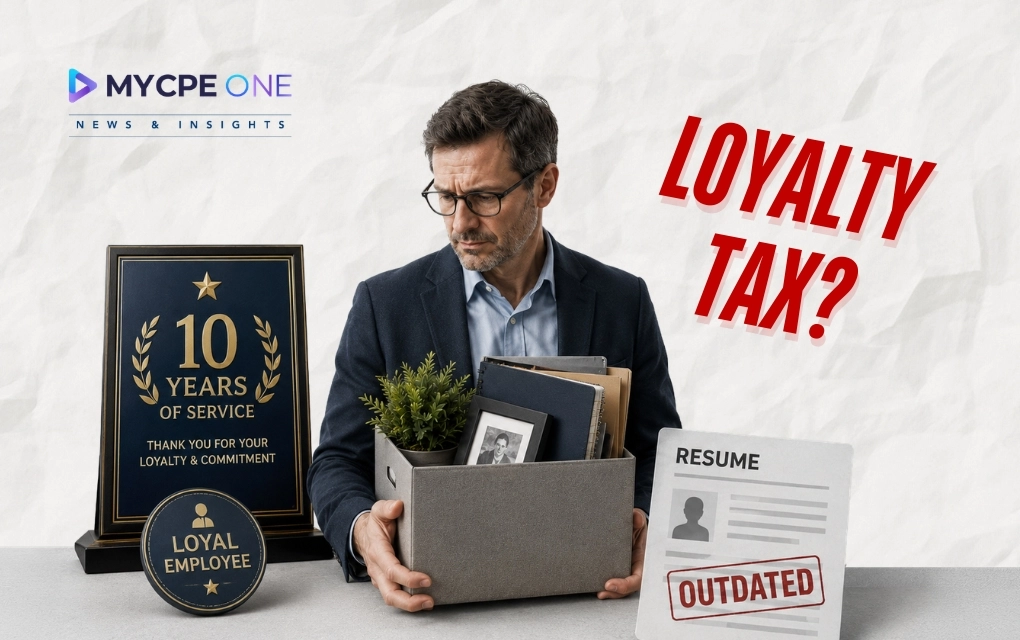
Loyalty used to feel like a safe seat at the table. Stay late, learn the systems, train the new hires, carry the institutional memory, and maybe the company returns the favor when the budget gets tight. That deal now looks shakier than a spreadsheet built with hidden formulas. A new phrase has entered the workplace conversation: “loyalty tax.” It sounds like something the IRS cooked up during a slow Friday, but it has nothing to do with Form 1040. In the workplace, the loyalty tax describes the professional price long tenured employees pay when they assume years of service will protect them from layoffs, stalled raises, outdated skills, or weaker market pay. The painful part? Many of these employees did everything right by the old rules. They stayed. They delivered. They believed the company knew their value. Then a restructuring memo, a calendar invite from HR, or a “business needs have changed” script told them otherwise. That is a hard reset, especially for professionals who built their identity around one employer for five, ten, or fifteen years.

Did Tenure Stop Being a Safety Net?

Careerminds surveyed 900 U.S. workers in April 2026 who had been laid off after five or more years with the same employer. The numbers tell a rough story. More than seven in ten believed their loyalty would protect them from layoffs. About two thirds felt blindsided when the layoff came. Nearly half had a resume that was badly outdated or did not exist, and more than half had a mostly inactive professional network. That is not just a job search problem. That is a career readiness problem.

Source: etax accountant

Long tenured employees often operate under an unspoken psychological contract: I gave you my best years, so you will look out for me when the market gets ugly. Companies rarely put that promise in writing, but plenty of workplace cultures quietly encourage it. They reward loyalty with praise, service awards, internal shoutouts, and maybe a cake in the break room. Then when demand shifts, margins tighten, or client work slows, finance teams start sharpening the pencil. That does not make every layoff reckless or unfair. Businesses face real pressure. Client pipelines change. Advisory demand cools. Interest rates reshape banking activity. Federal cost cutting can hit consulting work tied to government contracts. AI and automation can change the staffing math almost overnight.

Why Are Big Firms Cutting While Still Hiring?

PwC cut about 1,500 U.S. jobs in 2025, while KPMG reportedly reduced about 4% of its U.S. advisory workforce in 2026. Morgan Stanley also reportedly moved to cut around 2,500 jobs, or about 3% of its workforce. Banks, accounting firms, and consulting shops continue to rebalance headcount as revenue pressure, technology, and shifting client demand keep changing priorities. For employees, strong performance in last year’s business model may not guarantee value in this year’s operating model. A tax manager skilled in legacy compliance workflows may still need stronger AI, data, or advisory capabilities. An audit professional with years of engagement history may face pressure if demand weakens in that practice area.

This creates the real loyalty tax: employees stay loyal to the company, while the company stays loyal to the market. That does not mean professionals should become cynical job hoppers. It means they should stop treating tenure like insurance.

What Does This Mean for CPA Firms and Finance Teams?

The loyalty tax hits accounting and finance teams too, even though they often see cost pressures before others do. A controller notices budget freezes. A finance director sees margin pressure. A CPA firm partner tracks utilization and pipeline trends. Yet even professionals close to the numbers can be caught off guard when those numbers affect their own roles. Consider a senior audit manager who spent years training staff, managing clients, and keeping engagements on track. Feeling secure, she stopped updating her resume and networking. Then the firm loses key clients and restructures. Suddenly, she must market a decade of experience with outdated career materials.

  • For employers, layoffs send a message to those who remain. Employees notice how departures are handled, from severance and communication to career support. Poor treatment can damage morale and trust.
  • For employees, the lesson is simple: manage your career like an asset. Keep your resume current, document measurable achievements, maintain professional relationships, and continue building skills before the market demands them.

Can Professionals Avoid Paying the Loyalty Tax?

Yes, but not by abandoning loyalty altogether.

The better approach is balanced loyalty: do great work, support the firm, and build trust, but keep your career options current. Today’s professionals need to document their value, track market demand, maintain skills, and keep resumes and networks active. Hard work still matters, but invisible value often goes unrewarded. Companies should also pay attention to compensation. When loyal employees are denied raises while external hires receive higher pay, they send a clear message that leaving pays better than staying.

For employers, the question is whether institutional knowledge is being rewarded or quietly taxed. For employees, the question is simpler: if your role disappeared tomorrow, would you be ready? The loyalty tax rarely appears on a paystub. It shows up in outdated skills, weak networks, stagnant pay, and the realization that commitment did not guarantee security. Review your career like a CPA reviews a client file: check assumptions, document value, and identify risks. Loyalty still matters. Blind loyalty, though, is getting expensive.

Until next time…

Don’t forget to share this story on LinkedIn, X and Facebook

Subscribe now for $199 and get unlimited access to MYCPE ONE, from CPE credits to insights Magazine

📢MYCPE ONE Insights has a newsletter on LinkedIn as well! If you want the sharpest analysis of all accounting and finance news without the jargon, Insights is the place to be! Click Here to Join

Unlock Annual Access to News & CPE Subscription

You’ve reached the 3 free-content piece limit. Unlock unlimited access to all News & CPE resources.
Subscribe Today.

News & Insights

  • Exclusive News & Insights
  • Latest Regulatory Updates
  • Accounting Industry Trends
  • Expert Insights
  • AI-Driven Audio & Summaries
  • Infographics & Videos
  • CPE-Approved Articles
  • Digital Magazine
  • Benchmarking Insights

Unlimited CPE Access for 1 Year

  • 15,000+ Hours of Content
  • 500+ Subject Areas
  • Mandatory Ethics Courses
  • 250+ Compliance Packages
  • 50+ Virtual Conferences and Events Access
  • Format: Live, Audio, Video, E-Books
  • Audio Based Courses & Podcasts
  • Add External Certificates with AI
  • AI Compliance Tracking and Report
  • Instant Certification and Fast Reporting
  • Mobile App Access (iOS and Android)
  • Dedicated Support System
  • Practical Training Programs
  • AI Academy Access
  • Tax Academy Access
  • Audit Academy Access
  • Leadership Academy Access