Join 250,000+
professionals today
Add Insights to your inbox - get the latest
professional news for free.
Join our 250K+ subscribers
Subscribe23 MAR 2026 / ECONOMY
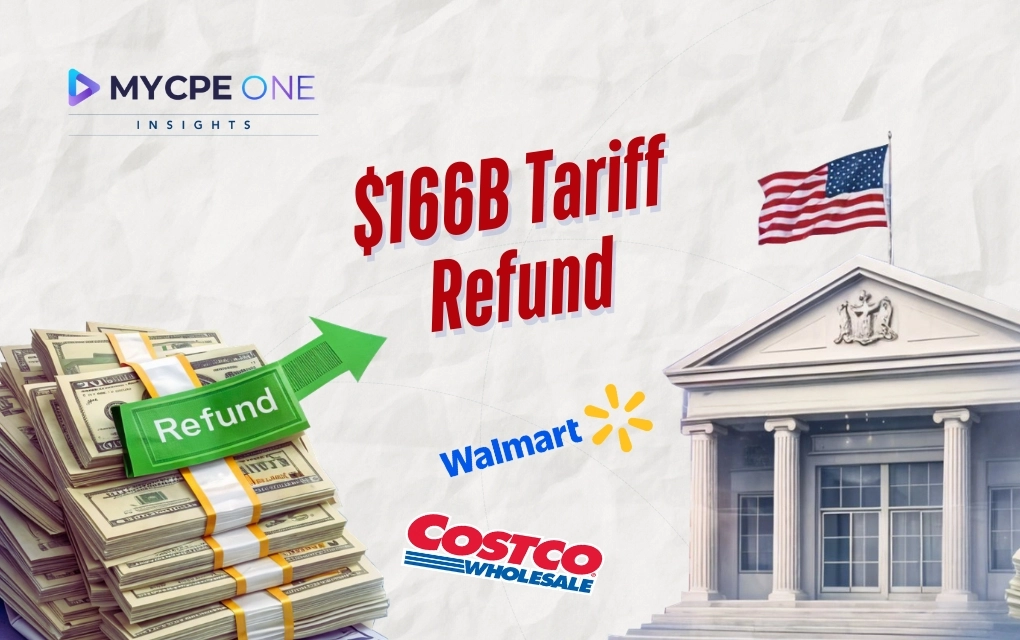
The US is set to refund companies approximately $166 billion following the Supreme Court's decision to declare tariffs imposed under the International Emergency Economic Powers Act as unlawful. The government is constructing a complex system- called CAPE to manage the refund process, which could potentially lower the cost of certain goods, as companies like Costco signal they might pass on the savings to consumers.
A client once told me, “Tariffs are like a hidden tax until someone asks for the receipt.” Turns out, a lot of companies just asked for theirs, and Washington now owes them about $166 billion. That number is not a rounding error. It is the size of a mid-tier federal program. And now, after the Supreme Court struck down tariffs imposed under the International Emergency Economic Powers Act, the U.S. government is building a system to send that money back. Slowly, carefully, and with a fair bit of uncertainty still hanging in the air. Let’s break down what actually happened, what is being built, and what this means if you sit in a finance seat today.
Rewind to the last year. The Trump administration used IEEPA authority to impose tariffs across a wide range of imports. The legal theory stretched emergency powers into trade policy, and for a while, it held. Until it didn’t. In February 2026, the Supreme Court ruled those tariffs unlawful. That ruling triggered something accountants immediately recognized, a massive reversal of previously recognized government revenue and a corresponding liability to refund importers, plus interest. Now layer in scale. Over 330,000 importers paid into this system. Millions of entries. Complex duty calculations. Different timing of payments. Some entries finalized, others still open. This is not a simple refund check. This is a full-blown reprocessing of the U.S. import duty system. And like any large-scale recalculation, the devil is in the workflow.
The government’s answer is a new system inside CBP’s Automated Commercial Environment, called CAPE. Think of it as a purpose-built pipeline to unwind a year’s worth of tariff activity.
Here is how it is supposed to work:
Clean on paper. Messy in execution. Development is somewhere between 40% and 80% complete, depending on the component. The target is to go live within roughly 45 days from mid-March 2026. That puts us in late April, give or take. And if you have been around any government IT rollout, you already know the vibe. Timelines are more of a suggestion than a promise.
Because uncertainty is expensive. Nearly 1,000 new lawsuits have been filed since March 1 alone. Big names like Adidas, DHL, and even airlines are jumping in. Total cases now exceed 3,000. That is not panic. That is a strategy. From a risk management perspective, filing a lawsuit is basically an insurance policy. If the administrative process excludes certain claims, delays payments, or interprets eligibility narrowly, companies with active cases already have a seat at the table.
There are still open questions:
If you are advising clients, this is where it gets real. Do you wait for the system, or do you hedge your position legally? Most large players are choosing both.
This is where things get interesting. In theory, removing $166 billion of tariff costs should ease input prices. Apparel, electronics, consumer goods, all the usual suspects could see cost relief. But here is the catch. Pass-through is not automatic.
Companies have choices:
Costco already tipped its hand. The company has signaled it may pass refunds directly to customers through price reductions. That aligns with its model: keep prices low, keep members happy, keep volume high. Walmart could follow a similar path, but has not publicly committed. If it does, expect a quiet price war in categories heavily impacted by tariffs. And then there is everyone else.
Retailers like Target or mid-tier importers might not have the same flexibility. Some will hold pricing steady and quietly repair margins. Others will selectively reduce prices where competition forces their hand. So, will consumers see relief? Probably, but unevenly. Think modest price softening in certain categories, not a broad-based drop in CPI. Especially since new tariffs in the 10% to 15% range are already being discussed for later this year. One hand gives, the other hand takes. That is trade policy in a nutshell.
If you are sitting in a controllership or advisory role, this is not just policy news. It is operational.
And finally, policy risk is not going away. While refunds are being processed, new tariff investigations under Section 301 are already underway. So, you could see a cycle of refund today, new duty tomorrow. Feels a bit like fixing last year’s tax return while Congress debates new rules for next year.
This story looks like a resolution on the surface. Court ruling, refund process, money coming back. In reality, it feels more like an intermission. Yes, $166 billion is heading back to importers. Yes, systems are being built to make that happen. And yes, some of that may trickle down to consumers. But the bigger picture is still in motion. Trade policy remains fluid. Legal boundaries are being tested. Companies are hedging with both administrative claims and litigation. And finance teams are left translating all of this into numbers that actually work. If you are advising clients or running a finance function, the question is simple: Are you treating this as a one-time refund, or as part of a longer cycle of policy risk and cost volatility? Because if the past year tells us anything, it is this: Tariffs may come and go. The complexity they leave behind sticks around a lot longer.
Until next time…
Don’t forget to share this story on LinkedIn, X and Facebook
Subscribe now for $199 and get unlimited access to MYCPE ONE, from CPE credits to insights Magazine
📢MYCPE ONE Insights has a newsletter on LinkedIn as well! If you want the sharpest analysis of all accounting and finance news without the jargon, Insights is the place to be! Click Here to Join
You’ve reached the 3 free-content piece limit. Unlock unlimited access to all News & CPE resources.
Subscribe Today.
Already have an account?
Sign In