Join 250,000+
professionals today
Add Insights to your inbox - get the latest
professional news for free.
Join our 250K+ subscribers
Subscribe02 SEP 2025 / MONTHLY NEWS CAPSULE
CPE Approved
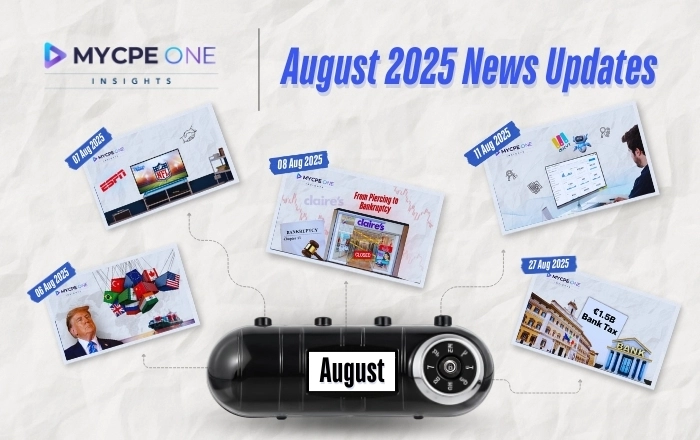
August was filled with various significant business-related events and discreet decisions, forging the course for changes in business operations. U.S. accessories retailer Claire's returned to bankruptcy court under the pressure of tariffs, inflation, and debt; Disney's ESPN acquired NFL Network, Fantasy, and RedZone rights, potentially altering the future of sports media; Goldman Sachs purchased a stake in ice cream giant Froneri; Keurig Dr Pepper bought JDE Peet's for $18 billion, leading to a company split; and Apple strategized its AI surge. The implications of these decisions may have profound effects on the economy, finance, and business sectors in the months to come.
August wasn’t just another month on the calendar; it was a highlight reel of business shakeups, policy pivots, accounting showdowns, and tech leaps that will shape the months ahead. From mall icons like Claire’s struggling under tariffs to Disney rewriting its sports streaming strategy, Italy’s banks facing fresh tax battles, and Apple plotting its AI comeback, the headlines were packed with stories that matter to professionals tracking finance, compliance, and growth. This recap compiles the most significant updates across business, economy, accounting, technology, and finance, all in 10 minutes or less.
Claire’s is back in U.S. bankruptcy court for the second time in seven years, and this round is a perfect storm of tariffs, inflation, and looming debt. The company faces a nearly $500 million loan maturing in 2026, with Trump’s tariff plans slamming its China-heavy supply chain. Add Shein, Amazon, and TikTok trends stealing the tween wallet, and mall traffic falling flat, and it’s déjà vu for a brand once synonymous with glitter and ear piercings.
Disney’s ESPN just pulled off a game-changing deal with the NFL, acquiring NFL Network, Fantasy, and RedZone rights in exchange for a 10% NFL equity stake. The move strengthens ESPN’s new streaming platform, launching on August 21, and puts the NFL in the boardroom without relying on cable operations. For Disney, it’s a way to secure churn-proof sports content, while the NFL gains long-term streaming upside. Is this the future of sports media, where leagues don’t just license content but co-own the platform?
Goldman Sachs is scooping up a stake in Froneri, the global ice cream giant behind Häagen-Dazs and Oreo, at a €15 billion valuation. The deal isn’t about a sweet tooth; it’s about scale, brands, and predictable cash flow. Froneri doubled revenue in five years, but its debt load is heavy, raising questions about leverage. With Goldman stepping in as lead investor, will this move turbocharge global expansion and challenge Unilever, or is the dessert aisle about to get a brain freeze?
Keurig Dr Pepper is spending $18 billion to buy JDE Peet’s and splitting itself into two U.S.-listed companies: Beverage Co. and Global Coffee Co. The breakup undoes its 2018 merger, giving soda and coffee separate growth paths. With Nestlé looming as a dominant rival and Starbucks struggling, the new Global Coffee Co. aims to capture market share in at-home brewing and retail shelves.
After 2023’s windfall tax fizzled, Rome is back with a softer play: freeze banks’ use of Deferred Tax Assets to raise €1–1.5B upfront. Instead of a direct levy, lenders can ring-fence capital at 2.5x the amount owed, easing profit hits but tightening near-term liquidity. Analysts see limited impact on earnings, yet lending could get tighter, especially for smaller firms facing high borrowing costs. The government still needs revenue to fund middle-class tax cuts without spooking markets.
Round two of tariff politics arrived with “reciprocal” duties and rapidly escalating rates, transforming a 10 percent floor into a 15–50 percent wall across key partners. The rollout pairs pressure with targeted deals, but the hit list is long: Canada at 35 percent, Brazil and India at 50 percent, Taiwan and Vietnam in the 20 percent zone, and the EU at 15 percent while lobbying for relief. India’s spike to 50 percent showcases the geopolitical edge of this strategy.
When the expanded federal Child Tax Credit ended, states stepped in with their own refundable versions. Programs in Minnesota, Vermont, and Colorado delivered meaningful per-child support and, per Columbia’s CPSP, helped blunt hardship. Early evidence suggests that more than just bill paying, families stabilized their housing and food, and stress eased, which supports child development. But design matters. Refundability determines who benefits, and many states cap the amount or phase it out quickly. The patchwork helped, yet gaps remain. Can states sustain momentum, or will Washington restore a fully refundable federal credit?
Chelsea’s 2024 “sale” of its women’s team to parent BlueCo 22 for £198.7 million, far above market estimates, shows how PSR math is getting gamed. On paper, it delivered profit and room to splurge on transfers. Aston Villa and Everton followed suit, turning internal shuffles into revenue. In early 2025, tactics widened: off-balance-sheet entities and homegrown player flips that book pure profit. Equity injections and debt-to-equity swaps keep clubs compliant, at least on paper.
NYC already collects over $60 billion yearly, with a heavy lift from top earners. Zohran Mamdani’s plan includes a 2 percent surcharge on incomes exceeding $1 million to fund buses, childcare, and rent freezes. The issues emerge quickly in the initial sections: definitional confusion over the “millionaire tax,” mobility risks for high earners, and evidence that residence shifts can erode the tax base. Proponents see equity and new revenue. Critics see flight risk and audit headaches.
Early sections detail how Melvin Louis Hughes allegedly weaponized Form 1041 by inventing huge withholding amounts, then claimed nine-figure refunds through paper trusts. The IRS actually sent out millions before fraud filters lit up, funding a Malibu house, Teslas, and crypto. Once flagged, agents used data matching and forensic accounting to follow the money and build charges. The message for pros is blunt: common forms can be misused at scale, and EFDS scrutiny is tightening.
Regulators fined Deloitte and two of its partners after finding gaps in the audits of Tianhe Chemicals and Sound Global. The first sections illustrate why: weak revenue recognition testing and missed red flags prior to costly delistings tied to overstated sales and fake cash. The AFRC’s action, paired with tougher cross-border cooperation, signals closer scrutiny where audits are riskiest. Deloitte says it cooperated and there was no deliberate misconduct, but the lesson sticks.
Early sections show AI evolving from a buzzword to a battery pack for practice management. Firms use ChatGPT to draft client replies, distill dense regulations, and streamline workflows, with leaders framing it as “language-assisted software,” which is helpful but not considered audit evidence. Then the grind: AP and expense tools embed GPT to shrink invoice cycles and cut errors, while automation drafts engagement letters and flags rule changes. The scaling chapter begins to emerge as adoption increases.
The first chapters spotlight why size can slow giants. Leaders like Hywel Ball argue culture and legacy stacks stall Big Four rollouts, leaving only a third of senior execs with agentic AI truly in play. Meanwhile, nimble firms design AI-first workflows, automate reconciliation, and surface fraud signals with fewer layers. Case studies from AI-native boutiques underline speed and precision. Deloitte’s ME Tax Pulse app shows the incumbents can answer back, yet the lift remains heavy. Will agility plus focus keep boutiques a step ahead?
Opening sections revisit Apple’s stumble: Apple Intelligence features underwhelmed, Siri slipped, and internal research called big models pattern matchers, not thinkers. Enter the AKI team and a native “Answer Engine” aimed at web-crawling knowledge, context-aware replies, and deep hooks into Siri, Safari, and Spotlight without leaning on OpenAI. Job posts and iPhone 17 cues hint at a platform pivot, not a bolt-on chatbot. If Apple gets privacy, integration, and reliability right, ubiquity beats raw IQ. Can a quiet, everywhere assistant win daily habits?
The first sections define HpAI as finance-born, not repurposed. Docyt blends LLMs with a curated bookkeeping dataset, 128 billion labeled data points across industries, to automate reconciliation, categorization, anomaly checks, and close. Features emphasize audit-readiness, confidence scores, and real-time adaptation without retraining client data. Reported gains include sharp review cuts and capacity lifts. Early testimonials echo cleaner financials with minimal intervention.
After decades of ERISA-compliant menus focused on liquid, low-fee public funds, an August executive order directs the DOL and the SEC to broaden “qualified” 401(k) investments to include cryptocurrencies, private equity, venture capital, real assets, and more. The move also aims to soften fiduciary litigation risk, with giants like BlackRock and Apollo reportedly prepping hybrid TDFs and brokerage windows. Advocates see diversification and private-market upside; skeptics flag fees, opacity, and liquidity. If guidance is released in six months, will sponsors adopt alternatives or proceed cautiously while education and operations catch up?
As summer winds down, one theme stands tall: disruption isn’t coming; it’s here. Whether it’s Trump prying open 401(k) menus for crypto, boutique firms racing past Big Four giants with AI, or regulators tightening audit rules, August showed that no sector is standing still. For accountants, tax pros, and financial leaders, the message is clear: adaptability and foresight are your best tools in an economy where the rules change overnight. Stay tuned with MYCPE ONE Insights, because the next wave of stories is already forming.
Until next time…
Don’t forget to share this story on LinkedIn, X and Facebook
Subscribe now for $199 and get unlimited access to MYCPE ONE, from CPE credits to insights Magazine
📢MYCPE ONE Insights has a newsletter on LinkedIn as well! If you want the sharpest analysis of all accounting and finance news without the jargon, Insights is the place to be! Click Here to Join
Transforming Finance & Accounting Operations for Enterprises!
We help 100+ clients streamline F&A operations with our full-suite outsourcing services—eliminating the need for in-house teams. Partner with us for Top-tier finance & accounting talent, Cutting-edge technology, and World-class infrastructure.
Our Full-Suite F&A Services Include:
We collaborate with CPA and accounting firms to drive real business value.
Schedule a no-obligation discovery callYou’ve reached the 3 free-content piece limit. Unlock unlimited access to all News & CPE resources.
Subscribe Today.
Already have an account?
Sign In