Join 250,000+
professionals today
Add Insights to your inbox - get the latest
professional news for free.
Join our 250K+ subscribers
Subscribe05 JAN 2026 / MONTHLY NEWS CAPSULE
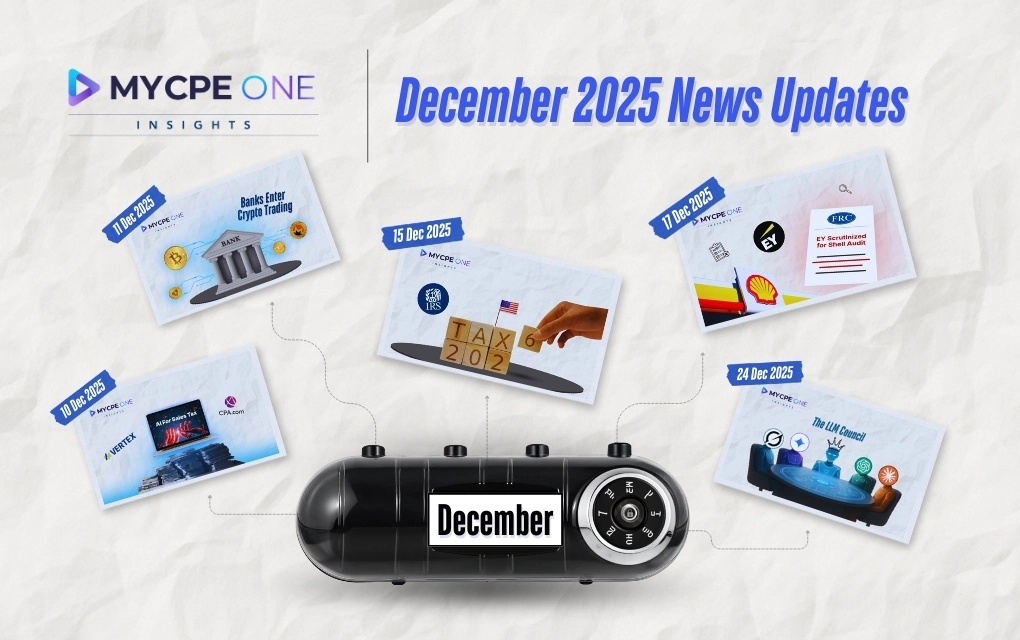
December 2025 established significant shifts in banking and finance, as U.S. regulators allowed crypto trade intermediation, Netflix bid for Warner Bros. Discovery, Baker Tilly planned to acquire Berkowitz Pollack Brant, and the Bank of Japan prepared to hike rates. Tech witnessed AI rewriting the consulting model and SoftBank acquiring AI infrastructure DigitalBridge. On the legal front, EY faced scrutiny for audit governance breaches and a Tennessee CPA was convicted for tax fraud. These changes signal a year-end transition within economic, technology, and financial industries.
December has a funny way of compressing the year into one loud, caffeinated blur. Markets keep moving, regulators keep regulating, tech keeps rewriting the rules, and everyone insists nothing important should happen until January, right before something very important happens. This month’s News & Insights recap captures that tension. From economic pressure points and tax enforcement to AI-driven shakeups across finance, consulting, and infrastructure, December 2025 delivered signals worth paying attention to. Not resolutions, not predictions, just the facts and frictions shaping what comes next.
After years of treating crypto like a regulatory liability, U.S. banking watchdogs quietly flipped the script in 2025. The OCC, FDIC, and Federal Reserve rolled crypto oversight into standard supervision, clearing banks to act as intermediaries in low-risk crypto trades without special approval. What once required side-eyes and disclaimers is now being treated like routine FX or securities activity. That shift could fundamentally change how consumers, institutions, and banks themselves interact with crypto rails.
Netflix’s $83 billion bid for Warner Bros. Discovery marks a dramatic break from its long-standing “build, don’t buy” philosophy. After years of debt pressure and a collapsing cable model, WBD split its streaming and studio assets from legacy networks, opening the door to bidders. Netflix moved fast, positioning itself as the cleanest regulatory option while rivals weighed full-company acquisitions. The deal reflects how consolidation pressure is reshaping streaming economics and competitive strategy.
iRobot’s fall from pandemic-era darling to Chapter 11 filer is a case study in margin pressure, trade shocks, and bad timing. Cheap overseas competitors crushed pricing power, tariffs spiked costs, and a debt-heavy balance sheet left little room to breathe. When Amazon’s $1.7 billion acquisition collapsed under EU scrutiny, the company lost its last clean exit. By late 2025, survival meant handing the keys to its primary supplier just to keep operations alive.
Baker Tilly’s planned acquisition of Berkowitz Pollack Brant signals a deliberate push into high-growth, high-complexity markets. After years of disciplined regional expansion, private equity backing accelerated its deal pace and national ambitions. Berkowitz Pollack Brant brings deep expertise in real estate tax and private client services, along with a strong South Florida footprint. The move strengthens Baker Tilly’s New York–Miami corridor and reflects how scale, specialization, and geography now drive firm strategy.
ACCA’s decision to end most remote exams is less about nostalgia and more about damage control. What began as a pandemic workaround unraveled as AI-powered cheating outpaced invigilation safeguards. With misconduct scandals already rattling the profession, ACCA opted to restore in-person testing to protect credibility. At the same time, it is redesigning exams to emphasize judgment, simulation, and real-world decision-making, acknowledging that AI is reshaping both how accountants work and how they must be assessed.
Indonesia’s tax authority is turning up the heat as fiscal pressure builds. With collections undershooting targets and the deficit edging closer to legal limits, officials have summoned wealthy families and professionals to revisit past filings. What’s raising eyebrows isn’t just the timing, but the opaque adjustments and negotiated settlements that follow. As accounting judgment blurs into enforcement pressure, the push is exposing deeper tensions between revenue needs, predictability, and taxpayer trust.
After decades of near-zero rates, the Bank of Japan is preparing a historic shift. Inflation has stayed above target, wages are finally moving, and a weak yen is hitting households where it hurts. Yet hiking rates comes with risks for a government carrying massive debt and markets reliant on cheap yen funding. As the BOJ walks this tightrope, investors are watching not just the move, but the signals about what comes next.
With the IRS preparing for the 2026 filing season, refund timing is already top of mind. Early indicators suggest refunds could arrive faster for many filers, especially those who e-file clean returns and opt for direct deposit. The end of paper checks and changes under the One Big Beautiful Bill Act add new wrinkles, while credits like EITC still trigger legal delays. Faster doesn’t mean instant, and preparation will matter more than ever.
What began as quiet nonprofit mismanagement ended as a federal tax evasion case. Over seven years, a Brooklyn pastor allegedly diverted church and daycare funds for personal use while failing to report the income. The IRS followed the mismatch between lifestyle and filings, turning a misuse-of-funds case into criminal tax charges. For professionals, it’s a stark reminder that weak controls and unreported income often collapse into the same investigation.
EY’s audit of Shell drew scrutiny not for faulty numbers, but for independence breaches tied to partner rotation rules. Regulators are examining how long-standing relationships crossed bright-line limits, even though financial statements remained unchanged. Layered on top of other UK probes, the case highlights a growing theme: audit governance and compliance failures can trigger just as much regulatory heat as accounting errors, especially when marquee clients are involved.
A Tennessee CPA’s access to client accounts became the engine of a years-long fraud. Using bookkeeping software and misleading labels, client funds were quietly siphoned off while false tax returns inflated refunds. The scheme unraveled when patterns no longer blended in. With a nine-year sentence and millions in restitution, the case highlights how unchecked access, weak oversight, and refund manipulation can devastate both clients and professional credibility.
Tricolor’s downfall didn’t start with regulators, it started with basic accounting failures JPMorgan couldn’t ignore. Double-pledged collateral, unreconciled bank records, and misstated loan aging eroded lender trust long before bankruptcy. As investigations deepened, what looked like sloppy controls morphed into alleged fabrication on a massive scale. The case underscores how routine breakdowns in reconciliation and collateral tracking can spiral into nine-figure losses and criminal charges.
Vertex and CPA.com’s expanded partnership brings AI directly into the sales tax compliance grind, aiming to tame nexus creep and filing chaos. Built with Kintsugi, the platform automates exposure analysis, registration, filing, and monitoring while integrating cleanly with ERP and e-commerce systems. For CAS and SALT teams stretched thin, the promise is fewer surprises and more advisory time, even as expectations rise for always-on, enterprise-level accuracy.
Andre Karpathy’s LLM Council flips the usual AI workflow by forcing multiple models to debate before delivering a final answer. Instead of trusting a single output, systems like GPT, Claude, and Gemini critique each other, with a “chairman” model synthesizing the result. For accountants and finance teams built on review and challenge, the approach feels familiar. It trades speed and cost for reliability, mirroring how professionals manage judgment-heavy work.
AI market nerves are rising as capex balloons and valuations cool, but the fundamentals look nothing like the dot-com era. Spending is translating into real revenue, scaling laws still hold, and infrastructure moats are deepening. The real risk may sit in software models chasing growth without sustainable margins. A reset appears likely, but it looks more like a filter than a collapse, separating hype-driven bets from durable AI businesses.
AI is reshaping consulting from the bottom up, thinning the traditional junior-heavy pyramid. As automation absorbs research, analysis, and documentation, firms are slowing graduate hiring and freezing entry-level pay while demand for senior judgment rises. Consulting isn’t shrinking, it’s changing shape. The future model leans toward specialist-heavy teams, hybrid human-AI delivery, and tighter governance, where reliability and explainability matter more than sheer headcount.
SoftBank’s acquisition of DigitalBridge signals a decisive shift toward AI infrastructure over flashy applications. By buying a global platform of data centers, fiber, and digital assets, Masayoshi Son is betting that control of power, land, and build capacity will define the AI race. The deal offers scale, co-investment leverage, and operational credibility, positioning SoftBank to profit from AI demand even as hardware cycles and grid constraints tighten.
December productivity doesn’t collapse because people stop caring, it collapses because routines get hijacked. Short weeks, travel planning, family obligations, and year-end wrap-ups all compete for attention, pushing focus to its annual low just before Christmas. Researchers say this is predictable, not personal failure. The fix isn’t grinding harder, but simplifying: fewer priorities, clearer work windows, and protected attention so December chaos doesn’t spill straight into January burnout.
As the Fed heads into its final 2025 meeting, markets expect another rate cut, but confidence is thin. Inflation remains sticky, job growth looks uneven, and shutdown disruptions have left policymakers working with incomplete data. For consumers, the impact is mixed: credit cards may ease slightly, mortgages likely stay elevated, and savings yields begin to slip. The bigger question isn’t this cut, but how long the Fed can balance inflation risks against a softening labor market.
Trump Accounts have officially moved from campaign promise to IRS-backed savings vehicle. With a $1,000 federal seed deposit for eligible children and strict long-term withdrawal rules, the program aims to encourage early, structured saving rather than short-term spending. Advisors will play a key role in setting expectations, especially around access limits and investment control. As guidance expands, these accounts are poised to become a permanent fixture in family financial planning conversations.
Andersen Group’s planned IPO marks a rare moment where accounting history meets modern capital markets. With over $800 million in recent revenue and global reach through Andersen Global, the firm is positioning itself as a growth-focused advisory player, not just a legacy name. Investors will be watching whether expansion spending translates into sustained profitability, and whether a public listing enhances credibility or introduces new pressures in a trust-driven profession.
If there’s one theme running through December’s headlines, it’s transition. Systems are tightening, expectations are rising, and long-standing models are being stress-tested in real time. Whether it’s central banks walking a policy tightrope, regulators enforcing trust boundaries, firms rethinking how work gets done, or technology forcing new trade-offs between speed and judgment, the direction is clear even if the destination isn’t. As we roll into the new year, the professionals who stay ahead won’t be the ones chasing noise, they’ll be the ones reading the signals early, asking sharper questions, and adjusting before the pressure becomes unavoidable. December didn’t slow down. It set the stag
Until next time…
Don’t forget to share this story on LinkedIn, X and Facebook
Subscribe now for $199 and get unlimited access to MYCPE ONE, from CPE credits to insights Magazine
📢MYCPE ONE Insights has a newsletter on LinkedIn as well! If you want the sharpest analysis of all accounting and finance news without the jargon, Insights is the place to be! Click Here to Join
You’ve reached the 3 free-content piece limit. Unlock unlimited access to all News & CPE resources.
Subscribe Today.
Already have an account?
Sign In