Join 250,000+
professionals today
Add Insights to your inbox - get the latest
professional news for free.
Join our 250K+ subscribers
Subscribe02 DEC 2025 / MONTHLY NEWS CAPSULE
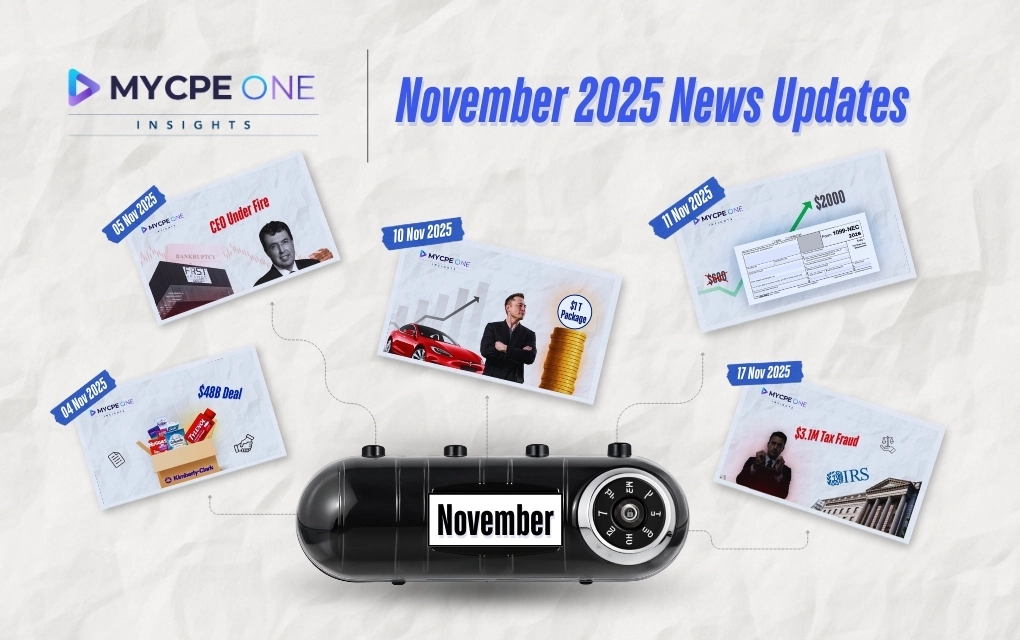
November 2025 marked a turbulent period for economic, financial, and regulatory developments, with significant changes impacting businesses, professionals, and consumers. The landscape changes included notable corporate scandals, changes to tax strategies, acceleration of AI-powered workflows and a deeply divided economy, hinting at stricter regulation, faster adoption of technology, and economic dynamics primarily driven by consumer confidence in 2026.
November 2025 delivered one of the most unpredictable stretches of economic, financial, and regulatory news we’ve seen all year. From boardrooms greenlighting trillion-dollar pay packages to governments wrestling with tax math that barely survives a spreadsheet, the month revealed how quickly the landscape is shifting for businesses, professionals, and consumers alike. Companies made bold bets, regulators drew sharper lines, AI took another leap into professional workflows, and the economy continued pulling in two very different directions. This recap breaks down the most important developments across Business, Accounting & Taxes, Finance, Technology, and the broader Economy, giving you a clear, concise snapshot of the stories shaping decisions heading into 2026.
First Brands’ bankruptcy reads like a worst-case study in leveraged growth gone off the rails. New leadership alleges founder Patrick James engineered years of fraud, piling up $12 billion in debt while the company held just $12 million in cash. Forensic reviews point to inflated invoices, double-pledged assets, and SPVs used to hide liabilities, with hundreds of millions allegedly diverted to James and his affiliates. Lenders and investors are now wondering what other balance sheets hide similar surprises.
In small-town Michigan, alleged CPA fraud just got very real. Prosecutors say Joseph Vanator forged a state CPA certificate, hung it on the wall, and practiced under credentials he never earned, exposing how much the profession still runs on framed paper and trust. The case highlights fragile verification habits, scattered state portals, and firms that often “check once and forget.” It’s a wake-up call for tighter, tech-driven license monitoring before the next fake certificate slips through.
Kimberly-Clark’s $48.7 billion bid for Tylenol parent Kenvue is part diaper empire, part headache. By folding in ten billion-dollar health brands, the company aims to vault past Unilever and sit just behind P&G in global health and wellness. Yet Wall Street recoiled, hammering Kimberly-Clark’s stock while rewarding Kenvue’s. Early focus is on whether this bet on scale, legal risk, and heavy financing becomes a transformational win, or a Bayer and Monsanto style cautionary tale.
The One Big Beautiful Bill Act finally drags 1099 reporting out of the 1950s. Beginning in 2026, businesses file Form 1099-NEC only when payments to a contractor top $2,000, with the threshold indexed for inflation. OBBBA also hits reset on the 1099-K saga, restoring the old $20,000 and 200-transaction rule for payment apps like Venmo and PayPal. Layer in expanded casualty loss rules, and this “alphabet soup” bill could reshape daily compliance more than most owners realize.
Year-end tax planning is where your CPA earns their keep. This piece starts with entity choice, pushing owners to revisit whether S corporation status still makes sense now that a flat 21 percent corporate rate is locked in, at least for now. It then shifts to timing moves like equipment purchases, bonus depreciation, and donor-advised funds, before tackling underpayment penalties. The message is simple: ask sharper questions now, or pay for missed opportunities later.
New York’s new mayor is betting big on higher corporate and millionaire taxes, counting on roughly $9 billion a year to pay for free childcare, rent freezes, public buses, and even city-run groceries. But raising the corporate rate to 11.5 percent and slapping a 2 percent surcharge on million-dollar incomes pushes top marginal rates above 53 percent. That’s the kind of math that sends CFOs and wealthy residents shopping for Florida zip codes instead of footing the bill.
The Connecticut fraud case reads like a checklist of what not to do as a tax pro. Preparer Diana Miller Lloyd allegedly treated deductions as a buffet, inflating expenses for high-income clients and then hiding behind another accountant’s credentials during audits. Prosecutors say she sought more than $1 million in bogus refunds, costing the IRS roughly $473,000. Her guilty plea shows how quickly weak controls and bad ethics can turn routine filing work into criminal exposure.
BDO’s £5.9 million penalty in the UK is a masterclass in how ignored red flags snowball into a regulatory disaster. Senior manager Amanda Nightingale allegedly faked audit evidence, issued unauthorized opinions, and reused partners’ digital signatures for years, all under weak supervision. The FRC found systemic control failures from 2012 to 2019, leading to fines, bans for two partners, and mandated remediation. For auditors everywhere, this is a blunt reminder that light-touch oversight can end in reputational and financial wreckage.
The Velazquez case shows just how far scammers will go to weaponize tax jargon and fear. Posing as an IRS insider, he sold desperate homeowners on a fake foreclosure refund program, then helped them file returns claiming six-figure phantom withholdings. Wire transfers flowed, refunds didn’t, and IRS Criminal Investigation eventually unraveled the pattern. His conviction for wire fraud, false returns, and impersonating an IRS officer underscores how quickly bogus “special programs” can turn financial pain into full-blown disaster.
The OBBBA doesn’t just tweak the tax code, it rewires the startup playbook. Founders and investors get earlier QSBS exclusions at years three and four, a higher issuer cap, and a bigger per-issuer gain shield, making equity more valuable well before a classic five-year exit. Layer on permanent 100 percent bonus depreciation, revived R&D expensing, and a locked-in 199A deduction, and entrepreneurs suddenly have roomier tools to time exits, structure entities, and turn tax rules into real runway.
Tesla shareholders just greenlit what could be the biggest pay package in history, tying Elon Musk’s potential $1 trillion payday to a dozen ultra-ambitious milestones. To fully cash in, he needs to push Tesla’s value to $8.5 trillion, sell 20 million vehicles, launch a million robotaxis, and deploy a million Optimus robots, all while ramping profits to jaw-dropping levels. Fans see it as genius incentive design, skeptics see fantasy finance, and the real test is still ahead.
Black Friday 2025 arrived with flashy banners but far tighter math. Tariffs and higher input costs mean many “deals” are really just discounts layered on earlier price hikes, while cautious, inflation-fatigued consumers are trimming holiday budgets. Big brands are also pulling back on deep promotions to protect margins and brand image, letting scarcity do the selling. The result is a season where shoppers need sharper budgets, better price tracking, and scam awareness to spot real value from retail theater.
Goldman Sachs is riding its strongest M&A wave in almost a quarter century, advising on roughly a third of this year’s $3.8 trillion in global deals. From mega-transactions like EA’s $55 billion take-private to rail and consumer giants reshaping entire sectors, the firm has planted itself at the center of boardroom strategy. Dealmaking frozen by earlier tariff jitters is thawing fast, unleashing shelved transactions and record mandates, with big implications for advisors tracking who might be next.
Thomson Reuters’ new CoCounsel suite promises to move tax and audit work from manual grind to agentic automation. Ready to Review preps 1040s by ingesting source docs and prior-year returns, spitting out files ready for human sign-off. On the audit side, Document Analysis and Audit Intelligence Test slashes evidence matching and transaction tracing time, with some firms cutting tests by more than half. With deep content integrations and explainable outputs, the big question now is how aggressively firms lean in.
Intuit is writing OpenAI a nine-figure annual check so TurboTax, QuickBooks, Credit Karma, and Mailchimp can live inside ChatGPT and run on its top models. The idea: users ask one question and get answers powered by their actual financial data, all from a single conversational hub. Intuit keeps custody of the sensitive numbers while ChatGPT becomes the front door. If it works, tax prep, bookkeeping, and cash-flow insights may start where people already chat, search, and plan.
Deloitte’s latest AI citation controversy, this time in a $1.6 million, 526-page health workforce report for Newfoundland and Labrador, shows how hallucinated references can slip into big-ticket consulting work. Local journalists found non-existent journal articles, misattributed authors, and baffled academics, echoing Deloitte’s earlier Australian welfare-review fiasco. The firm has admitted multiple faulty citations and promised a full review, while unions and politicians question oversight and value. For finance and policy teams, it raises tough questions about how to police AI-assisted deliverables.
America’s 2025 economy is a K-shaped chart come to life, with top earners swiping cards while everyone else counts coins. Fast-food giants and Fed speeches are telling the same story: high-income households keep spending, lower-income consumers are trading down, cutting back, and leaning on debt. With nearly half of all consumer spending coming from the top 10 percent, the question isn’t whether growth continues, but how long a split economy can balance on this many shaky blocks.
Under Fed supervisor Michelle Bowman, U.S. regulators are quietly loosening post-2008 guardrails, potentially unlocking up to $2.6 trillion in bank lending capacity. Lower leverage ratios, softer Basel III “Endgame” rules, and friendlier stress tests could supercharge earnings and buybacks, while nudging global rivals into a reluctant race to the bottom. As the U.S. trades some safety for speed, other regulators must decide: match the move, or gamble that tighter rules and slower growth win out in the long run.
November didn’t just offer headlines; it delivered a blueprint for what professionals must watch next. Corporate scandals signaled deeper governance risks, tax changes reshaped planning strategies, and AI partnerships accelerated a new era of automation. Meanwhile, markets pushed forward even as consumers pulled back, highlighting a divide policymakers can’t ignore. Whether you advise clients, manage teams, or oversee financial strategy, these stories point to a 2026 defined by sharper regulation debates, faster tech adoption, and an economy where confidence, not just capital, drives outcomes. Stay curious, stay critical, and keep your planning flexible. The next round of shifts is already forming, and those paying closest attention will stay ahead of the curve.
Until next time…
Don’t forget to share this story on LinkedIn, X and Facebook
Subscribe now for $199 and get unlimited access to MYCPE ONE, from CPE credits to insights Magazine
📢MYCPE ONE Insights has a newsletter on LinkedIn as well! If you want the sharpest analysis of all accounting and finance news without the jargon, Insights is the place to be! Click Here to Join
Transforming Finance & Accounting Operations for Enterprises!
We help 100+ clients streamline F&A operations with our full-suite outsourcing services—eliminating the need for in-house teams. Partner with us for Top-tier finance & accounting talent, Cutting-edge technology, and World-class infrastructure.
Our Full-Suite F&A Services Include:
We collaborate with CPA and accounting firms to drive real business value.
Schedule a no-obligation discovery callYou’ve reached the 3 free-content piece limit. Unlock unlimited access to all News & CPE resources.
Subscribe Today.
Already have an account?
Sign In