

MYCPE ONE
MYCPE ONE LOGO

Join 250,000+
professionals today

Add Insights to your inbox - get the latest
professional news for free.

MYCPE ONE insights

November 2025 Recap: Compliance & Regulatory Insights in 10 Mins

Join our 250K+ subscribers

Join our 250K+ subscribers

Subscribe

02 DEC 2025 / MONTHLY REGULATORY CAPSULE

November 2025 Recap: Compliance & Regulatory Insights in 10 Mins

November 2025 Recap: Compliance & Regulatory Insights in 10 Mins

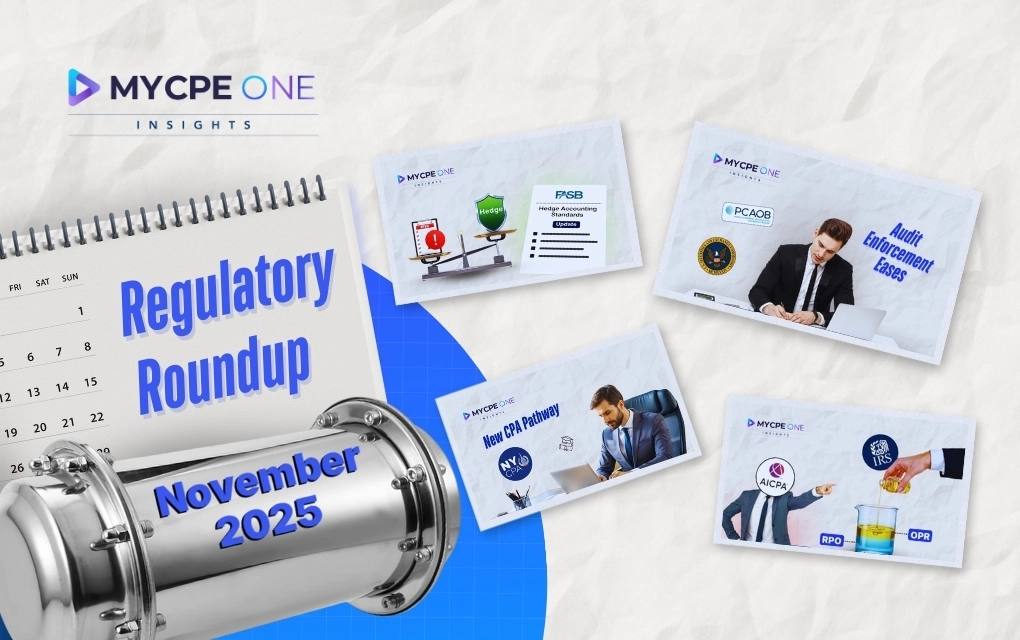
November felt like the kind of month where every regulator decided to grab a microphone at once. The IRS rolled out new deductions, new limits, and new crypto rules while still digging out from the longest shutdown in U.S. history. FASB stayed busy too, tightening hedge accounting, revisiting crypto derecognition, and simplifying purchased loan rules ahead of major 2026 effective dates. And across the broader policy landscape, states, federal agencies, and audit regulators sparked debates that will shape talent pipelines, independence rules, and professional mobility. If you missed a headline or two, you’re not alone. This recap pulls together the biggest compliance and regulatory shifts in one fast, digestible read, so you can get the story, stay informed, and dive deeper where it matters. 

IRS Updates 

Thanksgiving in the Season of Taxes, Tips and Tariffs 

Thanksgiving came with a side of policy whiplash: shiny new deductions for tips and overtime under the One Big Beautiful Bill Act, and then instant confusion over how anyone is supposed to calculate them. Notice 2025-69 basically tells workers to “use what you’ve got,” from Box 7 Social Security tips to gig app logs, while SSTB professionals get surprise transition relief and overtime deductions focus only on the FLSA “half.” Layer on Trump’s tariff U-turn and that teased “tariff dividend,” and the full story gets even spicier. 

IRS Signals Big Changes Ahead for Farm Loan Refinancing

Section 139L sounds like a sweet deal for rural lenders, letting them exclude 25 percent of interest on qualifying post–July 4, 2025 ag and rural real estate loans. But the interim rules turn refinances into a split personality: only the “new money” above old principal can qualify, leaving legacy balances fully taxable. That pushes lenders toward topped-up refis, tighter collateral docs, and sharper tracking of how every dollar is used, with the bigger pricing implications unpacked inside the article. 

AICPA Opposes IRS Merger Plan That Mixes Oil and Water 

The IRS idea to merge the Office of Professional Responsibility with the Return Preparer Office sounds like “efficiency,” but the AICPA sees a recipe for taxpayer confusion. OPR oversees credentialed pros under Circular 230; RPO handles PTINs, EA enrollment, and uncredentialed preparers. Blend them, and taxpayers could assume everyone is held to the same standards, while shady preparers flash the OPR name like a fake badge. The article digs into how this merger could stretch enforcement thin and blur trust in the system. 

IRS Updates 401(k) and IRA Limits for 2026 

Fresh off a marathon shutdown, the IRS dropped new 2026 retirement limits like a surprise project in your inbox. Workplace plan deferrals climb to $24,500, with higher catch-ups letting some older workers stash over $35,000 if their plans cooperate, even as data shows only a small slice of savers actually max out. IRAs nudge up to $7,500 with indexed catch-ups and higher phase-out ranges for deductions and Roth eligibility, setting the stage for planners to rethink contribution strategies the article explores in detail. 

IRS’s New Crypto Rule Could Turn ETFs Into Yield Machines 

Revenue Procedure 2025-31 finally gives crypto ETFs and ETPs a tax-safe sandbox for staking assets like ETH and SOL. Funds can stake a single token alongside cash using independent validators and qualified custodians, as long as rewards are paid out at least quarterly and slashing losses don’t hit investors’ wallets. That transforms staking from a legal gray area into a potential yield engine for mainstream products, and the article walks through how Wall Street, regulators, and advisors are gearing up for the next phase. 

IRS FAQs Reveal the Fine Print on Crypto Reporting 

Form 1099-DA turns the IRS into full-time blockchain hall monitor, forcing platforms treated as “brokers” to report digital asset sales starting with 2025 activity. New FAQs spell out who’s in the net, from kiosks that actually sell coins to platforms that can identify users, while pure transfer-only services get a pass. Then comes the cost-basis drama: incomplete history, zero-basis defaults, and self-transfers that can make real-world losses look like paper gains. The article unpacks how messy those mismatches can get once forms start flying. 

IRS offers relief on Tip Deduction and Overtime Reporting Rules 

Under Notice 2025-62, the IRS quietly gives employers a 2025 grace year on breaking out qualified tips and overtime, waiving penalties while everyone scrambles to retool payroll systems. At the same time, the One Big Beautiful Bill Act’s “No Tax on Tips” and “No Tax on Overtime” deductions promise sizable breaks for workers in tipped and overtime-heavy roles, but only when the income is properly reported. Then comes the curveball: Direct File gets shelved after rave reviews, and the article digs into what that means for compliance, software, and your next busy season. 

FASB Updates 

Unlocking the New Hedge Accounting Rules 

FASB’s latest hedge accounting update finally closes long-standing gaps in ASC 815, especially around purchased financial assets and the portfolio layer method. Companies that were economically hedged but unable to qualify for hedge accounting now have a clearer path, thanks to new eligibility for purchased loans and more flexible layer hedging mechanics. The changes also ease friction with CECL, creating a smoother link between credit loss modeling and hedge measurements. The article walks through how these updates reshape strategy and documentation. 

FASB Opens a New Chapter on Crypto Transfer Accounting 

FASB has turned its attention back to crypto, launching a project to clarify when digital assets should be derecognized and how to treat wallet transfers, wrapped tokens, and receipt tokens under Subtopic 350-60. With companies using wildly different interpretations today, the board aims to bring order to a reporting landscape that often feels like “choose your own adventure.” The article also explores parallel debates around stablecoins, CAMT relief, and why crypto accounting is entering a more structured phase. 

FASB Just Rewired Purchased Loans Accounting 

For years, purchased loan accounting split assets into PCD and non-PCD buckets, creating messy inconsistencies and double-counted credit losses. FASB’s update replaces that two-track system with a broader “purchased seasoned loan” model, simplifying acquisition accounting ahead of its 2026 effective date. The new rules improve comparability, deepen credit quality disclosures, and reduce the documentation acrobatics companies once relied on. The article digs into CECL implications, political pressure on standard-setting, and what teams should prepare for next. 

Trending News Updates 

New York Lights Up a New Route for CPA Candidates 

New York just cracked open the CPA pipeline with a 120-hour pathway that restores a simpler, more accessible route to licensure. The new model trims the long-criticized 150-hour requirement by pairing fewer education hours with two years of experience, giving firms a fresh recruiting edge and students a break from expensive fifth-year programs. With 24 states already modernizing rules and others watching closely, the article explores whether this shift marks a true turning point for national uniformity and long-term talent growth. 

Is the SEC Quietly Preparing to Rewrite Big Four Auditor Independence? 

The SEC is signaling that two decades of auditor independence rules may no longer fit today’s AI-driven, cloud-entangled business world. With Big Four firms embedded in vast tech ecosystems and partnerships shifting faster than regulators can track, officials hint that a more materiality-focused, judgment-based framework may replace rigid prohibitions. The article digs into why this rethink is gaining momentum, what looser guardrails could mean, and how audit committees and firms may navigate a more nuanced independence landscape. 

What Softer SEC–PCAOB Enforcement Means for Audit Quality 

Regulators may be easing off the throttle, but the risks aren’t. With leadership changes, a delayed QC 1000 rollout, and an SEC shift toward major cross-border threats, the audit enforcement climate looks calmer at least on paper. Yet PCAOB data shows quality control failures, global component issues, and independence lapses remain under the microscope. The article breaks down why reduced penalties don’t equal reduced expectations and how firms must tighten documentation, risk assessment, and oversight before the next enforcement cycle hits. 

PCAOB agrees on audit regulation deal with Lithuania 

The PCAOB just added Lithuania to its growing web of cross-border oversight, signing a Statement of Protocol with the country’s audit regulator, AAAPVIM. The deal, effective November 12, opens the door for information sharing, joint inspections, help with investigations, and access to work papers for firms operating across both jurisdictions. It’s the 29th such agreement, signaling that even in a softer enforcement climate, global cooperation on audit quality is quietly tightening in the background. 

AICPA, NASBA object to Ed. Dept. downgrade of accounting degree programs 

The Department of Education’s proposal to exclude accounting from its “professional degree” list, capping loans at $100,000 instead of $200,000, has set off alarm bells across the profession. AICPA, NASBA, and state societies warn this move could choke off access to graduate accounting education just as the CPA pipeline is already strained. With new Repayment Assistance Plan limits looming in 2026, the article explores how this classification fight could reshape who can afford to become a CPA. 

Department of Education Unclassifies Accounting as a Professional Degree 

In a follow-up twist, the Education Department’s draft framework formally leaves accounting off its professional degree roster, lumping it with other long-standing licensed fields like nursing, architecture, and education. AICPA and state societies argue this ignores the rigors of CPA licensure and rising market demand, where BLS projects accountant growth outpacing the broader job market. The article dives into why recognition, financial aid, and federal definitions now sit at the heart of the profession’s future pipeline. 

The Big Picture and What’s Ahead 

November’s updates made one thing clear: the regulatory world may be shifting, but it’s not slowing down. The IRS is redefining deductions, crypto oversight, and retirement limits. FASB is modernizing standards to match how businesses actually operate. And policymakers, from state boards to the Department of Education, are shaping debates that will determine who enters the profession and how firms navigate risk. The next few months will bring more commentary, more rulemaking, and more pressure to adapt. For now, consider this your snapshot of where things stand, and a reminder that staying ahead isn’t about predicting every change, but knowing which ones deserve your attention before the next wave hits. One recap, all the moves that matter only from MYCPE ONE Insights. 

Until next time…

Don’t forget to share this story on LinkedIn, X and Facebook

Subscribe now for $199 and get unlimited access to MYCPE ONE, from CPE credits to insights Magazine

📢MYCPE ONE Insights has a newsletter on LinkedIn as well! If you want the sharpest analysis of all accounting and finance news without the jargon, Insights is the place to be! Click Here to Join

The Only All-in-One CPE & Learning Platform for CPA & Accounting Firms

Get everything you need for team learning and CPE compliance—starting at just $199 per user/year!

  • 15,000+ hours of CPE-approved content
  • Learning Management Software to track & manage learning
  • CPE compliance tracking for all 50 states & 100+ designations
  • Mobile app access with audio-based courses
  • CPE-approved articles (like the one you're reading!)
  • Practical staff training & assessments
  • Learning & Development services

Learn more or schedule a no-obligation call!

Unlock Annual Access to News & CPE Subscription

You’ve reached the 3 free-content piece limit. Unlock unlimited access to all News & CPE resources.
Subscribe Today.

News & Updates

  • Exclusive News & Insights
  • Latest Regulatory Updates
  • Accounting Industry Trends
  • Expert Insights
  • AI-Driven Audio & Summaries
  • Infographics & Videos
  • CPE-Approved Articles
  • Digital Magazine
  • Benchmarking Blogs

Unlimited CPE Access for 1 Year

  • 15,000+ Hours of Content
  • 500+ Subject Areas
  • Mandatory Ethics Courses
  • 250+ Compliance Packages
  • 50+ Virtual Conferences and Events Access
  • Format: Live, Audio, Video, E-Books
  • Audio Based Courses & Podcasts
  • Add External Certificates with AI
  • AI Compliance Tracking and Report
  • Instant Certification and Fast Reporting
  • Mobile App Access (iOS and Android)
  • Dedicated Support System
  • Practical Training Programs
  • AI Academy Access
  • Tax Academy Access
  • Audit Academy Access
  • Leadership Academy Access