©2026 - www.my-cpe.com All rights reserved
support@my-cpe.com7 Days Free Trial
for Enterprise Subscriptions
You have Not Selected the Monthly or Annual Plan

#1 Global Platform for Continuing Education
Create your Free Account | Get Unlimited Access only @$199/Year ( View Details )
Trusted by 250,000+ Professionals for Continuing Education
Create Your Account 1/2
Already have an account? Log In
To Continue using Trial, please verify your email address
Didn’t received verification email? Resend Email
You can cancel anytime during your trial period.
Become a
MYCPE ONE Member
@ $299 $199
33% Discount on Annual Subscription


Complete Access to 12,000+ Hours of Content
Trusted by 250,000+ Professionals
"Steven was knowledgeable and thorough…”
Steven was knowledgeable and thorough in his information about the product and what is offered. He was empathetic to my situation. He went above and beyond answering all of my many questions. Excellent service!

Crystal lovejoy
"Great Customer Service”
Great service and very patient as I asked several questions. Steven answered all my questions and helped me make the right decision in my subscription purchase. Thank you.

Lori corry
"It is what it advertised to be”
It is what it advertised to be. Professional quality training and CPE tracking and certificates; systems knows AZ CPA CPE requirements and categories. I've needed help on several occasions and the assistance was quick and effective; however, there were some problems with data entry. The assistance sometimes asks for input, but when I try to type it is dissallowed for some reason. On several occasions I had to close the popup to get it out of my way.

Brian Carey
"Great customer service”
Great customer service. Classes are pertinent. Great value

Steve

Trusted by 250,000+ Professionals
Trusted by 250,000+ Professionals
"Steven was knowledgeable and thorough…”
Steven was knowledgeable and thorough in his information about the product and what is offered. He was empathetic to my situation. He went above and beyond answering all of my many questions. Excellent service!
Crystal lovejoy
"Great Customer Service”
Great service and very patient as I asked several questions. Steven answered all my questions and helped me make the right decision in my subscription purchase. Thank you.
Lori corry
"It is what it advertised to be”
It is what it advertised to be. Professional quality training and CPE tracking and certificates; systems knows AZ CPA CPE requirements and categories. I've needed help on several occasions and the assistance was quick and effective; however, there were some problems with data entry. The assistance sometimes asks for input, but when I try to type it is dissallowed for some reason. On several occasions I had to close the popup to get it out of my way.
Brian Carey
"Great customer service”
Great customer service. Classes are pertinent. Great value
Steve
Subscribe Now at $199/ 12 Months
Topic of Interest
Select the topics of your interest to receive Webinars/Virtual Events/E-Books/Podcasts of your interest.
Selected Topics
Important: Course Deactivation Alert
Below mentioned Courses will be deactivated soon due to outdated content. Complete the course within the next 7 days to receive credits. After Expiry date, the course will be unavailable for credit. For assistance or inquiries, please contact our support team at support@my-cpe.com.
Course Name
Thank You.
In 2025, the "One Big Beautiful Bill" (OBBB) is shaping up to be one of the most transformative legislative packages in recent history for U.S. businesses. While headlines focus on tariffs, taxes, and trade, the real impact will hit home for accounting professionals like you.
If you advise clients, manage payroll, oversee compliance, or drive financial strategy at a CPA firm, the OBBB has wide-ranging implications. From individual tax code overhauls to QBI revisions and payroll shifts, you can’t afford to ignore it. And the good news? With the right CPE courses, you don’t have to.
Let’s break it down.
To help CPAs and accounting professionals stay ahead, MYCPE ONE offers expert-led, IRS-approved courses dedicated to the nuances of OBBB. Here’s a quick look at what’s available:
| Course Title | Description | CPE Credits | Link |
|---|---|---|---|
| OBBB 2025: Trump Accounts and Personal Tax Reform | Comprehensive overview of individual taxation changes, estate planning implications, and new deductions under OBBB | 2 | Enroll Now |
| OBBB 2025 Part 1: QBI, Deductions, and SALT Changes | Deep dive into QBI revisions, new deduction strategies, and SALT cap impact | 1.5 | Enroll Now |
| Payroll After the OBBB: Tax Withholding & Compliance Updates | Real-world guidance on payroll changes, revised brackets, and employer responsibilities | 1 | Enroll Now |
| OBBB 2025 Energy Strategy and Global Impacts | Insights on global effects, energy incentives, and compliance for multinationals | 1 | Enroll Now |
| OBBB 2025 Tax Reform for Individuals and Businesses | Full-spectrum tax law changes for clients and business entities | 2 | Enroll Now |
Want access to all 15,000+ hours of approved CPE content? Explore MYCPE ONE’s subscription plans to gain unlimited learning access.
The "Opportunity for Better Business Bill" (OBBB) introduces sweeping reforms that affect both individual taxpayers and businesses. To understand its full impact, we’ve broken down the changes into two core categories: Individuals and Businesses, along with before-and-after snapshots to guide your strategic planning.
Here's a clearer, fact-checked breakdown of the major OBBB provisions, grouped into Individuals and Businesses, with details on what changed, who’s affected, before/after snapshots, and why it matters.

Who it affects: Employees and independent contractors in tip-based jobs (servers, bartenders, hairstylists, etc.)
What changed:
Why it matters: Lowers taxable income directly; could save several hundred dollars each year.
Who it affects: Hourly workers receiving overtime pay under FLSA
What changed:
Why it matters: Gives workers more take-home pay; payroll systems need updating.
Who it affects: Gig workers, freelancers, small business owners
What changed:
Why it matters: Less paperwork and fewer forms; still need to report income above $400.
Who it affects: Taxpayers aged 65 and older
What changed:
Why it matters: It can reduce AGI and taxable income significantly for seniors.
Who it affects: Buyers of new U.S.-assembled vehicles
What changed:
Why it matters: Helps offset financing costs; lenders must provide reporting form.
Who it affects: Families with children under age 17
What changed:
Why it matters: More generous credit, especially through 2028; benefits families with kids.
Who it affects: All taxpayers
What changed:
Why it matters: Removes uncertainty and simplifies tax planning; more income sheltered by deduction.
Who it affects: Taxpayers in high-tax states
What changed:
Why it matters: Offers significant relief to affluent filers in states with high income property taxes.

Here’s a detailed, plain-language breakdown of the Business & Employer side of OBBB, covering each change with what, who it affects, before vs. after, and why it matters:

What: You can deduct the full cost of qualified property—like equipment, machinery, and even manufacturing buildings—in the year purchased.
Who: Small to large businesses, manufacturers, real estate investors.
Before: Bonus depreciation was phasing out; Section 179 limits were lower.
After:
Why it matters: Immediate write-offs boost cash flow, encouraging investment in equipment, factories, and modernization.
What: A permanent 20% deduction on qualified business income for pass-through entities.
Who: Sole proprietors, partnerships, S-corporations.
Before: Set to expire end of 2025; phase-out income limits were lower.
After:
Why it matters: More reliable tax planning for small business owners and better benefit for mid-income filers.
What: Tax break on selling small-business stock.
Who: Investors in startups and early-stage companies.
Before: 100% gain exclusion only after 5 years; $10M cap.
After:
Why it matters: Makes startup investing more attractive with shorter holding periods and higher gains.
What: Tax incentives for semiconductors, fossil fuels, renewables.
Who: Energy producers, manufacturers, data-center developers.
Before: IRA provided clean energy credits; semiconductor credit was 25%.
After:
Why it matters: Strong incentive to build factories, data centers, and semiconductor fabs, but clean energy loses traction, and timing matters.
What: Foreign income tax rules rebranded and adjusted.
Who: Multinational corporations, U.S. shareholders of foreign companies.
Before: GILTI & FDII rules are liable.
After:
Why it matters: A Significant shift in multinational tax teams must revise global structuring and compliance systems.
What: Changes to non-wage worker perks.
Who: Employers offering family or health benefits.
Before: Some credits and benefits were temporary or limited.
After:
Why it matters: Employers can offer richer benefit packages, boosting retention and morale.
What: Threshold changes for reporting contractor income.
Who: Businesses issuing 1099s, gig platforms.
Before: 1099‑NEC/MISC at $600; 1099‑K at $600.
After:
Why it matters: Less admin burden for businesses and fewer forms filed—esp. gig platforms.
| Change | Who | Before | After | Why It Matters |
|---|---|---|---|---|
| Bonus Depreciation & Section 179 | Equipment & facility buyers | Phasing out | 100% write-off, higher limits | Frees up cash for expansion |
| R&D Deduction | Tech, biotech, manufacturing | Amortized | Full expensing retroactive & permanent | Funds innovation now |
| QBI Deduction | Pass-through owners | Temporary, lower thresholds | Permanent, higher thresholds, min floor | Tax consistency, broader benefit |
| Interest Deductibility | Businesses with loans | 30% EBITDA cap | Excludes depreciation/amortization | Better financing options |
| Excess Business Losses | Non-corporates | Temporary cap | Permanent, carried as NOL | Smoother loss treatment |
| QSBS Gains | Startup investors | Only 5‑year 100% | 3‑5 year phased exclusions, higher cap | Encourages entrepreneurship |
| Opportunity Zones | Community investors | Expiring | Permanent, rolling zones | Sustains impact investing |
| Energy & Industry Credits | Manufacturers, semicon, energy | IRA credits, 25% semicon | 35% semicon, fossil incentives, clean slump | Shapes investment direction |
| Global Tax Rules | Multinationals | GILTI/FDII | NCTI/FDDEI | Major compliance overhaul |
| Fringe Benefits | Employers | Temporary caps | Student-loan, telehealth, DC improved | Better employee perks |
| 1099 Reporting | Gig platforms | $600 threshold | $2k NEC, $20k/200 K | Less compliance hassle |
According to a 2024 survey by the AICPA, over 78% of CPAs believe legislation like the OBBB will create “significant workflow disruption” if they don’t update their compliance frameworks. Yet only 26% of firms have taken steps to upskill their teams.
This is where education plays a crucial role, and MYCPE ONE is here to help you lead the way.
A proactive stance helps you retain trust, minimize exposure, and position your firm as a forward-thinking advisor.
The OBBB isn’t just another bill. It’s a fundamental shift in how CPAs must approach planning, compliance, and strategy.
If you’re not upskilling in 2025, you’re falling behind.
The smartest firms will treat OBBB not as a challenge but an opportunity. With proper education and updated workflows, you can guide clients confidently through regulatory complexity, and set your firm apart.
Whether you're handling payroll, entity structuring, or tax advisory, the OBBB courses from MYCPE ONE ensure you're not just informed, you’re indispensable
It stands for the "One Big Beautiful Bill," a U.S. legislative reform package covering tax, payroll, and business regulations.
Most provisions roll out in phases starting Q2 of 2025. CPAs should prepare now.
Yes. Especially for clients with QBI deductions, SALT liabilities, or estate planning needs.
While not legally required in all cases, CPE is strongly recommended to ensure accurate compliance and protect client trust.
MYCPE ONE offers accredited courses led by experienced tax professionals. Explore here.

Jason (LPA, EA) is a seasoned tax expert, entrepreneur, and educator with over 18 years of experience in accounting, tax preparation, and business advisory. As the founder of Dinesen Tax & Accounting, P.C., he helps professionals understand complex tax concepts. A leading CPE presenter at MYCPE ONE, Jason has trained more than 200,000 professionals on tax updates, ethics, and IRS guidance. Known for his sharp insights and relatable teaching style, he helps CPAs, EAs, and finance professionals stay up to date and confidently navigate evolving tax laws.
Table of Contents

Compensation & Incentive Plans: Design, Cost & Governance



Succession Planning for Family Business & Wealth Transfer

Agentic AI in Audit and Assurance
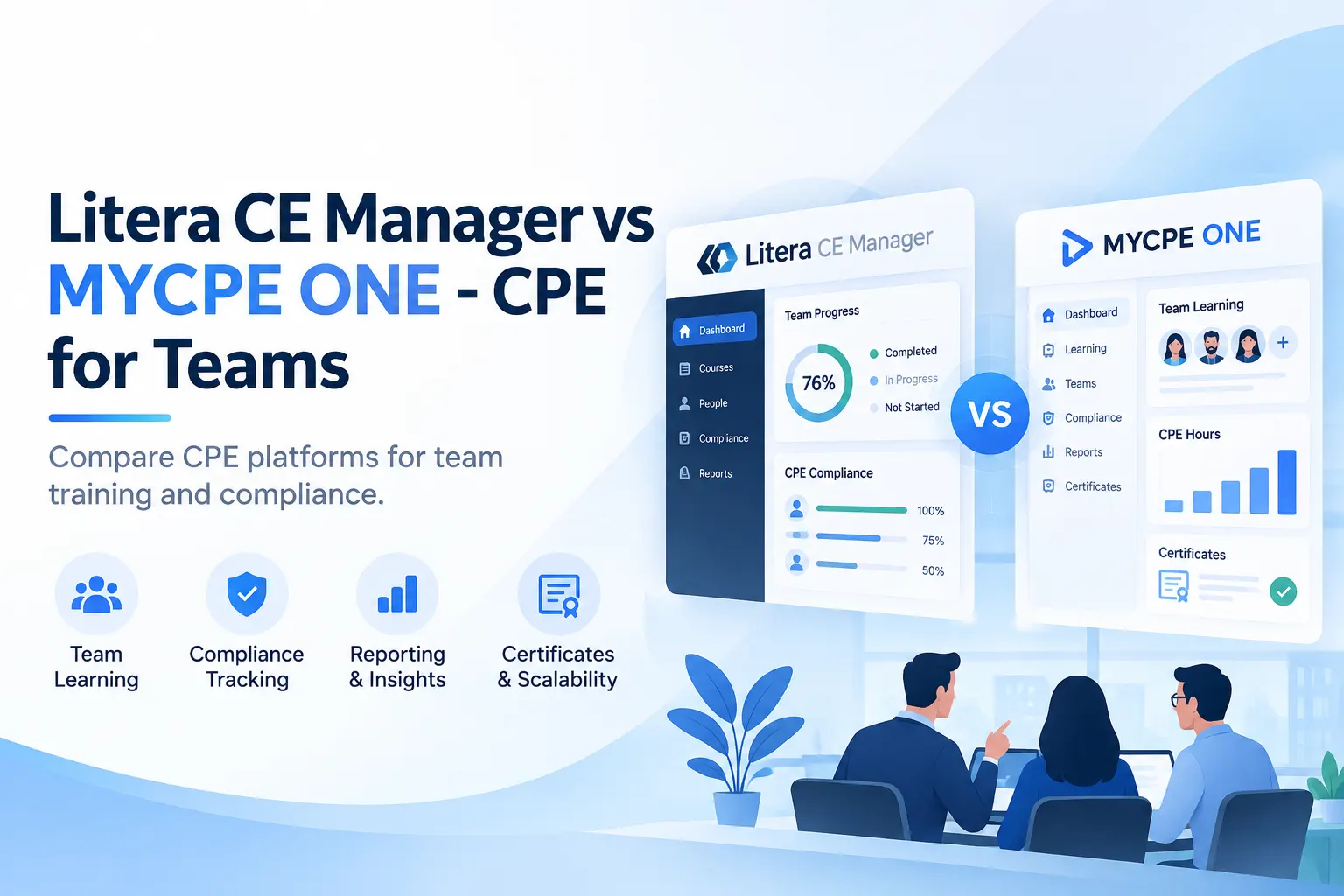
Can Your CPE Credits Be Rejected? 7 Mistakes That Could Put Your CPA License at Risk
 Imtiaz Munshi, CPA

Registration Completed

Something Went Wrong!! Please Try Again.

Registration Completed

Please Update Your Profile to Claim Your Continuing Education Credits.

Thank you for subscribing 7 Days Free Trial.
Please upgrade your browser to use MYCPE ONE
Experience MYCPE ONE at its best! Upgrade your browser for a more interactive, user-friendly interface, and stay ahead in your professional development journey.
Upgrade NowHow did you find out about us?
We were looking so hard for you now that you are finally here, So would you tell us how you found out about us?

What is your primary purpose to use MYCPE ONE?

Thank you for submitting your inquiry! We will contact you soon.
CloseOur Promise