©2026 - www.my-cpe.com All rights reserved
support@my-cpe.com7 Days Free Trial
for Enterprise Subscriptions
You have Not Selected the Monthly or Annual Plan

#1 Global Platform for Continuing Education
Create your Free Account | Get Unlimited Access only @$199/Year ( View Details )
Trusted by 250,000+ Professionals for Continuing Education
Create Your Account 1/2
Already have an account? Log In
To Continue using Trial, please verify your email address
Didn’t received verification email? Resend Email
You can cancel anytime during your trial period.
Become a
MYCPE ONE Member
@ $299 $199
33% Discount on Annual Subscription


Complete Access to 12,000+ Hours of Content
Trusted by 250,000+ Professionals
"Steven was knowledgeable and thorough…”
Steven was knowledgeable and thorough in his information about the product and what is offered. He was empathetic to my situation. He went above and beyond answering all of my many questions. Excellent service!

Crystal lovejoy
"Great Customer Service”
Great service and very patient as I asked several questions. Steven answered all my questions and helped me make the right decision in my subscription purchase. Thank you.

Lori corry
"It is what it advertised to be”
It is what it advertised to be. Professional quality training and CPE tracking and certificates; systems knows AZ CPA CPE requirements and categories. I've needed help on several occasions and the assistance was quick and effective; however, there were some problems with data entry. The assistance sometimes asks for input, but when I try to type it is dissallowed for some reason. On several occasions I had to close the popup to get it out of my way.

Brian Carey
"Great customer service”
Great customer service. Classes are pertinent. Great value

Steve

Trusted by 250,000+ Professionals
Trusted by 250,000+ Professionals
"Steven was knowledgeable and thorough…”
Steven was knowledgeable and thorough in his information about the product and what is offered. He was empathetic to my situation. He went above and beyond answering all of my many questions. Excellent service!
Crystal lovejoy
"Great Customer Service”
Great service and very patient as I asked several questions. Steven answered all my questions and helped me make the right decision in my subscription purchase. Thank you.
Lori corry
"It is what it advertised to be”
It is what it advertised to be. Professional quality training and CPE tracking and certificates; systems knows AZ CPA CPE requirements and categories. I've needed help on several occasions and the assistance was quick and effective; however, there were some problems with data entry. The assistance sometimes asks for input, but when I try to type it is dissallowed for some reason. On several occasions I had to close the popup to get it out of my way.
Brian Carey
"Great customer service”
Great customer service. Classes are pertinent. Great value
Steve
Subscribe Now at $199/ 12 Months
Topic of Interest
Select the topics of your interest to receive Webinars/Virtual Events/E-Books/Podcasts of your interest.
Selected Topics
Important: Course Deactivation Alert
Below mentioned Courses will be deactivated soon due to outdated content. Complete the course within the next 7 days to receive credits. After Expiry date, the course will be unavailable for credit. For assistance or inquiries, please contact our support team at support@my-cpe.com.
Course Name
Thank You.
QC 1000, the New Era of Audit Quality Control, is set to reshape and modernize the landscape for all PCAOB-registered firms. This new standard, released in May 2024 and effective from December 15, 2025, will significantly enhance quality control processes within audit firms, ensuring you are well-informed and prepared for the changes ahead.
Firms in this rapidly changing auditing landscape face challenges with complex accounting rules, a shrinking workforce, and increasing regulatory scrutiny. So, it becomes a greater need to develop a strong and scalable quality management system.
QC 1000 is simply a risk-based quality control standard for the firms registered with the Public Company Accounting Oversight Board (PCAOB). The standard focuses on improving quality standards for the firms performing audits for public companies.
Existing QC 1000 has seen so many upgrades, reforms, and amendments before it came into its current form.
Prior to PCAOB: Before the establishment of PC AOB, the American Institute of Certified Public Accountants AICPA usually developed and issued the quality control standards (QC20, QC30, QC40).
2002: A private sector nonprofit corporation, the Public Company Accounting Oversight Board (PCAOB), was established by the Sarbanes-Oxley Act of 2002. It reports to the Securities and Exchange Commission (SEC).
2003: The PCAOB adopted these AICPA-developed quality control standards (QC20, QC30, QC40) on an interim and transitional basis.
December 2019: PCAOB released a modernized quality control framework for public comments.
December 2022: The PCAOB formally proposed a quality control standard, QC1000, inspired by the IAASB's ISQM 1.
May 13, 2024: The PCAOB adopted QC 1000, "A Firm's System of Quality Control, replacing its existing interim standard from 2003.
September 9, 2024: Approved by the U.S. Securities and Exchange Commission (SEC), QC 1000 becomes the official regulatory requirement.
December 15, 2025: QC 1000 becomes effective for all PCAOB-registered firms.

There has been no change in Auditing practice for nearly three decades. So, was there such a need for QC 1000?
In an audit engagement review by PCAPB in 2023, conducted due to increasing regulatory scrutiny and the need for continuous improvement, almost half of the reviews lacked appropriate evidence. This highlighted the urgent need to drive continuous improvement and adopt modern audit practices, leading to the development of QC 1000.
The introduction of QC 1000 highly emphasizes updating quality control systems by risk-based assessment, effective governance, documentation, and engagement performance.

Building the fundamental ground, QC1000 provides the designing, Implementation, and operating process for the quality control system. This includes the quality audit, identifying risks, and designing a response to overcome the quality risks.
The component involves effective vigilance, operating QC system, organizational structure, managing the firm's culture, and decision making for effective governance. Management and Leadership should be committed to quality.
The component focuses on quality risk in ethics and independence. The form should specify policies and procedures beyond the basic requirements. This policy ensures staff act with integrity, identify threats independently, handle consultations and violations, and regularly monitor compliance.
Firms should specify the process to accept or continue an engagement. Ensure firms' independence and competency to perform the work unbiassed.
The section focuses on ensuring that the engagement is performed according to professional and legal standards. Defining the roles and responsibilities clearly, the firm should ensure proper planning, supervision, and reporting. Every complex or unique matter must be discussed with qualified individuals beforehand. Adequate documentation for all engagements should be prepared and reviewed.
To enhance audit oversight, “PCAOB Talks: Audit Committees” offers actionable insights into committee responsibilities, auditor interaction, digital asset oversight, and PCAOB expectations, critical for embedding quality at the top.
Stay focused on managing all your possible resources, like people, technology, common knowledge, and others that can support your quality control system. Hire and retain competent staff, provide appropriate Training, and ensure their effective utilization for quality outcomes.
The component ensures that all the relevant information is appropriately identified, properly captured, processed, and maintained accordingly to support your quality check system. Communicate the information with the relevant stakeholders effectively to reduce the uncertain barriers.
Keep a strict watch on your quality control system's operation, identify the deficiencies, and ensure that they are timely resolved.

A new approach is broadly applicable, ensuring a uniform way for audit practice. To achieve the quality objectives, QC 1000 has adopted a comprehensive, integrated, and risk-based framework. The Implementation is made at large, and firms not performing audits under PCAOB are also required to implement a QC system.
For QC in larger firms, the new addition with QC 1000 is the External Quality Control Function (EQCF). This includes independent Individuals having no direct and indirect connection with the principal or business, ensuring firms' fair judgment. They review firms' key decisions and annual quality control reports.
It mandates the annual evaluation of the firm's QC system. The evaluation should be conducted by September 30 annually. The report is submitted to PCAOB by November 30 annually.
Firms registered with PCAOB are commanded to prepare in-depth documentation of their quality check. The documents like QC, design, Implementation, operation, and also annual evaluation should be sufficient for the auditor to understand the system.

Reshipping the fundamentals of audit, QC 1000 sets its parameters to enhance quality control in audit, streamline practices, and create an evolving audit environment to protect investors' interests.

Here is why Q 1000 can be considered vital for CPA firms:
Replacing the old quality check standard QC 1000 with a way that is adaptive, integrated, scalable, and dynamic risk-based standard. Compared to the old checklist-based method (QC20, QC30, QC40 from the AICPA), the new standard is more adaptive with increased technology, firms' networks, and outside resources.
It aims to strengthen audit integrity, emphasize high-quality audits, and protect investors' interests. A high-quality audit enhances investors' confidence in a business's performance and financial reporting.
The new risk-based approach requires firms to identify and manage risks that can impact a firm's objectives. By the end of the year, it conducts a rigorous annual evaluation to monitor compliance practices continuously.
Preparing for QC 1000? This is a simple way; just follow the simple steps.
The most important thing for implementing anything new is appropriate Training. As a Firm, you should invest a substantial amount of time and effort in proper Training. Ensure every stakeholder is prepared for the Implementation of the new requirements.
Keep a thread open to communicate with clients about the changes. Get them involved in the change. Keep informing them that the firm's approach to compliance is crucial.
Each firm holds a separate identity with its own complexity. Consider how to scale the quality control system to their operation. Streamline and align the system according to the firm's size, operations, and internal and external complexity.

The implementation of Q 1000 presents several challenges for firms, including:
Increased Compliance Burden: Q 1000 is mandatory for all registered firms and even for those not registered for audit with PCAIB. So, it will be an added burden for firms to dedicate time and resources.
Cost of Implementation: Along with time and resources, it will also involve financial resources like implementing new technologies, training staff, and redesigning the system. So, smaller firms may face a financial hiccup.
Cultural Shift: Implementing a new system of risk-based approach for quality control will require an internal restructuring of the firm's existing culture and practices.
Delays in operations: adopting a new system can be a bit complicated, hindering the existing operations. Implementing a new system effectively, applying existing and new resources, changing the existing process, and the extra burden of finance, can delay the existing operations.
Talent retention: new processes may require new talents or revamping the existing ones. The increased responsibilities could make it harder for smaller firms to attract and retain talent.
QC 1000 is a major shift for CPA firms in their approach toward audit, quality control, and risk management. While the Implementation can be tricky, it also opens a new way to improve the workflow, strong governance, and build investor trust, especially when staying current with updates like those in SEC & PCAOB Updates: Reporting Requirements and Auditing Standards.
So, plan accordingly, invest your time and resources in training, and scale the system according to your firm's unique needs. Navigate the new standard confidently and build a streamlined and resilient audit practice for your firm.

The author, Nick Branson is a CPA and Co- president of MYCPE ONE – Continuing Education Platform for Professionals. He has experience of more than 2 decades in the field educating the top professionals in the field of CPA, CMA, CIA and many more.
Table of Contents


Compensation & Incentive Plans: Design, Cost & Governance


Succession Planning for Family Business & Wealth Transfer


Agentic AI in Audit and Assurance
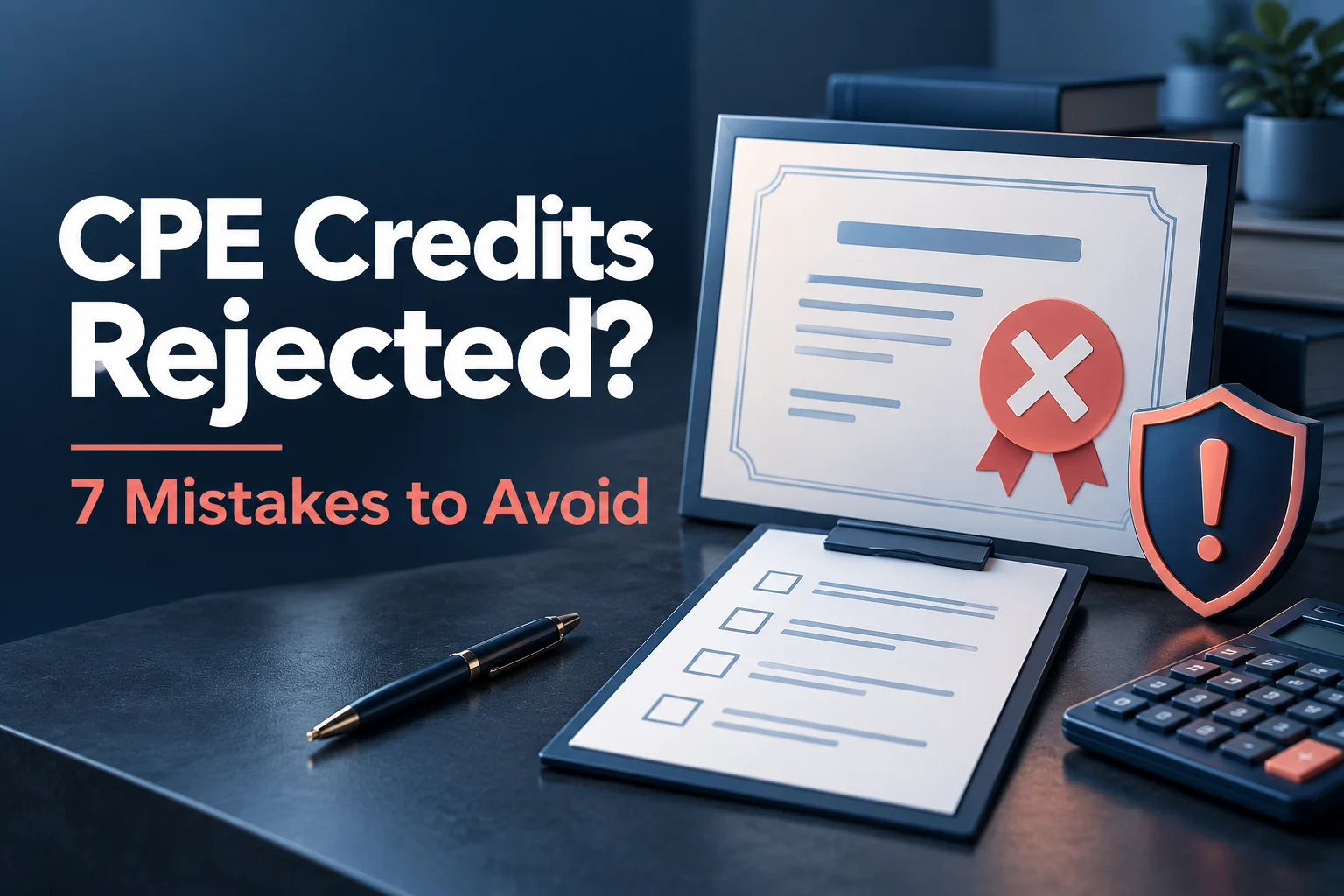
Can Your CPE Credits Be Rejected? 7 Mistakes That Could Put Your CPA License at Risk
 Imtiaz Munshi, CPA

Registration Completed

Something Went Wrong!! Please Try Again.

Registration Completed

Please Update Your Profile to Claim Your Continuing Education Credits.

Thank you for subscribing 7 Days Free Trial.
Please upgrade your browser to use MYCPE ONE
Experience MYCPE ONE at its best! Upgrade your browser for a more interactive, user-friendly interface, and stay ahead in your professional development journey.
Upgrade NowHow did you find out about us?
We were looking so hard for you now that you are finally here, So would you tell us how you found out about us?

What is your primary purpose to use MYCPE ONE?

Thank you for submitting your inquiry! We will contact you soon.
CloseOur Promise