©2026 - www.my-cpe.com All rights reserved
support@my-cpe.com7 Days Free Trial
for Enterprise Subscriptions
You have Not Selected the Monthly or Annual Plan

#1 Global Platform for Continuing Education
Create your Free Account | Get Unlimited Access only @$199/Year ( View Details )
Trusted by 250,000+ Professionals for Continuing Education
Create Your Account 1/2
Already have an account? Log In
To Continue using Trial, please verify your email address
Didn’t received verification email? Resend Email
You can cancel anytime during your trial period.
Become a
MYCPE ONE Member
@ $299 $199
33% Discount on Annual Subscription


Complete Access to 12,000+ Hours of Content
Trusted by 250,000+ Professionals
"Steven was knowledgeable and thorough…”
Steven was knowledgeable and thorough in his information about the product and what is offered. He was empathetic to my situation. He went above and beyond answering all of my many questions. Excellent service!

Crystal lovejoy
"Great Customer Service”
Great service and very patient as I asked several questions. Steven answered all my questions and helped me make the right decision in my subscription purchase. Thank you.

Lori corry
"It is what it advertised to be”
It is what it advertised to be. Professional quality training and CPE tracking and certificates; systems knows AZ CPA CPE requirements and categories. I've needed help on several occasions and the assistance was quick and effective; however, there were some problems with data entry. The assistance sometimes asks for input, but when I try to type it is dissallowed for some reason. On several occasions I had to close the popup to get it out of my way.

Brian Carey
"Great customer service”
Great customer service. Classes are pertinent. Great value

Steve

Trusted by 250,000+ Professionals
Trusted by 250,000+ Professionals
"Steven was knowledgeable and thorough…”
Steven was knowledgeable and thorough in his information about the product and what is offered. He was empathetic to my situation. He went above and beyond answering all of my many questions. Excellent service!
Crystal lovejoy
"Great Customer Service”
Great service and very patient as I asked several questions. Steven answered all my questions and helped me make the right decision in my subscription purchase. Thank you.
Lori corry
"It is what it advertised to be”
It is what it advertised to be. Professional quality training and CPE tracking and certificates; systems knows AZ CPA CPE requirements and categories. I've needed help on several occasions and the assistance was quick and effective; however, there were some problems with data entry. The assistance sometimes asks for input, but when I try to type it is dissallowed for some reason. On several occasions I had to close the popup to get it out of my way.
Brian Carey
"Great customer service”
Great customer service. Classes are pertinent. Great value
Steve
Subscribe Now at $199/ 12 Months
Topic of Interest
Select the topics of your interest to receive Webinars/Virtual Events/E-Books/Podcasts of your interest.
Selected Topics
Important: Course Deactivation Alert
Below mentioned Courses will be deactivated soon due to outdated content. Complete the course within the next 7 days to receive credits. After Expiry date, the course will be unavailable for credit. For assistance or inquiries, please contact our support team at support@my-cpe.com.
Course Name
Thank You.
The California Board of Accountancy (CBA) recently opened a survey on Continuing Professional Education requirements, and it deserves more attention than the average "please fill this out" request in your inbox. This isn't a satisfaction survey or a box to check before your license renews. It's an invitation to help decide what CPE should actually look like for California CPAs going forward.
That distinction matters more than it might seem at first glance.
Somewhere along the way, continuing education in this profession picked up a reputation problem. For a lot of CPAs, "CPE" quietly became shorthand for "the hours I need before my deadline," rather than "the knowledge I need to do my job well." That's not a knock on CPAs — it's a natural outcome when requirements are treated as a compliance line item rather than a professional development strategy.
But the two aren't supposed to be separate things. The hours you log should genuinely reflect how you learn, how your practice has changed, and what your clients now need from you. When a regulator like the CBA asks practitioners directly what's working and what isn't, that's a rare opportunity to close the gap between "meeting the requirement" and "actually growing."
Think about how differently a CPA's day-to-day looks now compared to five years ago. Advisory work has expanded. Automation has changed how audits and tax prep get done. And artificial intelligence has moved from a buzzword at conferences to something showing up in actual workflows — tools that draft memos, flag anomalies, and reshape how firms staff and price their services.
Yet plenty of CPE catalogs still lean heavily on the same handful of technical topics year after year, with newer areas like AI governance, data ethics, and technology risk treated as optional add-ons rather than core competencies. If the requirements themselves don't evolve alongside the profession, CPAs are left choosing between "what's required" and "what's actually relevant" and that's a choice nobody should have to make.
This is exactly why practitioner input matters so much right now. The people best positioned to say what CPE should cover next aren't regulators working from a template. They're the CPAs sitting across from clients who are asking harder, more current questions every year.
The survey itself takes only a few minutes to complete, but its impact isn't measured in minutes — it's measured in how CPE requirements get structured for years afterward. Every response adds to a clearer picture of what California CPAs actually need: more flexibility in format, more relevant subject matter, better recognition of self-directed learning, or simply more room for emerging topics that didn't exist when current rules were written.
If you're a licensed CPA in California, this is worth carving out five minutes for. And if you lead a team, sharing it doesn't just help the Board gather more data — it signals to your staff that their professional development experience is something worth advocating for, not just enduring.
CPE works best when it's treated as an investment rather than an obligation — when the courses on offer track the way the profession is actually moving, instead of what's easiest to certify. That's a mindset firms can build into their own culture regardless of what any single regulator decides: prioritizing learning that's current, practical, and tied to where the industry is headed, not just what fills a quota.
It's the same reasoning that's pushed learning providers across the profession to rethink their own catalogs. At MYCPE ONE, for instance, the course library gets refreshed year over year with exactly this kind of forward-looking content — AI tools, AI governance, and AI ethics sitting alongside the core technical hours every CPA still needs. Not because a regulator mandated it, but because firms started asking for it.
When the demand for relevance comes from practitioners themselves, providers tend to move faster than requirements do. That's arguably the healthiest way for CPE to evolve: firms and CPAs push for what they actually need, and both the market and the regulations eventually catch up.
The CBA's survey is a chance to push that mindset further at the regulatory level. Take the few minutes. Pass it along to your team. And keep expecting CPE to be worth the time you put into it because it should be.

Amrit Singh is a business leader with 10+ years of experience in continuing education. Helping accounting, tax, and finance professionals stay compliant with ease, he began his journey as a consultant. Learning across industries before stepping into a leadership role, he is shaped by both successes and failures. Amrit is passionate about problem-solving, building products, exploring technology, and mentoring future leaders. He is dedicated to transform continuing education, making it simpler, smarter, and more meaningful. Through his blogs and talks, he shares insights on accounting careers, CPA compliance, and the future of continuing education.

AI Liability and Malpractice Exposure for Professionals


Feedback for Growth: SBI, SCARF & Feedforward
AI Finance: Build an AP Fraud Detection Dashboard
Offshore Bookkeeping vs. In-House: What UK Accounting Firms Should Consider
 Christopher Rivera
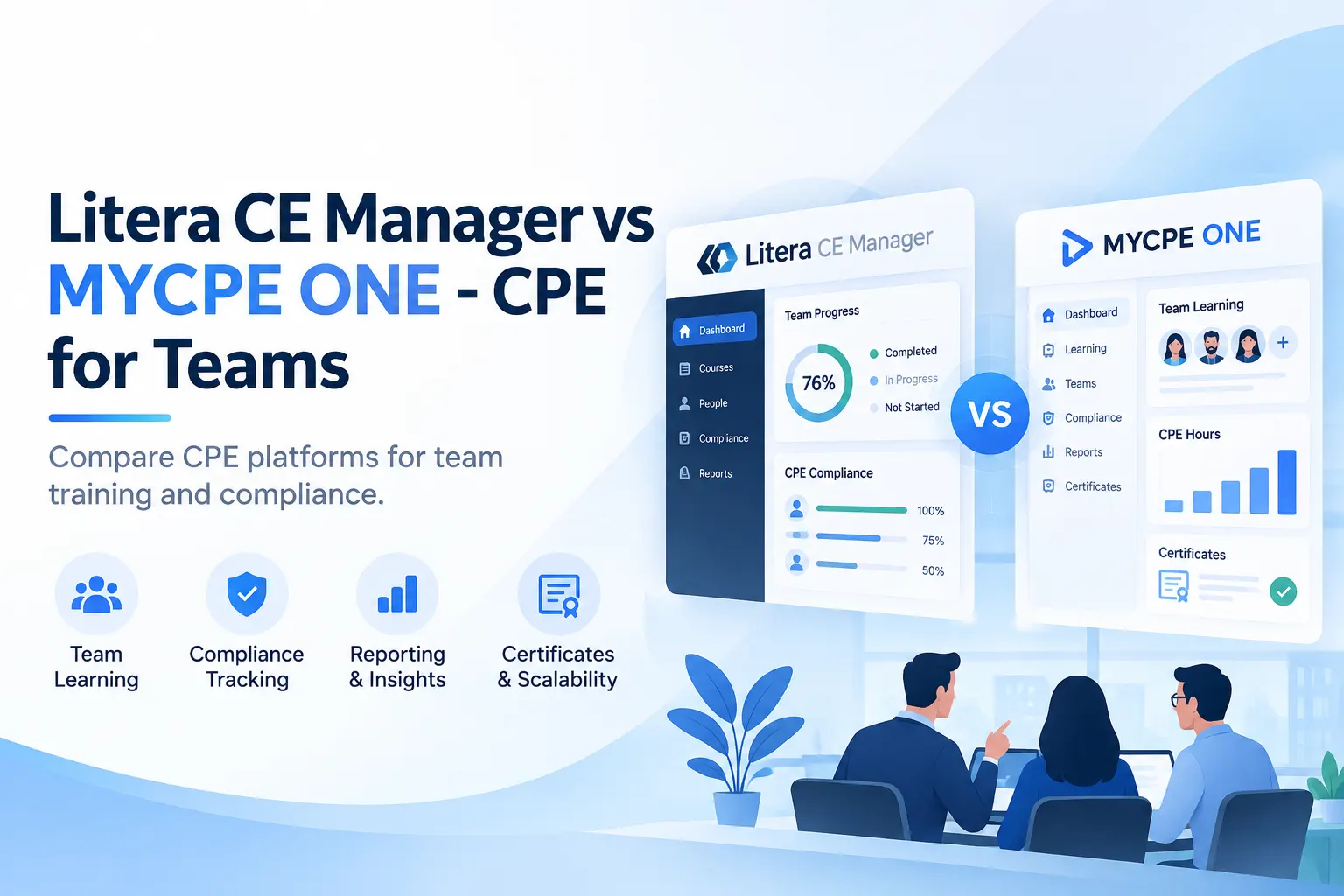

Registration Completed

Something Went Wrong!! Please Try Again.

Registration Completed

Please Update Your Profile to Claim Your Continuing Education Credits.

Thank you for subscribing 7 Days Free Trial.
Please upgrade your browser to use MYCPE ONE
Experience MYCPE ONE at its best! Upgrade your browser for a more interactive, user-friendly interface, and stay ahead in your professional development journey.
Upgrade NowHow did you find out about us?
We were looking so hard for you now that you are finally here, So would you tell us how you found out about us?

What is your primary purpose to use MYCPE ONE?

Thank you for submitting your inquiry! We will contact you soon.
CloseOur Promise