©2026 - www.my-cpe.com All rights reserved
support@my-cpe.com7 Days Free Trial
for Enterprise Subscriptions
You have Not Selected the Monthly or Annual Plan

#1 Global Platform for Continuing Education
Create your Free Account | Get Unlimited Access only @$199/Year ( View Details )
Trusted by 250,000+ Professionals for Continuing Education
Create Your Account 1/2
Already have an account? Log In
To Continue using Trial, please verify your email address
Didn’t received verification email? Resend Email
You can cancel anytime during your trial period.
Become a
MYCPE ONE Member
@ $299 $199
33% Discount on Annual Subscription


Complete Access to 12,000+ Hours of Content
Trusted by 250,000+ Professionals
"Steven was knowledgeable and thorough…”
Steven was knowledgeable and thorough in his information about the product and what is offered. He was empathetic to my situation. He went above and beyond answering all of my many questions. Excellent service!

Crystal lovejoy
"Great Customer Service”
Great service and very patient as I asked several questions. Steven answered all my questions and helped me make the right decision in my subscription purchase. Thank you.

Lori corry
"It is what it advertised to be”
It is what it advertised to be. Professional quality training and CPE tracking and certificates; systems knows AZ CPA CPE requirements and categories. I've needed help on several occasions and the assistance was quick and effective; however, there were some problems with data entry. The assistance sometimes asks for input, but when I try to type it is dissallowed for some reason. On several occasions I had to close the popup to get it out of my way.

Brian Carey
"Great customer service”
Great customer service. Classes are pertinent. Great value

Steve

Trusted by 250,000+ Professionals
Trusted by 250,000+ Professionals
"Steven was knowledgeable and thorough…”
Steven was knowledgeable and thorough in his information about the product and what is offered. He was empathetic to my situation. He went above and beyond answering all of my many questions. Excellent service!
Crystal lovejoy
"Great Customer Service”
Great service and very patient as I asked several questions. Steven answered all my questions and helped me make the right decision in my subscription purchase. Thank you.
Lori corry
"It is what it advertised to be”
It is what it advertised to be. Professional quality training and CPE tracking and certificates; systems knows AZ CPA CPE requirements and categories. I've needed help on several occasions and the assistance was quick and effective; however, there were some problems with data entry. The assistance sometimes asks for input, but when I try to type it is dissallowed for some reason. On several occasions I had to close the popup to get it out of my way.
Brian Carey
"Great customer service”
Great customer service. Classes are pertinent. Great value
Steve
Subscribe Now at $199/ 12 Months
Topic of Interest
Select the topics of your interest to receive Webinars/Virtual Events/E-Books/Podcasts of your interest.
Selected Topics
Important: Course Deactivation Alert
Below mentioned Courses will be deactivated soon due to outdated content. Complete the course within the next 7 days to receive credits. After Expiry date, the course will be unavailable for credit. For assistance or inquiries, please contact our support team at support@my-cpe.com.
Course Name
Thank You.
Earning a CPA license is a significant achievement. But completing with credit requirements demands your time, money, effort, and persistence in learning. In 2024 alone, over 22% of CPAs flagged in audits had missing or non-qualifying credits.
CPE isn’t just about clocking hours; it’s about avoiding costly CPA CPE mistakes that could put your license at risk. Failure to comply with requirements can result in serious penalties, license suspension, and increased CPA CPE audit risk.
This guide highlights critical pitfalls often overlooked by professionals. The key insights will help you navigate compliance and keep your prestigious license active.
Here are the seven common mistakes even professional CPA tend to make while pursuing their continuing education learning.

No offense to non-accredited courses that may contribute to your professional learning. However, when it comes to complying with the CPE requirement, do not neglect accreditation.
Imagine the deadline is in your head, and you are about to submit your CPE report. Suddenly, you discover a course that will not count towards your certification requirements. This will be a complete waste of your time, money, and effort. Moreover, it's mental pressure to complete your CPE requirement before the deadline.
You should be cautious and very vigilant about the course you choose. Before jumping into any course, confirm NASBA accreditation with your course provider. Remember, state Boards of Accountancy have the ultimate authority on accepting a course for CPE credits.
Each state comes with its unique CPE credit obligations. The requirements may vary in mandatory ethics subject-specific credits, CPE carry-forward limit, and other aspects.
One incorrect report of noncompliant credit can put your certification status at risk.
Strictly adhere to your state body guidelines and track progress. Familiarize yourself with yearly or multi-year CPE cycles. Focus on key areas, such as state-specific ethics requirements, Mandatory topics, the reporting cycle, and carry-forward limits.

Plan your continuing education accordingly. Don't let your CPE compliance become an unnecessary stress on your deadline.
Don't wait for the deadline to knock on your door. Non-compliance can be costly, so avoid CPA CPE audit risk. You may be charged a penalty and required to complete additional credit hours.
Stop Bing Nurd Pro to complete your CPE on time. Set your goals. Take a small step every day to learn constantly throughout the year. A small goal to complete 10 hours quarterly, and you are way ahead in your compliance management.
Ethics is mandatory for CPAs. Some states may not require you to obtain mandatory ethics credits, but do not neglect ethical requirements at all. Failing to meet these requirements will be counted as non-compliance. According to the AICPA, one of the most prominent reasons for license suspension is breaking the AICPA code of professional conduct.
Be sure to include the appropriate ethics course in your CPE learning materials. Please note that the course meets the specified credit hours, adheres to the codes of professional conduct, and complies with your state's requirements.
Focus fully on learning while earning your CPE credits. There should be no place for average content Learning just to complete your CPE requirements.
If you are doing so, you are making a deal with your skills and career prospects.
Select a reputable course provider and choose courses that are both of high quality and align with your career objectives. Key topics of A&A, Financial Accounting, Tax, Internal Audit, and Leadership. Offering real-world applications not only fulfills CPE requirements but also contributes to professional value.
Choose the courses that integrate with your work, drive real-world implementation, and contribute to your long-term career growth. Incorporate your learning into your day-to-day work. Demonstrate the value of what you learn.0
Courses that have more practical application will teach.
Simply by selecting the right LMS and continuing education provider, you can neutralize most of your CPE mistakes. And how so? A platform specifically designed to provide continuing education to CPAs and professionals will ensure that NASBA accredits the courses it offers suggested.
As your go-to CPE provider, MYCPE ONE will simplify the complications on your behalf.
Holding a single or multiple qualifications will require a multilayer requirement. With MYCPE ONE, you simply provide the designation you have, and elements will ensure you receive the course that is most suitable to your specific requirements and career development.
Integrate your learning with an established continuing education provider. It will track and maintain a clear record of your state-specific and subject-specific compliance requirements. It will provide you with access to modern technologies, including course suggestions, deadline reminders, ethics reminders, and the latest updates throughout the year, to help reduce last-minute stress.
Not sure which provider is best for your needs? Check out our list of the best online CPE platforms for CPAs for a detailed comparison.

Have a clear track of your completed and pending CPE credits, along with your state's specific requirements. A platform with a centralized dashboard will make your CPE management seamless. It is an assurance that you will never miss a CPE and be stress-free when the deadline approaches.
States have their own unique CPE compliance requirements. Compliance is not very elastic, but it may change. So, carefully review your body guidelines.
Avoid these pitfalls and maintain compliance with CPE. A good LMS Continuing Education platform may help you overcome these challenges. Additionally, you must be mindful of your compliance. Remember, maintaining a CPA CPE license is not the sole motive, but to upskill.
Implement the right learning approach that suits you and your career goals.
Most states generally require 40 hours of CPE annually, or 80 to 120 hours over a two- to three-year period. These credit hours include both ethics, technical, and non-technical credit hours.
According to specific requirements, CPE credits generally fall into distinct categories:
Professional networking and involvement in state associations or CPA societies play a significant role in maintaining a CPA license. It is a key place to connect with other professionals, share Information, and be a part of a professional community. They often offer opportunities for continuing education activities, too

Amrit Singh is a business leader with 10+ years of experience in continuing education. Helping accounting, tax, and finance professionals stay compliant with ease, he began his journey as a consultant. Learning across industries before stepping into a leadership role, he is shaped by both successes and failures. Amrit is passionate about problem-solving, building products, exploring technology, and mentoring future leaders. He is dedicated to transform continuing education, making it simpler, smarter, and more meaningful. Through his blogs and talks, he shares insights on accounting careers, CPA compliance, and the future of continuing education.
Table of Contents

Compensation & Incentive Plans: Design, Cost & Governance



Succession Planning for Family Business & Wealth Transfer


Agentic AI in Audit and Assurance
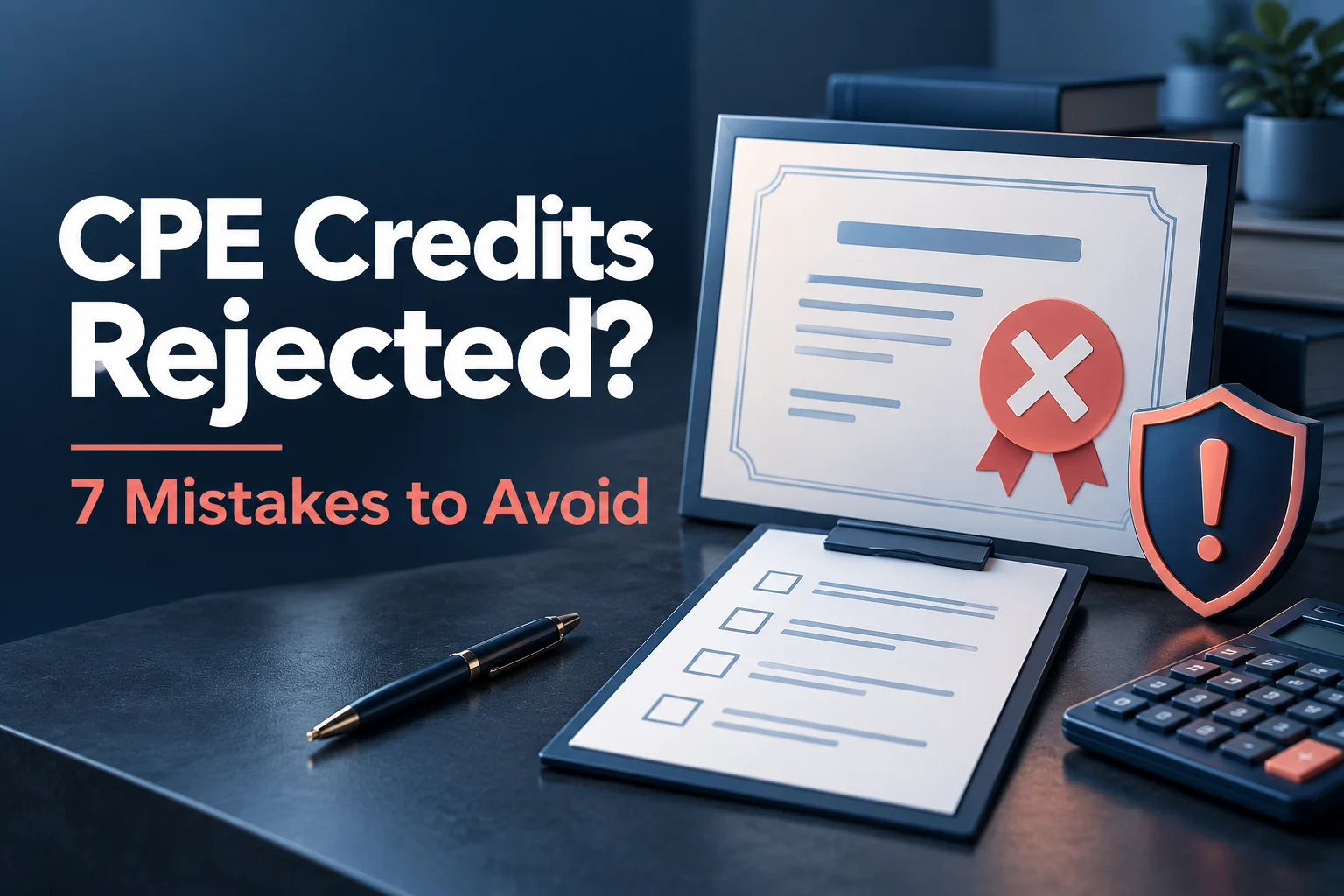
Can Your CPE Credits Be Rejected? 7 Mistakes That Could Put Your CPA License at Risk
 Imtiaz Munshi, CPA

Registration Completed

Something Went Wrong!! Please Try Again.

Registration Completed

Please Update Your Profile to Claim Your Continuing Education Credits.

Thank you for subscribing 7 Days Free Trial.
Please upgrade your browser to use MYCPE ONE
Experience MYCPE ONE at its best! Upgrade your browser for a more interactive, user-friendly interface, and stay ahead in your professional development journey.
Upgrade NowHow did you find out about us?
We were looking so hard for you now that you are finally here, So would you tell us how you found out about us?

What is your primary purpose to use MYCPE ONE?

Thank you for submitting your inquiry! We will contact you soon.
CloseOur Promise