©2026 - www.my-cpe.com All rights reserved
support@my-cpe.com7 Days Free Trial
for Enterprise Subscriptions
You have Not Selected the Monthly or Annual Plan

#1 Global Platform for Continuing Education
Create your Free Account | Get Unlimited Access only @$199/Year ( View Details )
Trusted by 250,000+ Professionals for Continuing Education
Create Your Account 1/2
Already have an account? Log In
To Continue using Trial, please verify your email address
Didn’t received verification email? Resend Email
You can cancel anytime during your trial period.
Become a
MYCPE ONE Member
@ $299 $199
33% Discount on Annual Subscription


Complete Access to 12,000+ Hours of Content
Trusted by 250,000+ Professionals
"Steven was knowledgeable and thorough…”
Steven was knowledgeable and thorough in his information about the product and what is offered. He was empathetic to my situation. He went above and beyond answering all of my many questions. Excellent service!

Crystal lovejoy
"Great Customer Service”
Great service and very patient as I asked several questions. Steven answered all my questions and helped me make the right decision in my subscription purchase. Thank you.

Lori corry
"It is what it advertised to be”
It is what it advertised to be. Professional quality training and CPE tracking and certificates; systems knows AZ CPA CPE requirements and categories. I've needed help on several occasions and the assistance was quick and effective; however, there were some problems with data entry. The assistance sometimes asks for input, but when I try to type it is dissallowed for some reason. On several occasions I had to close the popup to get it out of my way.

Brian Carey
"Great customer service”
Great customer service. Classes are pertinent. Great value

Steve

Trusted by 250,000+ Professionals
Trusted by 250,000+ Professionals
"Steven was knowledgeable and thorough…”
Steven was knowledgeable and thorough in his information about the product and what is offered. He was empathetic to my situation. He went above and beyond answering all of my many questions. Excellent service!
Crystal lovejoy
"Great Customer Service”
Great service and very patient as I asked several questions. Steven answered all my questions and helped me make the right decision in my subscription purchase. Thank you.
Lori corry
"It is what it advertised to be”
It is what it advertised to be. Professional quality training and CPE tracking and certificates; systems knows AZ CPA CPE requirements and categories. I've needed help on several occasions and the assistance was quick and effective; however, there were some problems with data entry. The assistance sometimes asks for input, but when I try to type it is dissallowed for some reason. On several occasions I had to close the popup to get it out of my way.
Brian Carey
"Great customer service”
Great customer service. Classes are pertinent. Great value
Steve
Subscribe Now at $199/ 12 Months
Topic of Interest
Select the topics of your interest to receive Webinars/Virtual Events/E-Books/Podcasts of your interest.
Selected Topics
Important: Course Deactivation Alert
Below mentioned Courses will be deactivated soon due to outdated content. Complete the course within the next 7 days to receive credits. After Expiry date, the course will be unavailable for credit. For assistance or inquiries, please contact our support team at support@my-cpe.com.
Course Name
Thank You.
Accounting and tax firms need more than occasional training to keep their teams prepared. With different job roles, credentials, experience level and specialization teams need a structured learning path to fill the skill gap.
A well-planned approach to staff training program helps firms build technical expertise, strengthen professional and technology skills, and respond to changing industry needs. When that training is CPE-approved, employees can also earn CPE credits and certifications. This positions your firm for sustained growth and long-term success.
This blog explores the essential components of an effective CPE training program and highlights how MYCPE ONE can help firms in structured continuous learning, upskill team, and provide CPE approved learning.
Occasional training can not fill the knowledge depth accounting and tax firm employees need. A well-designed program helps firms identify skill gaps, build role-specific learning paths, keep employees current with changing industry requirements, and prepare teams for emerging technologies and evolving client needs.
Teams increasingly need practical skills in AI, automation, accounting technology, cybersecurity, and data analytics. Leveraging technology through training enhances efficiency, accuracy, and the delivery of value-added services.
Tax professionals need timely training when rules, filing requirements, standards, and guidance change. Keeping up with the latest regulations and industry trends is crucial for staying compliant and providing strategic advice to clients.
Employees hold different responsibilities and skills that require a structured training program can give junior, mid-level, and senior professionals appropriate learning paths. a consistent framework for training establishes common knowledge standards relevant to individual roles and responsibilities. To navigate complex scenarios, strong leadership, communication, and critical thinking skills are key.
Year-round training connects with long-term employee development rather than meeting CPE deadline or specific business need. It exposes team members to strengthen their knowledge, explore new ideas, emerging trends, take challenges, and prepare for future responsibilities.
A strong staff training program is more then just meeting immediate job requirement or professional education need. It should combine compliance-focused education with technical training, emerging technology, ethics, and professional competency that support employees in their daily tasks. A well programed CPE training must include:
Include training on key subjects like tax regulations, accounting standards, auditing, financial reporting, compliance requirements, and other industry updates.
Firms can build practical expertise through specialized learning in areas such as tax, audit, assurance, and technology-related areas. Deepen your teams technical tax knowledge through focused training programs in taxation, deduction, and retirement planning:
Following specialized programs on audit and assurance can help firms to strengthen technical capabilities:
Train employees to recognize and address ethical aspect, understand the standards, and make professional decisions. Where applicable, ethics training can also contribute toward credential-specific CPE requirements.
Develop practical skills in AI, automation, accounting software, cybersecurity, and data analytics. Traditional accounting is root but the young green leaf's are important. Understand how technologies can improve accounting and tax workflows. Address concepts like data analytics, data security risk, accuracy, privacy, algo rhythm bias, and human oversight.
Firms can take this role-specific approach with practical AI training focused on accounting, audit and compliance, fraud and forensics:
Structure the learning paths based on employees' roles, responsibility, experience level, and skill development needs.
Tax professionals can build specialized expertise through programs such as:
From foundational training for new staff to advanced training for technical, advisory and leadership roles to practice-management skills, training must be a part of a training program.
Accounting and tax firms can strengthen their technical training programs with specialized learning focused on individual and pass-through taxation. J. Patrick’s training programs provide practical learning opportunities across key tax areas, allowing firms to align employee development with the types of returns and tax services they handle.
Build hands-on knowledge on specialized tax topics:
To strengthen client service and overall team performance, soft skills are similarly important to technical skills. Train employees to develop communication, critical thinking, leadership, collaboration, time management, client relationship,
Combine live webinars, instructor-led sessions, and on-demand courses to support different schedules and learning preferences. Live courses are best suitable for timely tax and regulatory updates. Choosing a reliable CPE platform with diverse learning is a plush point.
Centralize tracking of courses, credits, certificates, and compliance progress across different credentials and jurisdictions to improve visibility and reduce manual recordkeeping.

A successful CPE training program aligns with your firm's goals and addresses the individual growth paths of your team members. Here’s how to structure your program:
Assess Your Firms Training Needs: Identify skill gaps and future competencies required for your team's success. Consider employees' roles, experience levels, professional credentials, and service areas.
Segment Employees: Not one size fits all. Segregate team members based on their role and responsibility, professional qualification (CPA, EA, CIA, accountants, bookkeepers). This makes it easier to provide relevant training while addressing different CPE requirements.
Customized Learning Paths: Tailor learning programs to meet the diverse needs of your team, from junior accountants to senior leaders. Develop learning paths that match each employee's responsibilities and career levels.
Combine Different Learning Formats: Use a mix of live webinars, instructor-led sessions, audiobooks and short CPE clips to accommodate different schedules and learning preferences. MYCPE ONE's live webinars can provide timely, instructor-led learning on tax, accounting, technology, ethics, and other relevant topics, while on-demand formats give employees greater flexibility.
Live sessions can provide timely updates and interaction, on demand gives flexibility, while podcasts give feasibility to learning while driving.
Connect Training with Business Goals: Training should address capabilities that directly support the firm's objectives. If a firm is expanding advisory services, for example, it can develop employees through Practical Training for Client Advisory Services Professionals. Whether the goal is improving tax expertise, strengthening client service, or adopting AI, learning should have a clear connection to business performance.
Integrate CPE and Certification Opportunities: Where applicable, include CPE-approved courses and professional certification programs within employees' learning paths. This allows firms to support professional development while employees earn credits and credentials that remain valuable to them as part of their professional growth.
Track Learning and Measure Progress: A centralized system can help managers assign training, monitor completion, review employee progress, and maintain records of certifications and CPE credits. Firms can use this information to identify skill gaps, adjust learning paths, and plan future development.
MYCPE ONE offers a comprehensive platform that supports the effective implementation of your CPE training strategy by providing:
Simplify team CPE with MYCPE ONE. Start your 30-day free trial
Incorporating technology into your CPE training program is essential for creating engaging and accessible learning experiences. Platforms like MYCPE ONE offer digital solutions that seamlessly integrate into your firm’s training program, enabling:

Source: Trustpilot
The future of the tax and accounting industry belongs to firms that prioritize the continuous learning and development of their teams. By implementing a strategic CPE training program and leveraging MYCPE ONE as a learning partner, your firm can foster a culture of continuous improvement, adaptability, and excellence.
For accounting and tax firms looking to enhance their CPE training programs, MYCPE ONE offers a versatile platform that aligns with your team’s learning goals and evolving needs. Explore how MYCPE ONE can complement your CPE training program strategy and contribute to building a future-ready accounting team.
A CPE Training Program is designed to ensure that professionals in accounting and tax maintain and enhance their skills and knowledge. It's crucial for compliance, staying updated with industry changes, and improving the overall service quality of your firm.
When selecting a CPE provider, consider factors such as course variety, accreditation, flexibility, pricing, and the ability to track progress and compliance. A provider like MYCPE ONE offers extensive resources and tools to meet these needs.
Yes, CPE training programs can and should be tailored to meet the needs of different roles within your firm, from junior accountants to senior management, ensuring that each team member receives relevant and valuable training.
Online CPE training offers flexibility, allowing team members to learn at their own pace and schedule. It also provides access to a wide range of courses that can be updated regularly to reflect the latest industry standards and regulations.
An effective CPE training program includes needs assessment, customized learning paths, engaging and interactive content, and robust tracking and reporting to ensure compliance and progress toward learning goals.
Technology enhances CPE training by providing remote learning options, interactive modules, and scalable solutions that can adapt to the growing and changing needs of your firm. Platforms like MYCPE ONE integrate these technological advancements to maximize the impact of your training program.
Technology enhances CPE training by providing remote learning options, interactive modules, and scalable solutions that can adapt to the growing and changing needs of your firm. Platforms like MYCPE ONE integrate these technological advancements to maximize the impact of your training program.

The author, Nick Branson is a CPA and Co- president of MYCPE ONE – Continuing Education Platform for Professionals. He has experience of more than 2 decades in the field educating the top professionals in the field of CPA, CMA, CIA and many more.
Table of Contents

Compensation & Incentive Plans: Design, Cost & Governance


Succession Planning for Family Business & Wealth Transfer

Agentic AI in Audit and Assurance

Can Your CPE Credits Be Rejected? 7 Mistakes That Could Put Your CPA License at Risk
 Imtiaz Munshi, CPA

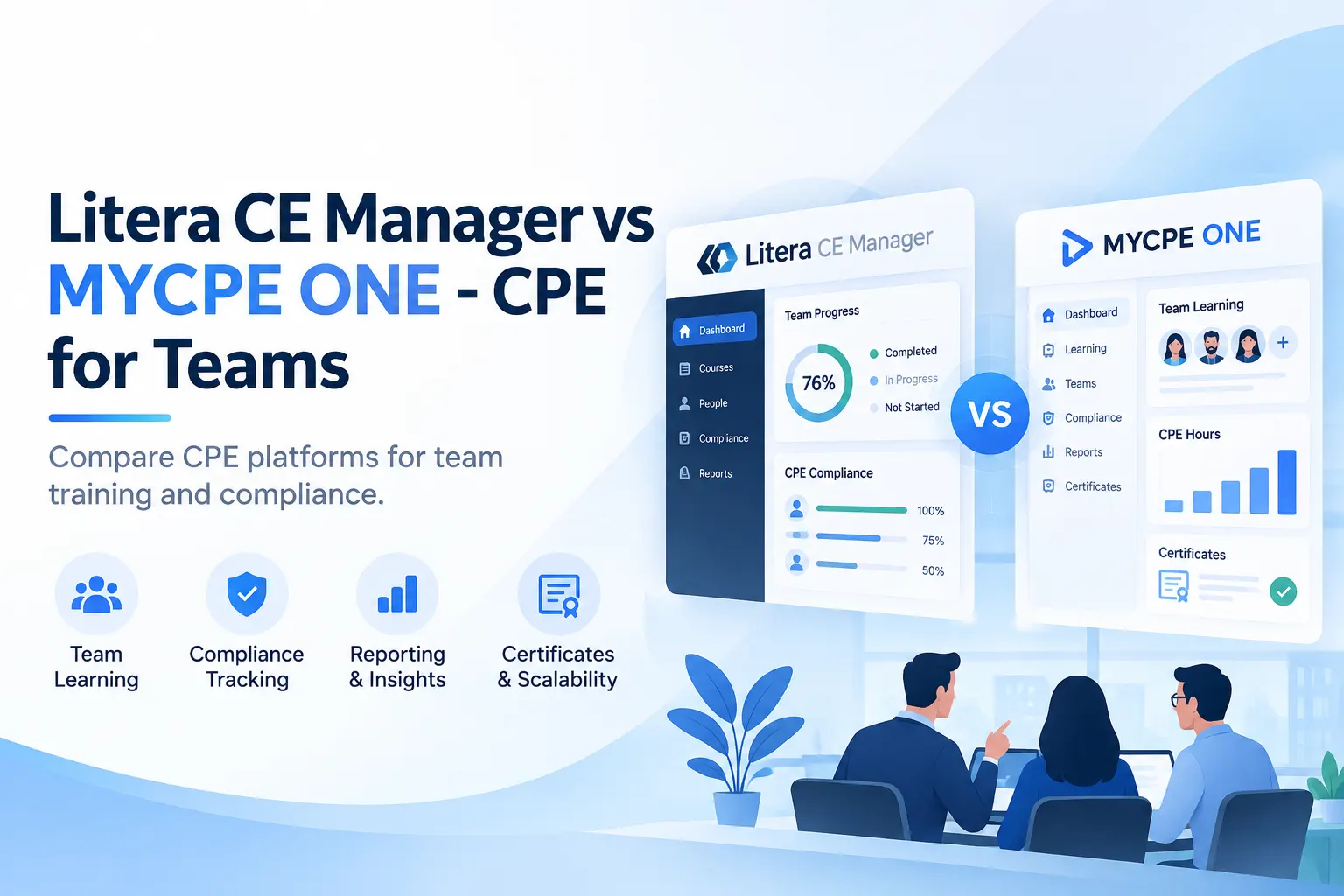
All in one Training & CPE Compliance Solutions for your Team

Registration Completed

Something Went Wrong!! Please Try Again.

Registration Completed

Please Update Your Profile to Claim Your Continuing Education Credits.

Thank you for subscribing 7 Days Free Trial.
Please upgrade your browser to use MYCPE ONE
Experience MYCPE ONE at its best! Upgrade your browser for a more interactive, user-friendly interface, and stay ahead in your professional development journey.
Upgrade NowHow did you find out about us?
We were looking so hard for you now that you are finally here, So would you tell us how you found out about us?

What is your primary purpose to use MYCPE ONE?

Thank you for submitting your inquiry! We will contact you soon.
CloseOur Promise