©2026 - www.my-cpe.com All rights reserved
support@my-cpe.com7 Days Free Trial
for Enterprise Subscriptions
You have Not Selected the Monthly or Annual Plan

#1 Global Platform for Continuing Education
Create your Free Account | Get Unlimited Access only @$199/Year ( View Details )
Trusted by 250,000+ Professionals for Continuing Education
Create Your Account 1/2
Already have an account? Log In
To Continue using Trial, please verify your email address
Didn’t received verification email? Resend Email
You can cancel anytime during your trial period.
Become a
MYCPE ONE Member
@ $299 $199
33% Discount on Annual Subscription


Complete Access to 12,000+ Hours of Content
Trusted by 250,000+ Professionals
"Steven was knowledgeable and thorough…”
Steven was knowledgeable and thorough in his information about the product and what is offered. He was empathetic to my situation. He went above and beyond answering all of my many questions. Excellent service!

Crystal lovejoy
"Great Customer Service”
Great service and very patient as I asked several questions. Steven answered all my questions and helped me make the right decision in my subscription purchase. Thank you.

Lori corry
"It is what it advertised to be”
It is what it advertised to be. Professional quality training and CPE tracking and certificates; systems knows AZ CPA CPE requirements and categories. I've needed help on several occasions and the assistance was quick and effective; however, there were some problems with data entry. The assistance sometimes asks for input, but when I try to type it is dissallowed for some reason. On several occasions I had to close the popup to get it out of my way.

Brian Carey
"Great customer service”
Great customer service. Classes are pertinent. Great value

Steve

Trusted by 250,000+ Professionals
Trusted by 250,000+ Professionals
"Steven was knowledgeable and thorough…”
Steven was knowledgeable and thorough in his information about the product and what is offered. He was empathetic to my situation. He went above and beyond answering all of my many questions. Excellent service!
Crystal lovejoy
"Great Customer Service”
Great service and very patient as I asked several questions. Steven answered all my questions and helped me make the right decision in my subscription purchase. Thank you.
Lori corry
"It is what it advertised to be”
It is what it advertised to be. Professional quality training and CPE tracking and certificates; systems knows AZ CPA CPE requirements and categories. I've needed help on several occasions and the assistance was quick and effective; however, there were some problems with data entry. The assistance sometimes asks for input, but when I try to type it is dissallowed for some reason. On several occasions I had to close the popup to get it out of my way.
Brian Carey
"Great customer service”
Great customer service. Classes are pertinent. Great value
Steve
Subscribe Now at $199/ 12 Months
Topic of Interest
Select the topics of your interest to receive Webinars/Virtual Events/E-Books/Podcasts of your interest.
Selected Topics
Important: Course Deactivation Alert
Below mentioned Courses will be deactivated soon due to outdated content. Complete the course within the next 7 days to receive credits. After Expiry date, the course will be unavailable for credit. For assistance or inquiries, please contact our support team at support@my-cpe.com.
Course Name
Thank You.
So, the preparation is for the final season of 2027. Tax year 2026 returns are here, completely rewritten by the One Big Beautiful Bill Act (OBBBA). Before tax season hit, a tax accountant should take a federal tax update course on information reporting, IRS procedures, and state conformity.
Timing matters! It’s mid-October; PTIN renewals are open now. Complete AFSP coursework by December 31, 2026.

Tax season preparation is important, and what could be better when you can complete learn that along with your continuing education requirement. Well, 20 to 30 hours will be enough to cover most of the updates.
Build your pre-season plan around key areas:
Well, friendly advice would be to take an Annual Federal Tax Update in case of time constraints. And manage to try to add ethics, anyway your licensing bodies require it.
The 2027 filing season covers income earned in 2026. Many OBBBA provisions applied to 2025 returns, but a second wave starts in 2026. Preparers who learned the 2025 rules last season still have new material to absorb.
The table below lists tax year 2026 changes that most firms will meet, and the CPE topic that covers each one.
| CPE topic to cover it | Changes in Tax Year 2026 | What it means in practice |
|---|---|---|
| Federal tax update | Standard deduction increases to $16,100 for single and $32,200 for MFJ. | Check whether standard deduction or itemizing individual expenses will be more beneficiary. |
| Individual tax planning | SALT deduction increases to $40,400, with an income-based phase-out. | High-income clients in high-tax states need fresh projections |
| Individual deductions update | 0.5% of AGI floor on itemized charitable gifts; new deduction for non-itemizers | Charitable planning and documentation change for both groups |
| High-net-worth planning | Itemized deduction value capped at 35% for the top bracket | Affects modeling for 37% bracket clients |
| Information reporting | Form 1099-NEC and 1099-MISC threshold rises from $600 to $2,000 | Update vendor reporting workflows for business clients |
| Digital asset taxation | Form 1099-DA reports cost basis for covered digital assets | Expect basis mismatches for assets moved between wallets |
| Payroll and individual update | Qualified overtime reported separately on Form W-2 | Easier to verify the overtime deduction; transition relief ends |
| Federal tax update | Energy Efficient Home Improvement and Residential Clean Energy credits end | Clients may still expect these credits; set expectations early |

Work through this list in order. Each item names the course type, why it matters, and who needs it most.
This is the foundation. A good tax update CPE course covers inflation-adjusted figures, new forms, and IRS guidance issued since the last season. Look for one built for the 2027 filing season, not a recycled 2025 course with a new title.
Who needs it: every preparer, regardless of credential.
The new deductions for tips, overtime, car loan interest, and seniors created questions last season about eligibility and documentation. In 2026, the charitable changes and the SALT phase-out add more planning work. A focused course helps you explain these to clients in plain language.
Who needs it: 1040-heavy practices and seasonal preparers.
Bonus depreciation, Section 174A research expensing, Section 179, and the qualified business income deduction all changed under OBBBA. Mistakes here are expensive because they carry into future years through depreciation schedules and amended returns.
Who needs it: CPAs and EAs who prepare S corporation, partnership, or Schedule C returns.
The jump to a $2,000 threshold for Forms 1099-NEC and 1099-MISC changes what your business clients must file in January 2027. Form 1099-DA now carries basis for covered digital assets, so mismatches with client records will show up on Form 8949 and, later, in IRS notices.
Who needs it: firms that handle bookkeeping or year-end 1099 filing for clients, and anyone with crypto clients.
Most credentials require ethics hours, and a tax-specific ethics course is the most useful way to meet them. Cover due diligence, conflicts of interest, client records, and the rules on taxpayer consent for disclosure and use of return information under Section 7216.
Who needs it: every EA and AFSP participant, and CPAs whose state requires ethics hours this cycle.
Tax practices are a top target for phishing and account takeover in January and February. The FTC Safeguards Rule requires a written information security plan, and IRS Publication 5708 offers a template for small firms. A short course before season helps you update the plan and train staff before the first client portal upload.
Who needs it: firm owners and every staff member with access to client data.
Clients call about notices all year, and busy season is no exception. A course on CP2000 responses, penalty abatement, and payment plans means you can resolve issues quickly instead of researching them under deadline pressure.
Who needs it: EAs, CPAs who offer representation, and AFSP participants who want to use their limited representation rights.
States decide separately whether to follow federal changes such as bonus depreciation and the new individual deductions. A state update course or a firm-specific briefing prevents returns that are right federally and wrong on the state side.
Who needs it: multistate preparers and firms in states that decouple from federal law.
Technical CPE prepares you for the law. Workflow training prepares you for the volume. Learn your tax software’s new features, document intake tools, and any AI review assistants your firm uses, along with the review controls that keep them accurate.
Who needs it: teams adopting new tools or onboarding seasonal staff.
| When | What to do |
|---|---|
| Mid-October | Renew your PTIN for 2027. Review your CPE hours to date and list the gaps. |
| Late October to November | Take the federal tax update and the law-change courses that fit your client base. |
| Early December | Finish ethics, data security, and any AFSP courses. Confirm hours are reported to the IRS where required. |
| December 31 | Last day for AFSP coursework and the annual EA minimum. |
| January | Software updates, workflow training, and a short team refresher on anything new. |
On MYCPE ONE, more than 250,000 accounting professionals use live webinars and self-study courses to meet CPE requirements.
Preparing for the 2027 tax season. The latest federal tax changes, information reporting requirements, state tax conformity, and IRS guidance that affect tax year 2026 returns need high attention.
Well, an annual federal tax update with added focus on courses based on your clients, practice areas, and professional responsibilities, along with ethics. Complete ethics, data security, and required AFSP coursework before the December 31 deadline. Use January to review tax software, improve workflows, and prepare your team for the filing rush.
T,ake a federal tax update for the upcoming filing season, focused courses on the law changes that affect your clients, a tax ethics course, and a data security refresher. Add information reporting, IRS procedure, and state conformity as needed.
Enrolled agents need 72 hours every three years, with at least 16 hours each year. Two of those annual hours must be in ethics, and courses must come from an IRS-approved CE provider.
The Annual Federal Tax Refresher (AFTR) is a 6-hour course with a comprehension test, required for non-exempt preparers in the IRS Annual Filing Season Program. You must pass the test with at least 70% by December 31.
AFSP coursework must be completed by December 31, 2026. You must also renew your PTIN for 2027 and consent to Circular 230 obligations to receive the Record of Completion.
Not always. CPA requirements are set by each state board, and most allow a mix of fields. CPAs who prepare returns benefit from tax CPE every year, and some states require a state-specific ethics course.
Key changes include the $40,400 SALT cap, a 0.5% AGI floor on itemized charitable gifts, a $2,000 threshold for Forms 1099-NEC and 1099-MISC, cost basis on Form 1099-DA, and the end of the residential energy credits.
Yes. Several providers offer free webinars or starter credits. Check that the course is from a NASBA-registered sponsor for CPA credit, or an IRS-approved provider for EA and AFSP credit.`

Imtiaz Munshi, CPA (US), is the CFO at Azstec, LLC and a trusted advisor to high-net-worth entrepreneurs. A seasoned tax planner and a business strategist with his 25 years of experience, he helps businesses grow smarter and stronger. Imtiaz specializes in guiding entrepreneurs and enterprises through complex financial decisions with clarity and confidence. His passion lies in simplifying strategy, optimizing tax outcomes, and driving sustainable growth. Through his work and thought leadership, Imtiaz continues to empower CPAs and business owners to stay ahead in an evolving financial landscape shaped by AI, ESG, and data-driven change.
Table of Contents


Monthly AI Update – October 2026


Substantive Procedures in Government Audit
Auditing Cloud Security & Vendor Risk for Data Protection

Compliance vs Compliance Plus: Pricing and Features Compared for Your Team
 Amrit Singh
Offshore Bookkeeping vs. In-House: What UK Accounting Firms Should Consider
 Christopher Rivera
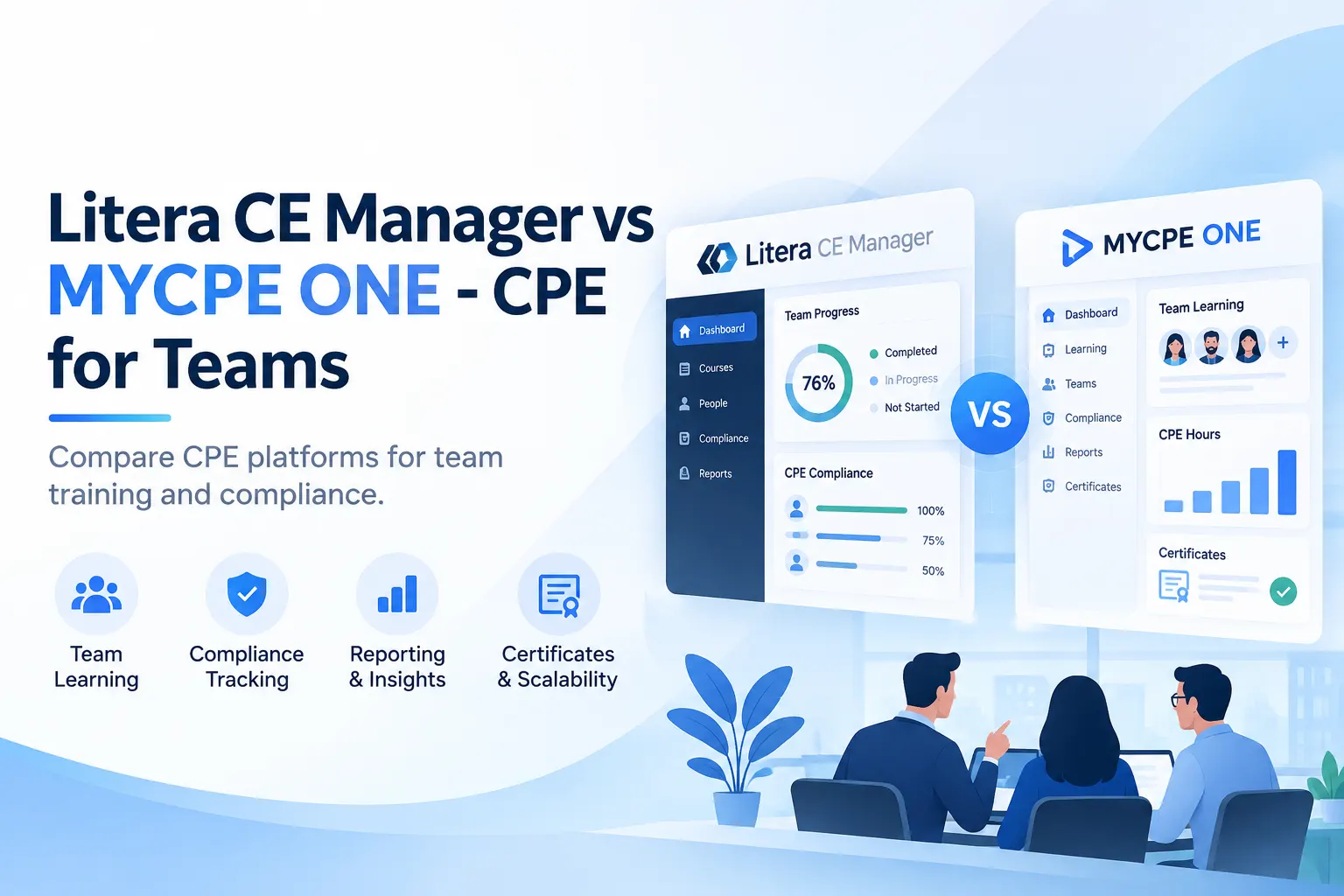

Registration Completed

Something Went Wrong!! Please Try Again.

Registration Completed

Please Update Your Profile to Claim Your Continuing Education Credits.

Thank you for subscribing 7 Days Free Trial.
Please upgrade your browser to use MYCPE ONE
Experience MYCPE ONE at its best! Upgrade your browser for a more interactive, user-friendly interface, and stay ahead in your professional development journey.
Upgrade NowHow did you find out about us?
We were looking so hard for you now that you are finally here, So would you tell us how you found out about us?

What is your primary purpose to use MYCPE ONE?

Thank you for submitting your inquiry! We will contact you soon.
CloseOur Promise