Scale your CPA & accounting firm with elite offshore talent trusted by 1,000+ firms.
Thank you for your interest. Our due diligence checklist will be shared with you within 48 hours.

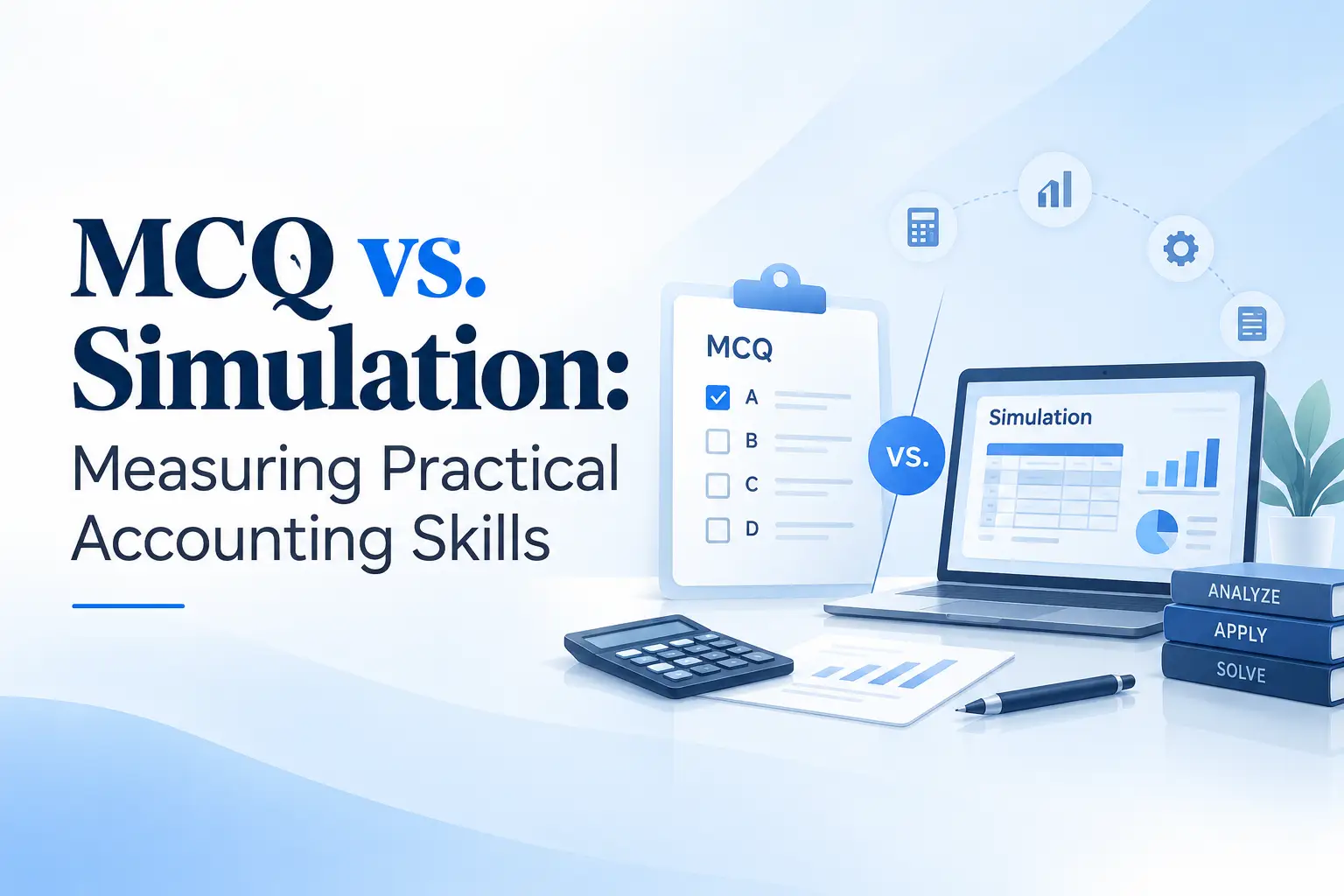
An accounting skills assessment test enables firms to evaluate real competency beyond resumes and interviews. The blog covers role-based assessments for entry, mid, and senior levels, structured scoring, interview integration, application-focused testing, and using assessment data for onboarding and training.
It also highlights common mistakes, the growing importance of assessment in accounting, and how MYCPE ONE delivers secure, AI-monitored, job-relevant evaluations for confident, data-driven hiring.
Hiring accounting professionals has never been more complex. Technical standards are evolving, automation is reshaping workflows, and client expectations continue to rise. Yet many firms still rely heavily on resumes and traditional interviews to make hiring decisions.
The result? Costly mis-hires, extended training cycles, and inconsistent performance. A structured accounting skills assessment test changes that.
Instead of guessing based on credentials or years of experience, firms can use data-driven evaluation to measure real competency. When implemented correctly, an accounting assessment becomes a strategic hiring tool not just an additional screening step.
An accounting test for job interview purposes is often treated as optional. But interviews primarily assess communication, confidence, and personality, not technical depth.
A candidate may speak fluently about audit procedures or tax compliance yet struggle when asked to apply concepts in a real-world scenario.
That’s where structured assessment in accounting becomes critical.
An accounting skills assessment test allows you to evaluate:
It replaces assumption with measurable performance.
A common mistake firms make is using the same accounting assessment for all roles. Entry-level and senior-level expectations are fundamentally different.

Your test structure should reflect that.
At this stage, you are evaluating foundation, not strategic judgment.
A basic accounting assessment test for entry-level roles should measure:
You are not testing advanced research skills. You are testing whether the fundamentals are strong enough to build upon.
At this stage, technical knowledge must translate into independent execution.
An effective accounting skills assessment test should evaluate:
Here, the focus shifts from “Can they do the task?” to “Can they do it without supervision?”
Senior accountants and managers are expected to demonstrate judgment.
Their accounting assessment should test:
At this level, depth of reasoning matters more than mechanical calculation.

An accounting skills assessment test only works if scoring is consistent.
A simple competency scoring model works best:
After scoring, categorize readiness:
If a candidate scores zero in a must-have competency, that should outweigh strengths elsewhere. A critical technical gap can significantly impact performance.
Structured scoring removes bias and emotion from the hiring process.
A common question firms ask is when to administer the accounting test for job interview screening.
Best practice:
Placing the accounting assessment before final interviews ensures you only invest time in technically capable candidates.
It also allows you to tailor interview questions based on assessment performance.
The strongest assessment in accounting does not rely on rote theory questions.
Instead of asking:
“What is GAAP?”
Ask:
“A client recognized revenue upfront for a multi-year contract. Identify the issue and propose correction.”
Application-based questions reveal how candidates think.
A strong accounting skills assessment test should simulate real work reconciliations, audit adjustments, review comments, or tax scenarios. The closer the test mirrors actual responsibilities, the more predictive it becomes.
An accounting assessment should not end once the candidate is hired.
Assessment results can be used to:
For example, if a new hire scores lower in documentation accuracy but strong in technical theory, managers can allocate additional review time early on.
This transforms assessment from a filtering tool into a development framework.
Even when using a basic accounting assessment test, firms often undermine its effectiveness.
Common errors include:
The goal is clarity, not complexity.
An effective accounting skills assessment test should be practical, relevant, and aligned with actual job expectations.
The accounting profession is evolving rapidly. Automation now handles repetitive compliance work, while advisory expectations continue to rise. At the same time, regulatory frameworks are becoming more complex and technology stacks more demanding.
Today’s accountants are expected to do far more than prepare returns or close books. They must interpret data accurately, apply changing regulations, use modern tools efficiently, and communicate insights clearly to clients.

Traditional interviews alone cannot reliably measure these multidimensional skills.
In this environment, structured assessment in accounting is no longer optional. It helps firms evaluate real capability before a candidate joins the team -not after mistakes begin to surface.
Firms that rely solely on interviews risk:
Competency-based accounting assessment tools bring objectivity into hiring. They validate technical accuracy, problem-solving ability, and real-world application of accounting standards before an offer is made.
The result is more predictable performance, reduced training burden, and stronger risk control. Over time, that advantage compounds into operational stability and sustainable growth.
Not all assessment tools understand accounting. MYCPE ONE is built specifically for CPA and accounting firms. Every accounting skills assessment test is designed around real-world competencies not generic aptitude questions.
Our structured process filters candidates based on role, experience level, and practical ability.
What truly sets MYCPE ONE apart is AI monitoring.
It ensures every accounting assessment is secure, credible and protected from unfair practices. Firms can trust the results.
Detailed performance reports highlight strengths, skill gaps, and overall readiness giving firms complete clarity before making a hiring decision. That means better decisions with less guesswork and more confidence. With MYCPE ONE, assessment in accounting becomes standardized, scalable, and reliable making hiring more predictable.

An accounting skills assessment test is not about adding another hurdle in the hiring process. It is about protecting your firm’s standards.
When designed correctly, it allows you to:
Resumes tell you where someone has worked.
Interviews tell you how they speak.
A structured accounting assessment tells you what they can actually do.
In today’s competitive accounting environment, clarity is not optional.
Yes, An accounting assessment reduces hiring mistakes by measuring real technical ability before a final decision is made. Instead of relying only on resumes or interviews, firms evaluate how candidates apply accounting concepts in practical scenarios.
When structured properly, an accounting skills assessment test highlights competency gaps early preventing costly mis-hires, extended training cycles, and performance issues later.
Efficiency comes from structure. Firms should define role-based competencies, use standardized scoring frameworks, and integrate the accounting assessment into the hiring workflow before final interviews.
Many firms streamline the process using structured platforms like MYCPE ONE, which offer ready-built accounting skills assessment tests, automated scoring, and reporting eliminating the need to build assessments from scratch.
AI monitoring protects the integrity of the assessment. In remote or hybrid hiring environments, it ensures that candidates complete the accounting skills assessment test independently and without unfair assistance.
This increases trust in results, reduces manipulation risks, and ensures that hiring decisions are based on genuine technical performance.
In multi-office firms, inconsistency in hiring standards is common.
Structured accounting assessments create a uniform evaluation framework across locations. Every candidate is tested using the same competency of benchmarks and scoring criteria.
This ensures fairness, comparability, and consistent quality regardless of which office is hiring.
A strong accounting assessment platform should offer:
Most importantly, it should be built specifically for accounting and CPA firms not a generic testing solution.

Amrit Singh is a business leader with 10+ years of experience in continuing education. Helping accounting, tax, and finance professionals stay compliant with ease, he began his journey as a consultant. Learning across industries before stepping into a leadership role, he is shaped by both successes and failures. Amrit is passionate about problem-solving, building products, exploring technology, and mentoring future leaders. He is dedicated to transform continuing education, making it simpler, smarter, and more meaningful. Through his blogs and talks, he shares insights on accounting careers, CPA compliance, and the future of continuing education.


Crack the Code: Unleashing Hidden Talents for Workplace Magic


.webp-1717773117 "Understanding Your Talent Development Function")
Understanding Your Talent Development Function


Fundamentals of Managing and Developing Talent