Join 250,000+
professionals today
Add Insights to your inbox - get the latest
professional news for free.
Join our 250K+ subscribers
Subscribe04 FEB 2026 / MONTHLY NEWS CAPSULE
January 2026 marked a shift in financial and business landscapes with increasing pressure and exposure across accounting, tax, and finance sectors. Major updates included business shifts towards efficient financial reporting and e-invoicing, important acquisitions and AI investments, tax disputes, a rise in government borrowing, and an increased focus on leadership learning; all signaling the need for tighter controls, careful assumptions, and intentional investing amidst growing complexity.
January did not arrive quietly. From boardrooms and finance teams to regulators and markets, the start of 2026 made one thing clear: pressure is shifting, not easing. Businesses are rethinking how they report, governments are leaning harder on debt to sustain growth, and technology is moving from promise to accountability. Across accounting, tax, and finance, the common thread is exposure. Assumptions that once held are being tested in real time, and shortcuts are getting expensive. This month’s recap pulls together the signals that matter, not the noise, highlighting where risk is building, where strategy is changing, and where professionals need to pay closer attention.
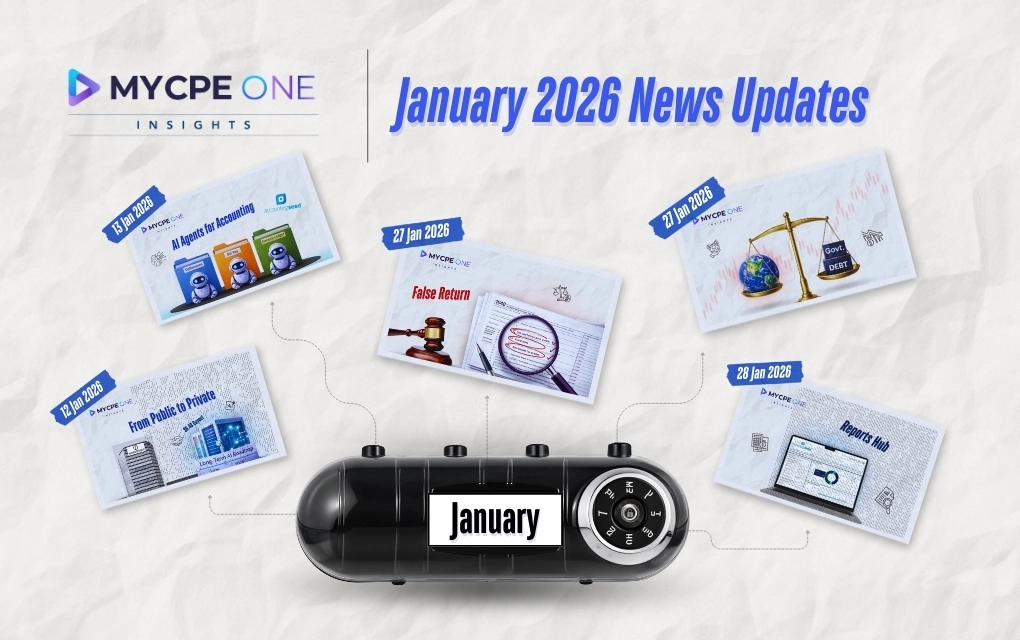
Accounting Seed’s new Financial Reports Hub targets a familiar pain point: reporting friction that keeps finance teams trapped in spreadsheets. By allowing data to load dynamically at runtime, the platform lets users pivot, filter, and regroup without rerunning reports or closing periods. Built directly inside Salesforce, it removes reconciliation delays and version confusion. The result is less time rebuilding reports and more time interpreting results, a shift that could quietly reshape how fast-growing finance teams operate.
Deloitte and Thomson Reuters’ expanded alliance reflects how e-invoicing has moved from a technical nuisance to a core compliance risk. Using the ONESOURCE Pagero platform, the partnership offers a managed global model that centralizes e-invoicing and reporting across dozens of jurisdictions. The message is clear: fragmented, country-by-country fixes no longer work. As mandates accelerate worldwide, firms and clients alike are being pushed toward operational ownership, not just rule interpretation.
Smithfield’s all-cash acquisition of Nathan’s Famous is less about growth and more about certainty. By buying the brand it already licenses, Smithfield eliminates renewal risk, future royalties, and strategic uncertainty tied to intellectual property. The deal underscores a broader trend in consumer staples: mature brands paired with scaled operators can deliver predictable cash flow in volatile markets. For accountants, it is a reminder that margin protection and clarity often matter more than headline synergies.
PwC’s latest Global CEO Survey reveals a disconnect between heavy AI investment and actual returns. While adoption is nearly universal, most leaders report little measurable benefit so far. The issue is not technology readiness, but foundational discipline: data quality, governance, and process clarity. AI is exposing organisational weaknesses rather than fixing them. The quiet tension CEOs feel reflects uncertainty about whether their systems can support the speed and scale AI promises.
Modern leadership is being reshaped by rapid skill decay, talent shortages, and rising expectations around empathy and adaptability. With a large share of managers lacking formal training, organisations are discovering that upskilling leaders is no longer optional. The shift from command-and-control to coaching-driven leadership places learning at the center of engagement and retention. Companies that embed continuous development into culture, not compliance, are seeing stronger teams and fewer costly turnover surprises.
Government borrowing has shifted from a temporary lever to a permanent feature of global growth. With public debt projected to exceed 100% of global GDP by decade’s end, governments are leaning on deficits to fund defense, aging populations, and strategic investments, even as interest costs rise. From the U.S. and Europe to Asia and emerging markets, borrowing is replacing reform. The numbers suggest stability for now, but growing dependence raises questions markets will not ignore forever.
A Wisconsin tax preparer’s conviction highlights how fraud often shows up in real life: repetitive, unsophisticated, and driven by volume. By inflating credits and fabricating figures across hundreds of returns, the scheme scaled quietly until patterns became impossible to ignore. The case underscores the IRS’s growing focus on preparer-level analytics and repeat behavior tied to PTINs. For firms, it is a reminder that refund chasing, weak oversight, and misaligned incentives create risks that compound fast.
The fallout from the largest tax data leak in IRS history landed hard in January 2026, when the Treasury cancelled $21 million in Booz Allen contracts. Although the revenue impact was small, markets reacted sharply, underscoring how trust failures amplify reputational risk. The case exposes insider access as the weakest link in data security and signals tougher scrutiny for government contractors. For compliance professionals, it marks a shift toward zero tolerance for control gaps tied to sensitive taxpayer data.
BlueCrest’s decision to take its £200 million tax dispute to the UK Supreme Court puts partnership taxation under the spotlight. At issue is whether high-earning portfolio managers qualify as partners or employees for tax purposes. The ruling could redefine “significant influence” across LLPs, affecting hedge funds, law firms, and consultancies alike. Beyond one firm, the case tests whether economic power alone is enough or if formal governance control now determines tax treatment.
A seven-year embezzlement scheme at a New York medical practice shows how fraud thrives on familiarity and weak controls. By issuing checks to herself and altering records, a trusted bookkeeper siphoned nearly $1.8 million before an internal audit raised questions. The case reinforces that long tenure is not a safeguard and that tax issues inevitably follow financial fraud. For advisors, it highlights how quietly risk can accumulate when oversight fades.
The First Brands bankruptcy has pulled a regional accounting firm into a $12 billion dispute over off-balance-sheet debt and inventory financing. Although the firm performed limited specified procedures, creditors now question how narrowly scoped work fed into massive credit decisions. The case illustrates how limited engagements can carry outsized exposure when complex structures unravel. For CPAs and lenders, it is a cautionary tale about reliance, documentation, and the risks hidden inside clever financing vehicles.
Accounting Seed’s new AI Accounting Agents signal a shift from experimental automation to daily accounting execution. Built natively inside Salesforce, the agents support collections, bill pay, and general ledger work without breaking audit trails or controls. By reducing duplicate payments, speeding collections, and shortening close cycles, the focus is on reclaiming time rather than showcasing flashy tech. For SMBs facing talent shortages, this move brings AI closer to where accounting pressure actually lives.
BCG’s evolution into a product-driven, AI-enabled firm marks a turning point for consulting. Through BCG X, thousands of internally built AI agents now support real client work, not just slide decks. Governance, security reviews, and reusable tools sit at the core of this model. The shift reflects a broader message: advice without execution is losing value, and firms that treat technology as infrastructure are pulling ahead of those that do not.
Oracle’s aggressive AI infrastructure push has run headfirst into balance sheet reality. Massive capital commitments, rising debt costs, and dependence on cash-burning partners have rattled investors despite strong AI demand. Unlike rivals funding AI internally, Oracle is scaling with leverage, shrinking margins, and tighter credit tolerance. The market reaction underscores a familiar lesson: innovation does not suspend financial discipline, and debt magnifies mistakes faster than ambition can cover them.
Thomson Reuters’ launch of ONESOURCE Sales and Use Tax AI targets one of tax’s most painful pressure points: manual, repetitive compliance work. By automating data validation, return mapping, and audit documentation, the tool promises faster cycles and lower audit exposure without removing professional judgment. As sales tax complexity grows post-Wayfair, this move reflects a broader push toward agentic systems that reduce friction while keeping humans firmly in control.
OneStream’s decision to go private in a $6.4 billion deal led by Hg reflects a strategic bet on long-term AI execution over short-term market pressure. With strong CFO adoption and rising AI bookings, the move gives management room to invest aggressively in finance-focused AI without quarterly scrutiny. Rather than signaling weakness, the buyout highlights how private capital is backing patient innovation as finance teams demand faster closes, better forecasting, and decision-ready insights.
Berkshire Hathaway’s move to register its Kraft Heinz stake for potential sale marks a shift in capital discipline under new CEO Greg Abel. After years of impairments and underperformance, the decision reflects less nostalgia and more math. For finance professionals, the real story sits in tax basis, impairment history, and exit timing. This is not just a food-sector unwind, but a case study in how leadership transitions reshape tax outcomes and capital allocation priorities.
Headline household debt ratios suggest stability, but delinquency trends tell a more uneven story. Rising credit card and auto loan delinquencies are concentrated among lower and middle-income households, where debt increasingly funds necessities, not discretion. The gap between averages and lived reality highlights a K-shaped recovery that matters for forecasting and risk planning. For professionals, the signal is not crisis, but caution: consumer resilience is thinning where margins for error are already tight.
Taken together, January’s updates point to a familiar but uncomfortable truth: complexity is no longer theoretical. Whether it is AI moving closer to core workflows, debt reshaping economic growth, or enforcement catching patterns that once slipped through, the margin for error is shrinking. The firms and leaders that adapt are not chasing headlines, they are tightening controls, questioning assumptions, and investing with intention. For professionals, this moment is less about predicting what comes next and more about being prepared when it arrives. The themes surfaced this month are not closing chapters, they are early pages. And the rest of 2026 is likely to write faster than most expect.
Until next time…
Don’t forget to share this story on LinkedIn, X and Facebook
Subscribe now for $199 and get unlimited access to MYCPE ONE, from CPE credits to insights Magazine
📢MYCPE ONE Insights has a newsletter on LinkedIn as well! If you want the sharpest analysis of all accounting and finance news without the jargon, Insights is the place to be! Click Here to Join
You’ve reached the 3 free-content piece limit. Unlock unlimited access to all News & CPE resources.
Subscribe Today.
Already have an account?
Sign In