©2026 - www.my-cpe.com All rights reserved
support@my-cpe.com7 Days Free Trial
for Enterprise Subscriptions
You have Not Selected the Monthly or Annual Plan

#1 Global Platform for Continuing Education
Create your Free Account | Get Unlimited Access only @$199/Year ( View Details )
Trusted by 250,000+ Professionals for Continuing Education
Create Your Account 1/2
Already have an account? Log In
To Continue using Trial, please verify your email address
Didn’t received verification email? Resend Email
You can cancel anytime during your trial period.
Become a
MYCPE ONE Member
@ $299 $199
33% Discount on Annual Subscription


Complete Access to 12,000+ Hours of Content
Trusted by 250,000+ Professionals
"Steven was knowledgeable and thorough…”
Steven was knowledgeable and thorough in his information about the product and what is offered. He was empathetic to my situation. He went above and beyond answering all of my many questions. Excellent service!

Crystal lovejoy
"Great Customer Service”
Great service and very patient as I asked several questions. Steven answered all my questions and helped me make the right decision in my subscription purchase. Thank you.

Lori corry
"It is what it advertised to be”
It is what it advertised to be. Professional quality training and CPE tracking and certificates; systems knows AZ CPA CPE requirements and categories. I've needed help on several occasions and the assistance was quick and effective; however, there were some problems with data entry. The assistance sometimes asks for input, but when I try to type it is dissallowed for some reason. On several occasions I had to close the popup to get it out of my way.

Brian Carey
"Great customer service”
Great customer service. Classes are pertinent. Great value

Steve

Trusted by 250,000+ Professionals
Trusted by 250,000+ Professionals
"Steven was knowledgeable and thorough…”
Steven was knowledgeable and thorough in his information about the product and what is offered. He was empathetic to my situation. He went above and beyond answering all of my many questions. Excellent service!
Crystal lovejoy
"Great Customer Service”
Great service and very patient as I asked several questions. Steven answered all my questions and helped me make the right decision in my subscription purchase. Thank you.
Lori corry
"It is what it advertised to be”
It is what it advertised to be. Professional quality training and CPE tracking and certificates; systems knows AZ CPA CPE requirements and categories. I've needed help on several occasions and the assistance was quick and effective; however, there were some problems with data entry. The assistance sometimes asks for input, but when I try to type it is dissallowed for some reason. On several occasions I had to close the popup to get it out of my way.
Brian Carey
"Great customer service”
Great customer service. Classes are pertinent. Great value
Steve
Subscribe Now at $199/ 12 Months
Topic of Interest
Select the topics of your interest to receive Webinars/Virtual Events/E-Books/Podcasts of your interest.
Selected Topics
Important: Course Deactivation Alert
Below mentioned Courses will be deactivated soon due to outdated content. Complete the course within the next 7 days to receive credits. After Expiry date, the course will be unavailable for credit. For assistance or inquiries, please contact our support team at support@my-cpe.com.
Course Name
Thank You.
What actually makes CPE requirements complicated? one is ethics course and second is carryforward rules. If you've ever finished a CPE reporting period with a few extra hours in the bank, you've probably asked the same question yourself: do these extra credits carry over?
The State Board governs the carryover policy, and every state sets its own policy. From no rollover to up to a set cap or a specific category cannot be carryover. A wrong carryover adn you stuck with a paperwork inconvenience. Miscounting carryover hours triggers CPE audit findings, delay your license renewal.
But CPE carryover works very simple. Just remember your state's carryover limit and check it quarterly as it may change anytime. So, why does the rule exist? And how the states handle it
Carryforward, rollover or carryover is the same thing. The CPE hours earn above the maximum requirements of one reporting period, which are then applied toward the requirement in your next reporting period.
EG: if your state requires 80 hours every two years and you complete 95 hours, you'd have 15 excess CPE hours that can be rolled over to the next reporting cycle depending on your state board rules.

CPE carryover rules directly affect CPA compliance, especially for professionals managing multiple licenses or jurisdictions.
States generally use one of three structures asking professional for CPE reporting.
| Reporting Period | Typical Total Hours | Example States |
|---|---|---|
| Annual | 40 hours/year | New York, Connecticut, Arkansas, Alabama |
| Biennial (2- years) | 80 hours | California, Florida, Georgia, Pennsylvania |
| Triennial (3- years) | 120 hours | Texas, Illinois, Ohio, Virginia, Washington, New Jersey |
A state can allow rollover toward your overall total while still refusing to let carried-over hours satisfy an annual minimum.

| State | Reporting Period | General Requirement | Carryover Allowed? | Details |
|---|---|---|---|---|
| California | Biennial | 80 hours | No | CPE cannot be carried from one two-year period to the next. |
| New York | Annual | 24 or 40 hours | No | CPE must be completed each calendar year; excess hours do not carry forward. |
| Texas | Triennial | 120 hours | No | Unused CPE hours do not carry forward. |
| Illinois | Triennial | 120 hours | No | Excess hours above the 120-hour requirement cannot be used in the next cycle. |
| Ohio | Triennial | 120 hours | No | Extra hours are forfeited at the end of the reporting cycle. |
| Florida | Biennial | 80 hours | No | Excess CPE hours cannot be applied to the next reporting period. |
| Georgia | Biennial | 80 hours | Yes, capped | Up to 15 hours may carry forward, subject to restrictions. |
| Tennessee | Biennial | 80 hours | Yes, capped | Up to 24 excess hours may carry forward, but generally only toward the overall requirement. |
| New Jersey | Triennial | 120 hours | Yes, limited | Excess hours may carry forward, but specific subject-area requirements still apply. |
| Connecticut | Annual (July 1–June 30) | 40 hours | Verify with State Board | Carryover treatment should be confirmed with the Connecticut Department of Consumer Protection. |
| Pennsylvania | Biennial | 80 hours (20/year minimum) | Verify with State Board | Annual minimums apply; confirm current carryover rules with the Pennsylvania State Board of Accountancy. |
In almost all jurisdictions that allow carryover, excess hours cannot be used to satisfy annual minimums, specific technical subjects like accounting and auditing (A&A), or professional ethics requirements.
Some Common Examples:
You should always verify exact limits directly with your specific State Board of Accountancy before relying on excess credits.
There are few situations which sit outside the general rules above and deserve their own callout, we can call it exception:
There's no shortcut to knowing your state's CPE carryover rule. Always check it again periodically, since boards do revise these policies. Treat extra CPE hours as a bonus, and not a plan to meet CPE requirements, and to confirm your CPA CPE Carryover Rule for States with MYCPE ONE.
Carryover limits are simply several hours and nothing much. You will need to remember your states' requirements and not all states. So, it is way simpler than you think.
In some states, yes - but it's not the default. Major states including California, New York, Texas, Illinois, Ohio, and Florida do not allow any carryover. States like Georgia, Tennessee, and New Jersey allow limited carryover, usually with a cap.
It depends entirely on your state. Where carryover is allowed, caps commonly range from around 15 to 24 hours, and carried hours usually apply only to your overall total not to ethics or subject-specific requirements.
Generally, no, even in states that allow general carryover. Ethics requirements are typically treated as a separate, standalone obligation each period.
Sometimes. Some boards cap how much self-study can count toward carryover, even when they cap total self-study hours separately for the current period.
It depends on the board. Grace-period hours often satisfy only the prior period's shortfall and aren't treated as carryover-eligible surplus.

Imtiaz Munshi, CPA (US), is the CFO at Azstec, LLC and a trusted advisor to high-net-worth entrepreneurs. A seasoned tax planner and a business strategist with his 25 years of experience, he helps businesses grow smarter and stronger. Imtiaz specializes in guiding entrepreneurs and enterprises through complex financial decisions with clarity and confidence. His passion lies in simplifying strategy, optimizing tax outcomes, and driving sustainable growth. Through his work and thought leadership, Imtiaz continues to empower CPAs and business owners to stay ahead in an evolving financial landscape shaped by AI, ESG, and data-driven change.


Compensation & Incentive Plans: Design, Cost & Governance



Succession Planning for Family Business & Wealth Transfer


Agentic AI in Audit and Assurance

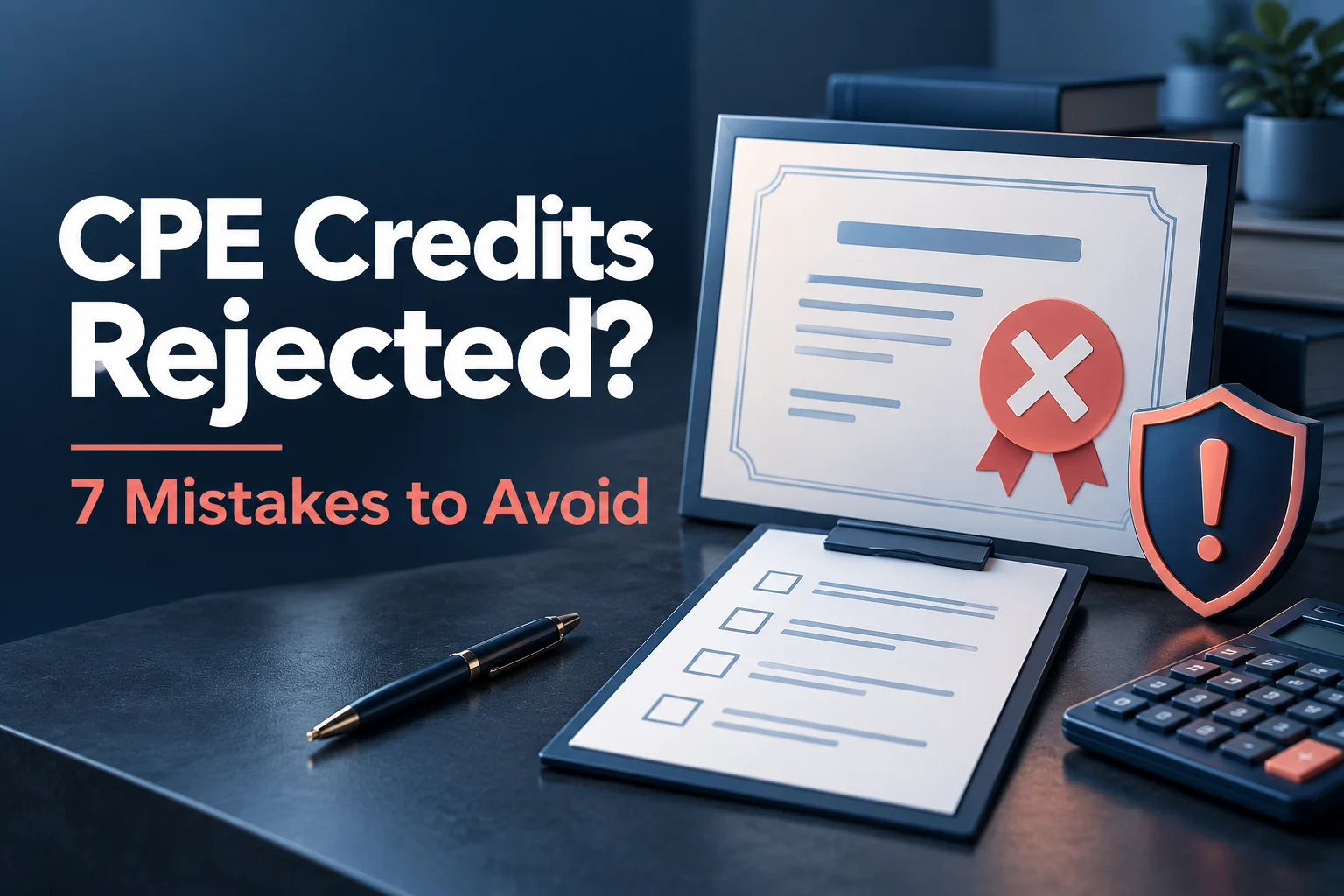
Can Your CPE Credits Be Rejected? 7 Mistakes That Could Put Your CPA License at Risk
Imtiaz Munshi, CPA

Registration Completed

Something Went Wrong!! Please Try Again.

Registration Completed

Please Update Your Profile to Claim Your Continuing Education Credits.

Thank you for subscribing 7 Days Free Trial.
Please upgrade your browser to use MYCPE ONE
Experience MYCPE ONE at its best! Upgrade your browser for a more interactive, user-friendly interface, and stay ahead in your professional development journey.
Upgrade NowHow did you find out about us?
We were looking so hard for you now that you are finally here, So would you tell us how you found out about us?

What is your primary purpose to use MYCPE ONE?

Thank you for submitting your inquiry! We will contact you soon.
CloseOur Promise