©2026 - www.my-cpe.com All rights reserved
support@my-cpe.com7 Days Free Trial
for Enterprise Subscriptions
You have Not Selected the Monthly or Annual Plan

#1 Global Platform for Continuing Education
Create your Free Account | Get Unlimited Access only @$199/Year ( View Details )
Trusted by 250,000+ Professionals for Continuing Education
Create Your Account 1/2
Already have an account? Log In
To Continue using Trial, please verify your email address
Didn’t received verification email? Resend Email
You can cancel anytime during your trial period.
Become a
MYCPE ONE Member
@ $299 $199
33% Discount on Annual Subscription


Complete Access to 12,000+ Hours of Content
Trusted by 250,000+ Professionals
"Steven was knowledgeable and thorough…”
Steven was knowledgeable and thorough in his information about the product and what is offered. He was empathetic to my situation. He went above and beyond answering all of my many questions. Excellent service!

Crystal lovejoy
"Great Customer Service”
Great service and very patient as I asked several questions. Steven answered all my questions and helped me make the right decision in my subscription purchase. Thank you.

Lori corry
"It is what it advertised to be”
It is what it advertised to be. Professional quality training and CPE tracking and certificates; systems knows AZ CPA CPE requirements and categories. I've needed help on several occasions and the assistance was quick and effective; however, there were some problems with data entry. The assistance sometimes asks for input, but when I try to type it is dissallowed for some reason. On several occasions I had to close the popup to get it out of my way.

Brian Carey
"Great customer service”
Great customer service. Classes are pertinent. Great value

Steve

Trusted by 250,000+ Professionals
Trusted by 250,000+ Professionals
"Steven was knowledgeable and thorough…”
Steven was knowledgeable and thorough in his information about the product and what is offered. He was empathetic to my situation. He went above and beyond answering all of my many questions. Excellent service!
Crystal lovejoy
"Great Customer Service”
Great service and very patient as I asked several questions. Steven answered all my questions and helped me make the right decision in my subscription purchase. Thank you.
Lori corry
"It is what it advertised to be”
It is what it advertised to be. Professional quality training and CPE tracking and certificates; systems knows AZ CPA CPE requirements and categories. I've needed help on several occasions and the assistance was quick and effective; however, there were some problems with data entry. The assistance sometimes asks for input, but when I try to type it is dissallowed for some reason. On several occasions I had to close the popup to get it out of my way.
Brian Carey
"Great customer service”
Great customer service. Classes are pertinent. Great value
Steve
Subscribe Now at $199/ 12 Months
Topic of Interest
Select the topics of your interest to receive Webinars/Virtual Events/E-Books/Podcasts of your interest.
Selected Topics
Important: Course Deactivation Alert
Below mentioned Courses will be deactivated soon due to outdated content. Complete the course within the next 7 days to receive credits. After Expiry date, the course will be unavailable for credit. For assistance or inquiries, please contact our support team at support@my-cpe.com.
Course Name
Thank You.
This guide breaks down CPA CPE requirements state-by-state so licensed CPAs can stay compliant without confusion. It explains how CPA CPE Requirements by state vary across jurisdictions, including required credit hours, ethics mandates, reporting cycles, and state board exceptions.
The blog addresses the common challenge of interpreting complex rules by providing clear comparisons and practical insights that help CPAs plan CPE efficiently, avoid compliance issues, and renew licenses on time with confidence.
Meeting CPE requirements isn’t just a regulatory checkbox; it’s essential for staying licensed, relevant, and trusted. With over 650,000 licensed CPAs in the U.S. and state boards enforcing different renewal cycles, it’s easy to miss key updates.
This comprehensive guide will take you on a journey to easily understand all the CPA CPE requirements by State and how to ensure proper completion of the same in a less burdensome manner.
So, let's discuss step-by-step about the CPA CPE requirements by State:
The CPA CPE requirements provided by NASBA require a CPA to ensure effective completion of certain CPE credits (varying from state to state) each year in which CPE credits can only be obtained by attending a CPE program provided by a NASBA-approved CPE provider.
Additionally, each state board has set its own additional CPA continuing education requirements based on NASBA guidelines.
Here are the Top 10 states with the highest number of registered CPAs and their additional CPE requirements provided by their state boards:
120 hours in each three-year period, with a minimum of 20 hours in each one-year period, click here to know more.
80 hours every two years, with a minimum of 20 hours per year, in which at least 40 hours in technical subjects, with a minimum of 12 hours per year, and at least 2 hours in regulatory review every 6 years, click here to know more.
CPAs can choose either the 24-hour or 40-hour rule each year
40 hours of CPE in any combination of fields of study
At least 4 hours of New York-specific ethics every 3 years
24 hours of CPE in a single field of study
At least 4 hours of New York-specific ethics every 3 years, click here to know more.

120 hours in a rolling three-year period, with a minimum of 20 hours per year, click here to know more.
120 hours every 3 years, with a minimum of 20 hours per year, click here to know more.
120 hours every 3 years, with a minimum of 20 hours per year, click here to know more.
120 hours every 3 years. Click here to know more.
80 hours every 2 years, with a minimum of 20 hours per year, click here to know more.
40 hours/ 2000 CPE minutes every year, click here to know more
80 hours every 2 years, with a minimum of 20 hours per year, click here to know more.
If you are registered in some other state then you can also check for your state board’s CPE requirements.


Source: Trustpilot
In order to complete CPE requirements for CPA one must adhere to only those subjects which are approved by NASBA. These subjects are categorized into technical and non-technical subjects, which are as follows:
Also, acceptable subject areas differ from state to state, but every state Board of Accountancy has determined its own subject area which more or less matches with the subjects provided by NASBA.
The importance of AI, especially in taxation and audit, is not an unknown topic to anyone, be it in the field of accounting or be it in taxation and audit.
Choosing to obtain CPE credits for CPA by opting CPE courses with AI, taxation and A&A gets you an edge over other competitors as it gets you updated with the latest trends and the technologies involved in order to provide the best possible services to the client.
It also increases the effectiveness and efficiency of CPAs as you would be able to spend less time on simple routine tasks and more time on value-adding services, making better use of the professional knowledge and skills that you have.
Advanced certification courses are a series of integrated modules specially designed by a subject matter expert in order to enhance your skill set portfolio and provide you with in-depth knowledge of the latest concepts.
Some of the major benefits of opting for advanced certification courses are as follows:
Before you understand the process of getting CPE credits for CPA, you must become cautious in choosing your CPE provider and make sure they are an authorized CPE provider by NASBA.
Example: MYCPE ONE is an approved CPE provider with registry id: 143597
So, basically, there are various ways of obtaining CPE credits, which are as follows:
Once you obtain your CPE credits, it is also mandatory to maintain a record of the same by keeping it documented for at least five years.
A CPA should keep Certificate of completion which contains the following details:-
Lastly, in this whole process never ever forget to accurately report your CPE credits that you have obtained and all the CPE activity that you have done in lieu of CPA continuing professional education requirements.
Generally, there are two types of subscription plans for CPE courses:
MYCPE ONE offers the most affordable packages and user-friendly CPE plans, making it easier for every CPA to get through their CPE credit process effortlessly.

To calculate the CPE requirements, one must adhere to the current CPE standards. CPE credit is given based on the NASBA word-count formula or pilot testing method. In self-paced courses, normally, an individual obtains 1 credit for a runtime of 50 minutes of an approved CPE course.
So, for example, if you have achieved a runtime of 500 minutes in an approved CPE program then you will be awarded with 10 credits of CPE.
In order to complete CPA CPE requirements in one go an individual may either opt for individual courses or a combination of combined advanced course packages provided by MYCPE ONE.
It is always advisable to go with an annual subscription plan in which MYCPE ONE takes care of all the CPE requirements to be fulfilled annually so as to make the CPE credit attainment way easier than it feels.
These packages involve professional skill development on various topics and learning needs which are aligned with the latest industrial requirements. Additionally, they are also beneficial as these state-specific packages will comply with all the state-specific requirements.
MYCPE ONE provides a CPE credit tracker for each of our users. Once a user enrolls in a subscription plan and finishes their CPE course, they earn their credits, then they would be able to track their earned CPE credits on the tracker. They can also download their certificates which can be kept as evidence for the CPE course completed.
Related Read: What is CPA CPE Credits – Your ultimate guide to CPE credits, course formats, and compliance strategies. A must-read companion to this state-by-state breakdown.
There are different CPE credit requirements by all 55 state boards for CPA. One can check them here: State-wise CPA CPE Requirements.
It is not the same for all states as it differs from state to state. For many states, it is yearly (40 hours) or for some it is biennially (80 hours) and for some states, it is triannually (120 hours).
States like Texas, California, and Illinois require CPAs to complete 120 hours of CPE over 3 years, among the highest nationwide. While the total hours are similar, each state sets different rules for how those hours must be allocated annually and which subjects are mandatory.
Across all 50 states, CPA candidates must complete a bachelor’s degree plus 150 total credit hours of college education. This typically includes advanced courses in accounting and business, though the exact course breakdown may vary slightly by state.
If you haven't met your CPE requirements, contact your state board right away. Several states, including California, allow CPAs to request extensions. You’ll likely need to provide your license number and a brief explanation of the delay.

Imtiaz Munshi, CPA (US), is the CFO at Azstec, LLC and a trusted advisor to high-net-worth entrepreneurs. A seasoned tax planner and a business strategist with his 25 years of experience, he helps businesses grow smarter and stronger. Imtiaz specializes in guiding entrepreneurs and enterprises through complex financial decisions with clarity and confidence. His passion lies in simplifying strategy, optimizing tax outcomes, and driving sustainable growth. Through his work and thought leadership, Imtiaz continues to empower CPAs and business owners to stay ahead in an evolving financial landscape shaped by AI, ESG, and data-driven change.
Table of Contents


AI Liability and Malpractice Exposure for Professionals


Feedback for Growth: SBI, SCARF & Feedforward

AI Finance: Build an AP Fraud Detection Dashboard

Offshore Bookkeeping vs. In-House: What UK Accounting Firms Should Consider
 Christopher Rivera
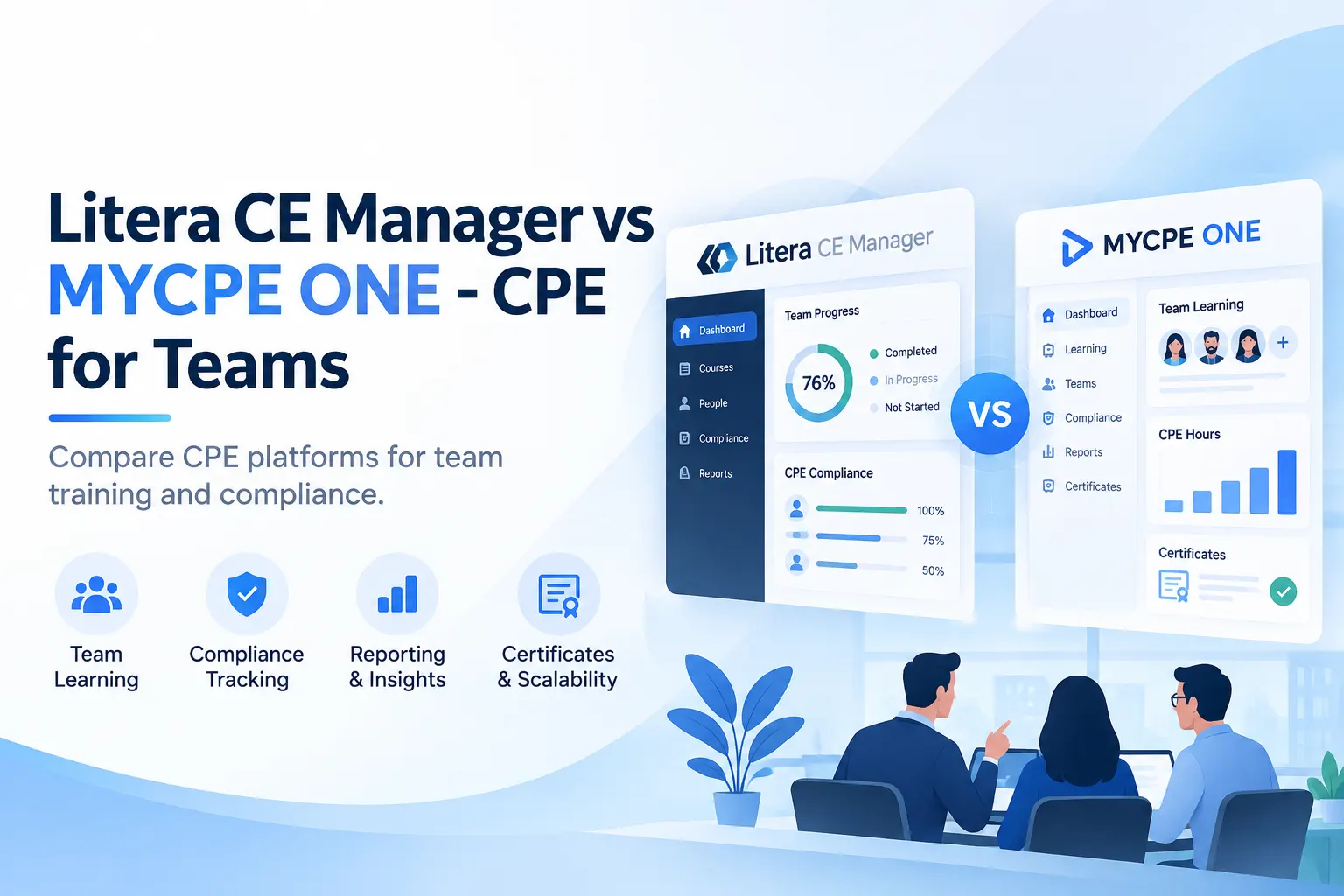
Get personalized course recommendations based on your qualification, state requirements, and subject areas helping you stay 100% CPE compliant.

Registration Completed

Something Went Wrong!! Please Try Again.

Registration Completed

Please Update Your Profile to Claim Your Continuing Education Credits.

Thank you for subscribing 7 Days Free Trial.
Please upgrade your browser to use MYCPE ONE
Experience MYCPE ONE at its best! Upgrade your browser for a more interactive, user-friendly interface, and stay ahead in your professional development journey.
Upgrade NowHow did you find out about us?
We were looking so hard for you now that you are finally here, So would you tell us how you found out about us?

What is your primary purpose to use MYCPE ONE?

Thank you for submitting your inquiry! We will contact you soon.
CloseOur Promise