©2026 - www.my-cpe.com All rights reserved
support@my-cpe.com7 Days Free Trial
for Enterprise Subscriptions
You have Not Selected the Monthly or Annual Plan

#1 Global Platform for Continuing Education
Create your Free Account | Get Unlimited Access only @$199/Year ( View Details )
Trusted by 250,000+ Professionals for Continuing Education
Create Your Account 1/2
Already have an account? Log In
To Continue using Trial, please verify your email address
Didn’t received verification email? Resend Email
You can cancel anytime during your trial period.
Become a
MYCPE ONE Member
@ $299 $199
33% Discount on Annual Subscription


Complete Access to 12,000+ Hours of Content
Trusted by 250,000+ Professionals
"Steven was knowledgeable and thorough…”
Steven was knowledgeable and thorough in his information about the product and what is offered. He was empathetic to my situation. He went above and beyond answering all of my many questions. Excellent service!

Crystal lovejoy
"Great Customer Service”
Great service and very patient as I asked several questions. Steven answered all my questions and helped me make the right decision in my subscription purchase. Thank you.

Lori corry
"It is what it advertised to be”
It is what it advertised to be. Professional quality training and CPE tracking and certificates; systems knows AZ CPA CPE requirements and categories. I've needed help on several occasions and the assistance was quick and effective; however, there were some problems with data entry. The assistance sometimes asks for input, but when I try to type it is dissallowed for some reason. On several occasions I had to close the popup to get it out of my way.

Brian Carey
"Great customer service”
Great customer service. Classes are pertinent. Great value

Steve

Trusted by 250,000+ Professionals
Trusted by 250,000+ Professionals
"Steven was knowledgeable and thorough…”
Steven was knowledgeable and thorough in his information about the product and what is offered. He was empathetic to my situation. He went above and beyond answering all of my many questions. Excellent service!
Crystal lovejoy
"Great Customer Service”
Great service and very patient as I asked several questions. Steven answered all my questions and helped me make the right decision in my subscription purchase. Thank you.
Lori corry
"It is what it advertised to be”
It is what it advertised to be. Professional quality training and CPE tracking and certificates; systems knows AZ CPA CPE requirements and categories. I've needed help on several occasions and the assistance was quick and effective; however, there were some problems with data entry. The assistance sometimes asks for input, but when I try to type it is dissallowed for some reason. On several occasions I had to close the popup to get it out of my way.
Brian Carey
"Great customer service”
Great customer service. Classes are pertinent. Great value
Steve
Subscribe Now at $199/ 12 Months
Topic of Interest
Select the topics of your interest to receive Webinars/Virtual Events/E-Books/Podcasts of your interest.
Selected Topics
Important: Course Deactivation Alert
Below mentioned Courses will be deactivated soon due to outdated content. Complete the course within the next 7 days to receive credits. After Expiry date, the course will be unavailable for credit. For assistance or inquiries, please contact our support team at support@my-cpe.com.
Course Name
Thank You.
Neglecting deadlines and failing to meet the CPE requirement may cost CPAs their licenses. And it is a direct loss of preventing them from working on accounting engagements and creating a direct revenue loss. The rule book, the Yellow Book, has governed the audit profession since 1972. GAO has separated the Government Auditors’ CPE with a more demanding obligation.
Keeping it straightforward: 80 hours of CPE every two years; at least 24 must be government-specific, with a 20-hour annual minimum. But here the real problem starts at the worst possible time of peer review.
Here we will discuss the seven most common CPE compliance challenges government organizations face, along with practical ways to fix them.
The most common but least discussed problem faced by auditors is identifying government-approved CPE. And when the justification is asked by the peers why the course should count toward the government's requirement, you have no good answer. And for this, you need a clear understanding of what counts toward CPE.
The 24 hours of CPE is a combination of three distinct buckets.
CPE Related to the Government Environment: courses on government organizations operate, such as government accounting, budgeting, ethics, procurement, grant management, fraud prevention
CPE Related to Government Auditing Standards: Training directly relevant to the standards applied during your audit work, Government Auditing Standards (GAGAS/Yellow Book), and other audit frameworks qualify.
CPE for Specific or Unique Audited Entity Environments: The course supporting specialized government audit areas, such as HUD programs, school districts, police departments, retirement systems, or nonprofit grant compliance, qualifies for the requirement.
For the course being approved for Government CPE, Content determines eligibility and not the audience.
How to fix it: Pre-classify approved courses into these three categories before auditors register. Choosing the right CPE training for government organizations can also help teams identify relevant courses and manage compliance more effectively. Build a simple internal list or approval workflow, so nobody must guess, and so there's a documented rationale sitting ready if a reviewer asks for one.

Auditors hold the leverage of the exemption in their CPE requirement. But the real problem lies when organizations assume an auditor qualifies for a reduced CPE load without ever documenting the basis for that assumption. The exemption doesn't hold up when questioned.
When are the Auditors eligible for exemptions?
Auditors can avail exemption if:
How to fix it: Review exemption status annually. Auditor's time allotted on GAGAS work shift year to year. So the organization is responsible for documenting the basis for any exemption granted.
Understand CPE compliance structure: Compliances vary by state. New Jersey requires 60 credits in technical subject areas across the three-year period, and CPAs in public practice need 24 of those hours specifically in Accounting and Auditing. Pennsylvania requires all licensees providing attest services to complete 24 credit hours in A&A, plus 52 hours in professional development.
Florida caps behavioral subjects at 20 hours, and Pennsylvania limits individual study to 50 percent. Technical subjects span a wide range — accounting, auditing, business law, economics, finance, information technology, management services, etc. And ethics requirements add another layer on top.
How to fix it: Automatic classification is the only reliable fix. A CPE provider with built-in LMS or an enterprise-level custom system can work. This specifically classifies your state CPE, minimum technical, max cop of non-technical, ethics, and state board-approved course, along with the government-Approved CPE for auditors separately.
State and GAGAS requirements are evaluated independently. Auditors assume a course satisfying their state’s CPA board's CPE requirement; it automatically counts toward Yellow Book CPE too. NASBA certification status of a sponsor has no bearing on Yellow Book eligibility at all.
Sometimes it does. Often it doesn't. When the content is related to government auditing, the environment, or the audited entity's environment, the overlap is acceptable.
How to fix it: Check both boxes separately for every course. Verify the subject against the three government CPE categories. Create a strong, documented answer for peer reviewers as to why the courses should be counted toward your 24-hour government requirement.
State and GAGAS requirements are evaluated independently. Auditors assume a course satisfying their state’s CPA board's CPE requirement; it automatically counts toward Yellow Book CPE too. NASBA certification status of a sponsor has no bearing on Yellow Book eligibility at all.
Sometimes it does. Often it doesn't. When the content is related to government auditing, the environment, or the audited entity's environment, the overlap is acceptable.
How to fix it: Check both boxes separately for every course. Verify the subject against the three government CPE categories. Create a strong, documented answer for peer reviewers as to why the courses should be counted toward your 24-hour government requirement.
Subscribe to MYCPE ONE – Start Your 30-Day Free Trial Today
Build a standardized approach to track and manage CPE. For auditors who join mid-period, transfer their jobs between departments, get hired mid-cycle, or move on to and off GAGAS engagements at different times highly need to strictly follow the approach.
Without a standardized approach, tracking 80 hours is a nightmare. Instead of tracking individual requirements from hiring date, audit organization can build a two year fixed or rolling-year period for entire team. Auditors who join mid-period are required to have prorated CPE numbers for full six-month intervals. for example, works out to 60 total hours (3/4 x 80) and 18 government-specific hours (3/4 x 24).
How to fix it: Standardize the two-year cycle across the entire audit team, regardless of individual start dates. A single change eliminates the tracking confusion that shows up when staff move between roles or departments.
In February 2024, GAO issued a complete revision of the Government Auditing Standards. It is a challenge for organizations to ensure what's changing, when, and how it will impact their existing CPE program.
The core CPE requirements remain the same. What's changing is the quality management framework, monitoring competence, compliance tracking, and documentation system.
Note: As of January 1, 2025, taxation was removed from the GAO's list of qualified government CPE subject areas.
How to fix it: Build a buffer into your planning now, particularly around the System of Quality Management deadlines in December 2025 and 2026. Update your approved course list. Confirm your documentation system to support a formal quality management framework.

Each of these issues can put professional licenses at risk. Fortunately, the challenges are not difficult to solve, and even small practices can make a meaningful difference.
Pre-classify courses before auditors register and document why each activity qualifies for Government CPE. Review exemptions annually instead of assuming prior rules still apply, and prepare early for the shift toward quality management standards.
Manual tracking cannot keep pace with complex CPE requirements. Choose an LMS that closes the gap between basic course administration and true compliance management. With MYCPE ONE, firms can simplify tracking, reduce administrative work, and keep professionals credentialed and compliant. Start your 30-day free trial today.
Audit organizations may grant up to two months to make up your CPE shortfall. After this window, non-compliant auditors can't work on GAGAS engagements until they're compliant. Note: Hours obtained during that window count toward the deficiency only and not toward the next cycle.
No. Each two-year cycle is self-contained. Extra hours earned in one period don't reduce the requirement in the next — every cycle starts at zero.
No. The Yellow Book doesn't mandate a separate ethics course as some state boards do. Ethics tied to government auditing or professional conduct in a government context will be counted.
Yes. Serving as a speaker, instructor, developing a course, and publishing professional articles or books earn CPE credit. Published writing credit is capped at 20 hours per two-year period.
Roughly every three years. Reviewers specifically check whether an auditor's CPE hours line up with their actual assignments. So, documented course classifications matter more than just completing CPE hour.

Imtiaz Munshi, CPA (US), is the CFO at Azstec, LLC and a trusted advisor to high-net-worth entrepreneurs. A seasoned tax planner and a business strategist with his 25 years of experience, he helps businesses grow smarter and stronger. Imtiaz specializes in guiding entrepreneurs and enterprises through complex financial decisions with clarity and confidence. His passion lies in simplifying strategy, optimizing tax outcomes, and driving sustainable growth. Through his work and thought leadership, Imtiaz continues to empower CPAs and business owners to stay ahead in an evolving financial landscape shaped by AI, ESG, and data-driven change.


Compensation & Incentive Plans: Design, Cost & Governance



Succession Planning for Family Business & Wealth Transfer


Agentic AI in Audit and Assurance

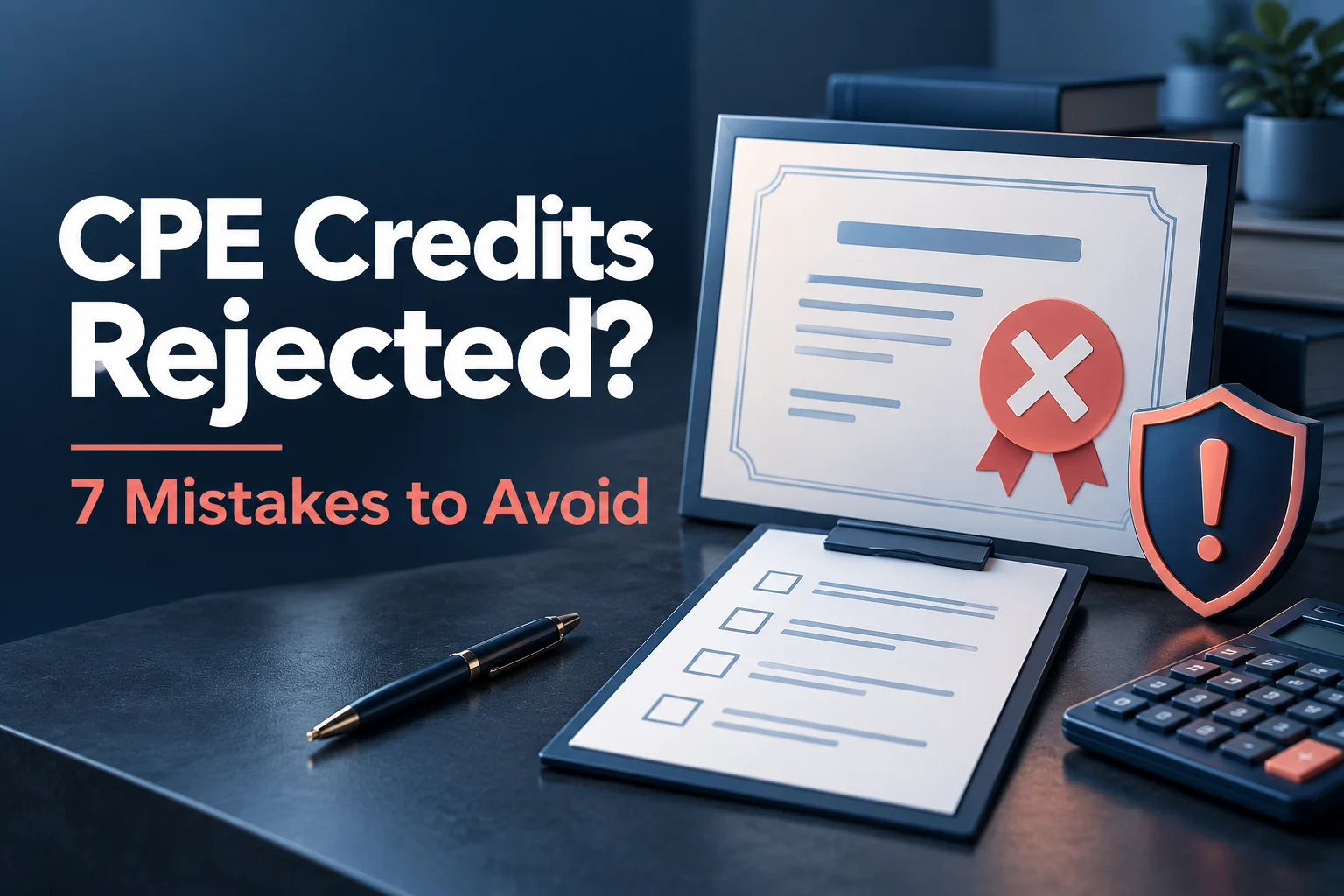
Can Your CPE Credits Be Rejected? 7 Mistakes That Could Put Your CPA License at Risk
Imtiaz Munshi, CPA

Registration Completed

Something Went Wrong!! Please Try Again.

Registration Completed

Please Update Your Profile to Claim Your Continuing Education Credits.

Thank you for subscribing 7 Days Free Trial.
Please upgrade your browser to use MYCPE ONE
Experience MYCPE ONE at its best! Upgrade your browser for a more interactive, user-friendly interface, and stay ahead in your professional development journey.
Upgrade NowHow did you find out about us?
We were looking so hard for you now that you are finally here, So would you tell us how you found out about us?

What is your primary purpose to use MYCPE ONE?

Thank you for submitting your inquiry! We will contact you soon.
CloseOur Promise