

Scale your CPA & accounting firm with elite offshore talent trusted by 1,000+ firms.
Thank you for your interest. Our due diligence checklist will be shared with you within 48 hours.

The benefits of endpoint security have never been more critical, especially given that the global cybersecurity skill gap is estimated to be a staggering 4.8 million professionals. Coupled with the rise of remote work and BYOD policies, businesses face an expanding attack surface that's difficult to defend with limited internal resources. In particular, 51% of all security alerts occur outside normal business hours, precisely when in-house teams are least available.
Managed endpoint security services offer a compelling solution to this challenge. We've seen 84% of organizations now leveraging next-generation endpoint security tools to stay protected. In this guide, we'll explore why managed services deliver superior protection, cost-effectiveness, and peace of mind compared to traditional in-house approaches.
Managed endpoint security services deliver critical protection for businesses facing an expanding threat landscape, where 70% of breaches originate from endpoints and cyberattacks occur every 39 seconds.
Essential insights for protecting your business:
With remote work expanding the attack surface and ransomware accounting for 20% of cyberattacks, managed endpoint security services provide the expertise, tools, and continuous monitoring necessary to protect your business data, maintain operations, and ensure regulatory compliance without the overhead of building internal security teams.
"Ponemon Institute research shows that 68% of organizations have experienced at least one endpoint attack that successfully compromised their data or IT infrastructure." — Ponemon Institute, Research organization focused on privacy, data protection, and security
Endpoint security protects devices like laptops, desktops, mobile phones, and servers that connect to your network from cyber threats. With hackers launching attacks every 39 seconds and 70% of breaches originating from endpoints, securing these entry points has become essential.
Remote work and BYOD policies have expanded the attack surface, making every device a potential vulnerability. The average data breach costs USD 4.45 million, with lost business comprising 40% of that cost. Managed endpoint security services provide the monitoring and expertise needed to defend these critical access points.
Endpoint security refers to protecting devices that connect to your network from malicious threats and cyberattacks. These endpoints include desktops, laptops, mobile devices, servers, and IoT devices like printers. Each device acts as a gateway to your systems and data, creating potential entry points for cybercriminals.
The process involves monitoring, managing, and securing these connection points to ensure they meet security standards before and after connecting to your network.
Endpoint protection solutions detect and prevent threats like malware, ransomware, and phishing attempts that could compromise sensitive information. For accounting firms handling tax returns, client financial data, and payroll information, securing these endpoints prevents unauthorized access to confidential records.

Cybercriminals launch attacks every 39 seconds, totalling 2,244 attacks daily. Endpoints have become prime targets, with 70% of successful security breaches originating from these devices. The shift to remote and hybrid work has amplified this risk significantly. Specifically, 12.7% of U.S. workers now work remotely, with 28.2% adopting hybrid schedules.
The number of connected devices continues to grow at an alarming rate. There were 22 billion connected devices in 2018, projected to reach 38.6 billion by 2025 and 50 billion by 2030. Verizon's threat report found that 30% of data breaches involved malware installed on endpoints.
BYOD policies and remote access have created additional vulnerabilities. Employees connect from home offices, airports, and personal devices, making traditional network perimeter security insufficient. Human error compounds these risks, with 95% of cybersecurity breaches resulting from unintentional employee actions.
The financial impact of endpoint breaches extends far beyond immediate technical damage. The average data breach costs USD 4.45 million, a 15% increase over three years. Lost business makes up almost 40% of this average cost. In the United States alone, cybercrime costs businesses over USD 6.9 billion annually.
For small and medium businesses, the average recovery cost from a single security incident is USD 86,500. Enterprises face even steeper losses at USD 861,000 per incident. The most expensive attack types involve zero-day vulnerabilities and targeted attacks, costing SMBs USD 149,000 and enterprises USD 2 million.
Detection speed directly impacts costs. Even when breaches are detected almost instantly, SMBs face USD 28,000 in damages. If undetected for more than a week, costs rise to USD 105,000 for SMBs and over USD 1 million for enterprises. Hence, 60% of small businesses experiencing cyberattacks go out of business within six months.
The benefits of endpoint security extend across multiple operational areas for accounting firms. Protection against malware and ransomware prevents costly attacks, while centralized visibility enables IT teams to monitor all devices from one console.
Data breach prevention safeguards client financial records through encryption and access controls. Centralized management simplifies policy enforcement across remote workforces. Organizations using automated endpoint security reduce incident response costs significantly. Remote work support ensures CPAs access tax software and client portals securely from any location.

Endpoint security solutions use signature-based detection combined with behavioral analysis and machine learning to identify both known and unknown threats. Advanced threat protection analyzes unusual patterns to detect zero-day exploits and sophisticated ransomware before damage occurs.
Ransomware accounts for 20% of cyberattacks, with average recovery costs reaching USD 2.73 million in 2024. For accounting firms handling tax returns during busy season, ransomware can encrypt client files and halt operations. Automated ransomware rollback capabilities revert encrypted files to their original state.
Comprehensive monitoring tracks endpoint activity across all devices, identifying potential threats and anomalies. Centralized management oversees endpoints from a single dashboard, simplifying security policy administration and ensuring consistent enforcement.
Real-time alerts notify administrators immediately when suspicious activities occur, enabling quick responses. Integration with firewalls, intrusion detection systems, and SIEM platforms creates a cohesive security strategy.
AI-enabled analytics help security teams quickly identify unknown endpoints and provide detailed visibility into device behavior.
Data encryption protects sensitive information at rest and in transit. Data loss prevention tools monitor, detect, and block unauthorized data transfers, ensuring client financial data remains within organizational control.
Multi-factor authentication and granular access controls ensure only authorized personnel access sensitive systems. Endpoint detection and response capabilities provide continuous monitoring to detect and respond to security incidents in real-time. By securing endpoints and controlling data access, firms minimize breach risks that could expose client tax documents or financial statements.
IT administrators oversee and control all endpoints from a single console. This approach streamlines deploying security policies, managing software updates, and enforcing compliance across organizational devices.
Simplified reporting features consolidate data from various endpoints into comprehensible reports. These reports offer insights into security incidents, compliance status, and overall system health. Centralized logging provides unified visibility for audit trails, threat correlation, and regulatory compliance documentation.
Automated threat detection and response processes significantly decrease resolution time. Organizations prevent financial losses associated with remediation, legal fees, regulatory fines, and reputational damage by stopping breaches.
Organizations investing in security automation incurred USD 2.20 million less in breach costs compared to those without proper endpoint oversight. Automated patch management reduces vulnerability exploitation risks while eliminating human error. Payback periods for endpoint management solutions can occur in under six months.
Effective endpoint security prevents cyber threats that disrupt business operations. By minimizing downtime, organizations maintain secure environments where employees focus on tasks rather than damage control.
Modern solutions feature intuitive interfaces requiring minimal user intervention, reducing friction associated with security measures. Endpoint security provides necessary protections for devices used outside traditional office setups. Solutions ensure secure access to corporate resources while maintaining data integrity, supporting flexible workforces.
Over 50% of employees use personal devices to access corporate applications during remote working.
"More than half of organizations that suffered a data breach in 2024 were grappling with a cybersecurity skills shortage." — IBM, Provider of cybersecurity insights and reports
Managed endpoint security services deliver superior protection compared to in-house solutions through continuous monitoring, expert teams, and predictable costs. For most mid-market organizations, managed services cost 25-40% of building an internal SOC. With the cybersecurity skill gap at 4.8 million unfilled positions globally, accessing specialized expertise becomes critical.
Managed providers offer 24/7 coverage when 51% of alerts occur outside business hours, automated patch management, and compliance support for HIPAA and PCI DSS requirements that accounting firms must meet.
Managed endpoint security services provide continuous monitoring with specialized analysts responding immediately to suspicious events.
For most mid-market organizations with 200 to 2,000 employees, a managed provider delivers equivalent or better coverage at 25 to 40 percent of the cost of a fully staffed in-house SOC. Annual costs run $100,000 to $800,000 depending on service depth and endpoint count.
Building an internal SOC requires significant investment in technology stack, headcount, threat intelligence feeds, and training. The global cybersecurity workforce gap sits at 4.8 million unfilled positions. Managed providers bring detection content mapped to the MITRE ATT&CK framework and tuned against real threat actor behavior across hundreds of client environments.
Managed services roll all costs into predictable monthly fees that grow with endpoint count. Providers handle automated patch cycles and maintain secure configurations. Organizations using security AI and automation identified and contained breaches an average of 98 days faster than those without.
Managed services isolate infected devices and kill malicious processes quickly with dedicated staff. An industry-leading 8 minute mean time to remediate minimizes business impact. Against advanced threats like ransomware that can encrypt entire networks in hours, this speed is critical.
Healthcare and finance sectors must adhere to strict frameworks such as HIPAA, PCI DSS, and GDPR. Providers systematically track relevant logs, align configurations to compliance baselines, and help produce documentation. Some providers offer compliance dashboards or standard reports.
Selecting the right managed endpoint security provider requires evaluating multiple factors beyond price. Check provider reputation through customer reviews on platforms like Gartner Peer Insights and verify certifications including SOC 2 and ISO 27001.
Assess service offerings such as API integrations with your tax software and response time SLAs. Verify scalability for growing CPA firms and cloud-based capabilities supporting remote staff. Most importantly, confirm compliance framework expertise in HIPAA, PCI-DSS, and SOX standards that accounting practices must meet.
Customer reviews from PeerSpot or Gartner Peer Insights reveal real user experiences with endpoint security companies. Providers recognized through industry awards and analyst rankings demonstrate validated capabilities. Request proof of third-party validation such as MITRE ATT&CK evaluations or AV-Test results, which reveal real-world performance under simulated attacks.
Essential certifications include ISO/IEC 27001, SOC 2 compliance, GDPR compliance, CCPA compliance, and adherence to NIST Cybersecurity Framework and FIPS 140-2/FIPS 140-3 standards.
Inquire whether the solution offers native API integrations with your current SIEM, ticketing system, and identity provider. Ask about response time SLAs, especially for critical threat incidents and patching delays. Understand their detection models and whether the platform uses static signatures, machine learning, or behavioral analytics.
Choose tools with cross-platform coverage for Windows, macOS, Linux, and mobile devices. Assess whether you require multi-tenant support, essential for MSPs and global operations.
Managed security providers should demonstrate thorough understanding of PCI DSS, HIPAA, FISMA, and SOX. Providers with multi-framework expertise help organizations map overlapping controls across HIPAA, CMMC, PCI-DSS, SOX, and FedRAMP requirements.

The benefits of endpoint security through managed services offer accounting firms the protection they need without the cost of building an in-house SOC. With cyberattacks targeting endpoints every 39 seconds and the cybersecurity skill gap at 4.8 million professionals, we believe managed providers deliver superior 24/7 coverage at a fraction of the cost.
Before choosing a provider, verify their compliance expertise in HIPAA, PCI-DSS, and SOX frameworks. Likewise, ensure they offer automated patch management and rapid incident response to protect your client data and maintain your firm's reputation.
Yes, endpoint protection is essential for businesses of all sizes. With cyberattacks occurring every 39 seconds and 70% of successful security breaches originating from endpoints, protecting devices that connect to your network is critical.
The average data breach costs USD 4.45 million, and 60% of small businesses experiencing cyberattacks go out of business within six months. Endpoint security safeguards laptops, desktops, mobile devices, and servers from malware, ransomware, and unauthorized access to sensitive data.
The three primary types of endpoint security are: signature-based detection (which identifies known threats using malware databases), behavioral analysis (which monitors unusual patterns to detect zero-day exploits and sophisticated attacks), and machine learning-based protection (which uses AI to identify both known and unknown threats).
Modern solutions often combine all three approaches to provide comprehensive protection against evolving cyber threats.
Endpoint protection services monitor, manage, and secure devices that connect to your network. They detect and prevent threats like malware, ransomware, and phishing attempts through continuous monitoring and real-time threat detection.
The service provides centralized management from a single dashboard, automated patch updates, data encryption, and access controls. When suspicious activity is detected, the system sends immediate alerts and can isolate infected devices to prevent spread across the network.
EDR (Endpoint Detection and Response) security offers continuous monitoring to detect threats in real-time, faster incident response with automated threat isolation, and detailed visibility into device behavior across your network.
Organizations using EDR with security automation identify and contain breaches an average of 98 days faster than those without. EDR also reduces incident response costs significantly, with some providers achieving an 8-minute mean time to remediate threats, minimizing business disruption.
Managed endpoint security services provide 24/7 monitoring and expert teams at 25-40% of the cost of building an internal Security Operations Center.
With the global cybersecurity skill gap at 4.8 million unfilled positions, managed providers offer immediate access to specialized expertise and advanced tools. They deliver automated patch management, faster incident response, compliance support for frameworks like HIPAA and PCI-DSS, and predictable monthly costs that scale with your business needs.

Blaise Wabo is a cybersecurity and compliance expert with 12+ years of experience helping organizations meet security and regulatory requirements. As the Healthcare and Financial Services Lead at A-LIGN, he advises businesses on SOC, HIPAA, and HITRUST compliance. Since 2013, he has led more than 500 SOC reviews and 300 HITRUST/HIPAA assessments for Fortune 500 and growing companies. Blaise is recognized for simplifying complex compliance challenges into practical, scalable security solutions.
AI in Cybersecurity: What It Means for Small and Midsized Businesses in 2026
Blaise Wabo
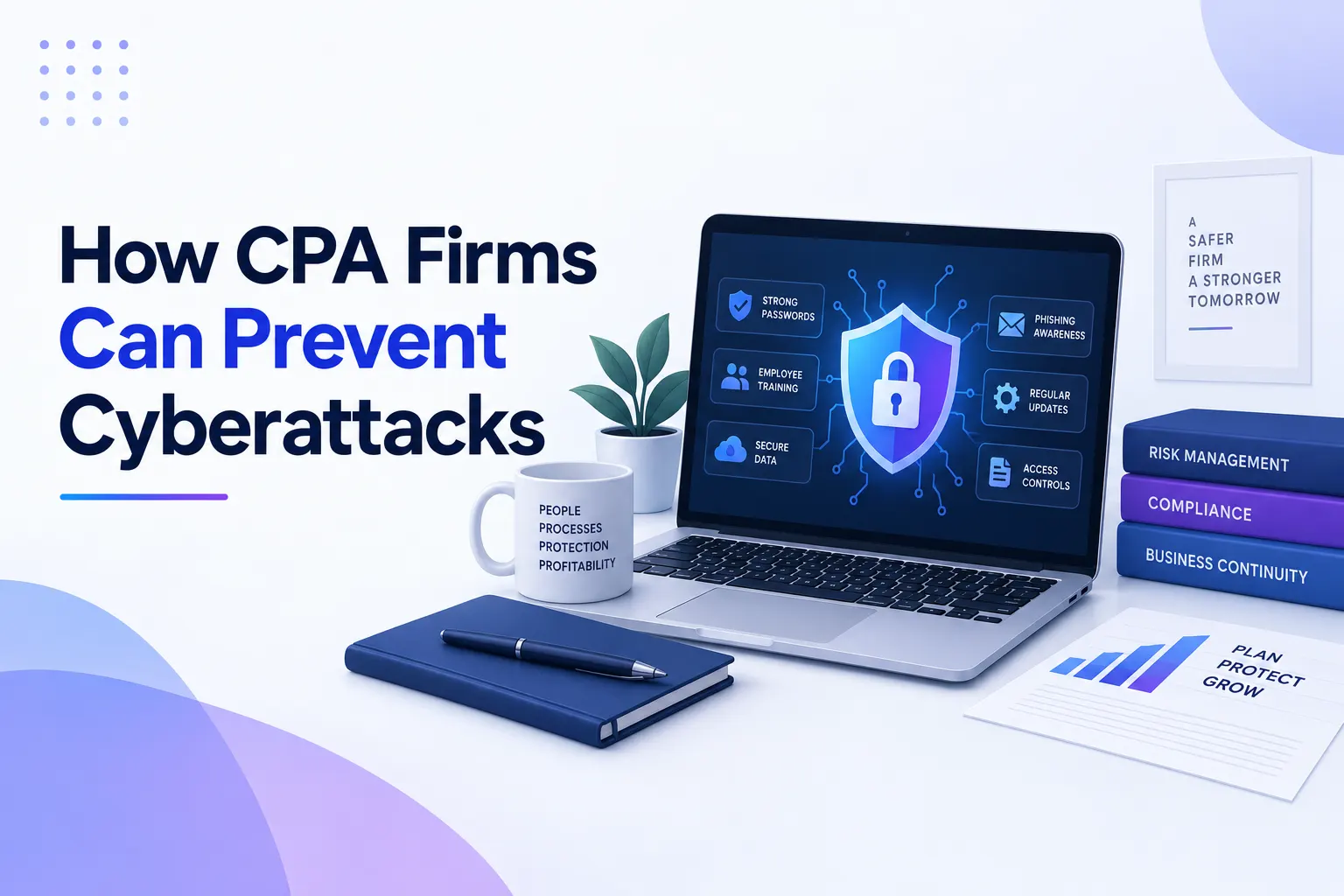
How Can CPA and Accounting Firms Prevent Data Breaches and Cyberattacks?
Blaise Wabo

Cybersecurity Requirements for Tax Preparers and Accounting Firms in 2026
Blaise Wabo





