Scale your CPA & accounting firm with elite offshore talent trusted by 1,000+ firms.
Thank you for your interest. Our due diligence checklist will be shared with you within 48 hours.

Building a hybrid onshore-offshore accounting team in Canada is no longer just a cost-cutting play; it’s a strategic model reshaping how CPA firms scale in 2026. This blog explains what the hybrid staffing model looks like, why Canadian firms are adopting it, how to structure roles between onshore and offshore, and what common mistakes to avoid. Whether you run a 5-person practice or a 50-person firm, this guide gives you a clear, practical framework to start.
The old model is cracking.
Canadian CPA firms are stretched thin. Senior talent is hard to find. Salaries keep climbing. And clients expect more - faster turnaround, broader services, competitive fees. The traditional “hire locally and hope for the best” approach isn’t scaling the way it used to.
That’s where the hybrid onshore-offshore accounting team model comes in.
In simple terms: your onshore team handles the high-trust, client-facing work. Your offshore team handles the execution, processing, and production work. Together, they function as one unit - not two separate silos.
Think of it like a relay race. The baton doesn’t stay with one runner the entire time. Each runner does what they’re best at, and the team wins together.
In 2026, this isn’t an experiment anymore. It’s how smart Canadian accounting firms are already using offshore staff to build competitive advantage.
The numbers are hard to argue with.
Hiring a senior accountant in Toronto or Vancouver can cost anywhere from $75,000 to $110,000 CAD annually, plus benefits, overhead, and onboarding time. An equally qualified offshore professional - in India, the Philippines, or Eastern Europe - often costs 40–70% less, with no sacrifice in technical skill.
But cost isn’t the only driver. Here’s what’s really pushing Canadian firms toward this model:
The signal is clear. The noise is just hesitation.

This is where most firms get it wrong.
They either try to offshore everything (and lose client trust) or keep everything onshore (and lose margin). The right answer is a clear division of labour based on function, not fear.
What works best onshore:
What works best offshore:
As CPAs who’ve seen this model in action, the rule of thumb is simple: if the task requires judgment, relationship, or legal accountability - keep it onshore. If it requires accuracy, process, and time - offshore it.
This isn’t about trust. It’s about leverage.
Most firms overthink this. It’s more straightforward than it seems.

Here’s a practical framework:
Patience is the skill most firms skip.
The firms that struggle with offshore staffing usually make the same mistakes. They hire without SOPs, expect immediate results, and blame the model when the real problem was the setup.
Here are the patterns to avoid:
Like Moneyball taught us, the advantage isn’t in spending more. It’s in building smarter systems with the talent others undervalue.
Here’s a practical model that’s working in 2026:
| Role | Location | Function |
|---|---|---|
| Managing Partner / Senior CPA | Onshore (Canada) | Client advisory, sign-off, strategy |
| Tax Manager | Onshore (Canada) | Tax planning, complex returns review |
| Client Services Coordinator | Onshore (Canada) | Client communication, onboarding |
| Senior Accountant (Offshore) | India / Philippines | T2 prep, financial statements, review |
| Bookkeeper (Offshore) | India / Philippines | Monthly bookkeeping, reconciliations |
| Payroll Specialist (Offshore) | India / Philippines | Payroll processing, ROE, T4 filings |
A 3-person onshore team supported by 3 offshore professionals can realistically handle the workload of a 6–8 person fully onshore team, at 30–40% lower total labour cost. If you’re evaluating India as your offshore destination, we’ve also put together a list of the top Canadian offshore accounting firms operating in India in 2026.
That’s not a minor efficiency gain. That’s a structural advantage.
The firms winning in 2026 aren’t the ones with the biggest offices or the most local hires. They’re the ones that figured out how to build lean, scalable, hybrid onshore-offshore accounting teams in Canada that can deliver more without burning people out.
It takes some setup. It takes patience. But the compounding effect of a well-run hybrid team - lower costs, faster delivery, better service- adds up faster than most Canadian CPAs expect. For a deeper look at what that return actually looks like, read our guide on how Canadian accounting firms can achieve better ROI through outsourcing.
The marathon runners always beat the sprinters over distance.
Finding the right offshore talent is one of the most consequential decisions a Canadian CPA firm will make in the next few years, especially as the industry demands professionals who are technically strong, AI-savvy, and familiar with Canadian compliance requirements.
At MYCPE ONE, we help CPA firms, accounting firms, and enterprises across Canada build high-quality offshore teams across accounting, tax, audit, and advisory functions. If you’d like to explore more, feel free to schedule a no-obligation call here.
Yes. There is no Canadian legislation that prohibits CPA firms from using offshore staff for bookkeeping, tax preparation, or financial reporting work. The signing CPA, who remains onshore and licensed in Canada, retains professional responsibility and final sign-off authority. Firms must, however, ensure client data is handled in compliance with PIPEDA (Canada’s federal privacy law) and provincial privacy regulations. Contracts with offshore staffing partners should include data security clauses and confidentiality agreements. Many firms already operate this way successfully under the CPA Ontario and CPA BC frameworks.
Time zone gaps are manageable with structured workflows. India (IST) is 9.5–10.5 hours ahead of Canada’s eastern time, which actually creates a natural overnight processing cycle - files assigned at the end of the day in Canada are ready the next morning. The Philippines (PHT) follows a similar offset. Most firms establish a 1–2 hour overlap window in the early morning (Canada) or evening (offshore) for live check-ins. Project management tools like Karbon, Asana, or ClickUp make async collaboration clean and trackable without requiring real-time availability.
A strong onshore offshore CPA firm strategy starts with one clear principle: offshore what you can document, onshore what requires judgment.
In practice, this means your Canadian CPAs focus on advisory, client relationships, planning conversations, and sign-offs - the work that demands trust and accountability. Your offshore team handles the production layer: bookkeeping, reconciliations, tax prep, payroll, and AP/AR.
The strategy works best when both teams operate inside the same workflow tools, share the same quality standards, and are reviewed on the same performance metrics. Treat it as one integrated team, not two separate vendors, and the results compound over time.
Building an offshore team for a Canadian accounting firm in 2026 typically follows a phased approach. Most firms start by identifying 3–5 high-volume, repeatable tasks -bookkeeping and T1 prep are the most common entry points.
They then document those workflows as SOPs, define the role clearly (tools, output expectations, volume), and hire one offshore professional through either a managed staffing platform or direct hire. The first 90 days function as a structured pilot. Once quality and communication benchmarks are met, firms scale the model to additional roles.
The key shift in 2026 is that this process is faster and lower-risk than it was even two years ago, thanks to better vetting platforms, cloud-native tools, and a larger pool of Canada-trained offshore candidates.
The most widely adopted offshore staffing model for Canadian firms in 2026 is the managed staffing model = where a specialist platform sources, vets, and onboards offshore professionals on your behalf, while you retain day-to-day management. This sits between the full outsourcing model (where an agency owns the workflow) and the direct hire model (where you recruit independently offshore).
For most Canadian firms under 50 staff, managed staffing offers the best balance: lower upfront risk, faster ramp-up, and pre-screened candidates familiar with Canadian compliance requirements. Larger firms with established processes sometimes shift to direct offshore hiring or build a captive offshore entity for greater control and long-term cost efficiency.

Nemin Vora, a CA and Tax Attorney, leads Client Relations at MYCPE ONE. With 7+ years of experience at Big 4 and top public accounting firms across America, he helps U.S. firms scale globally through remote talent, offshoring, and cloud operations. Known for his sharp tax insights and practical approach to firm growth, Nemin is a dynamic speaker. He breaks down complex topics such as leadership, AI, global staffing, and practice expansion into relatable lessons that professionals actually enjoy learning. Beyond the strategy decks, Nemin is a learner at heart, a stage actor, and a tech enthusiast.


How to Scale CAAS (Client Accounting & Advisory Service) + VCFO with Offshoring!


How To Scale CFO And Advisory Services With Offshoring

Bursting myths around Offshoring for an Accounting firm


Best Offshore Staffing Companies for CPA Firms in the Philippines (2026)
 Christopher Rivera
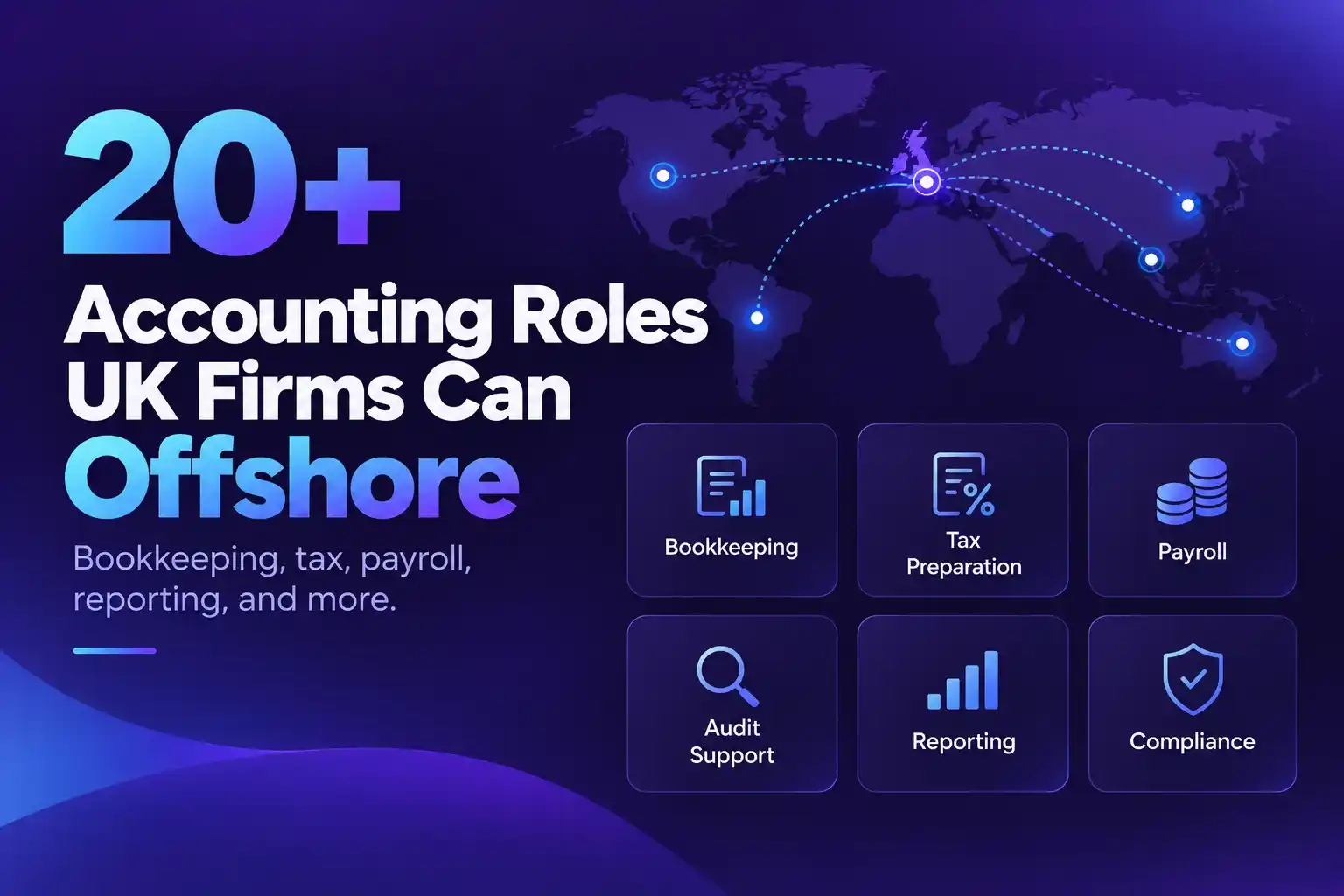
What Accounting Work Can UK Firms Offshore? 20+ Roles & Functions
 Amrit Singh