
Scale your CPA & accounting firm with elite offshore talent trusted by 1,000+ firms.
Thank you for your interest. Our due diligence checklist will be shared with you within 48 hours.

Unplanned IT downtime costs small businesses over $10,000 per hour. For accounting firms managing sensitive client data through tax season and audit deadlines, that number hits differently.
Technology challenges multiply as firms grow. Server failures, cybersecurity threats, compliance requirements, and unpredictable repair bills create bottlenecks that slow growth and pull your team's focus away from client work.
Managed IT services for accounting firms fix this. A qualified IT partner replaces reactive break-fix expenses with proactive monitoring, enterprise-grade security, and predictable monthly costs.
This guide covers how managed IT support services work for accounting firms, why scaling CPA practices need them, and how to choose the right provider. You'll get core service breakdowns, implementation steps, and the technology considerations that help accounting professionals grow without operational disruptions.
Managed IT services convert unpredictable technology costs into stable monthly expenses and deliver enterprise-grade security and compliance support built for accounting firms.
Transitioning to managed IT services requires a structured approach from infrastructure assessment through staff training. The payoff is predictable costs, reduced security risk, and technology that grows with your firm.
"Your firm needs more than a generic IT vendor. It requires a managed IT services provider that understands the language of audits, deadlines, and data integrity." — Tech Advisors, Managed IT services provider specializing in CPA firms
Managed IT services for accounting firms hand off the day-to-day management of your technology infrastructure to specialized providers who understand CPA practice demands. Generic IT support does not cut it here. These services address the specific challenges accounting professionals face: protecting sensitive financial data, maintaining compliance with regulations like GDPR and FINRA, supporting specialized software such as QuickBooks, CCH, and Drake Tax, and keeping systems operational during tax season and audit deadlines.
Managed IT support services for accounting firms bundle several capabilities into one partnership:
| Factor | Managed IT | In-House IT |
|---|---|---|
| Cost structure | Fixed monthly fee | Salaries, benefits, training |
| Coverage | 24/7, no gaps | Vacation and illness gaps |
| Expertise range | Security, compliance, cloud, software | Limited to staff skill sets |
| Scalability | Scales with firm growth | Requires additional hires |
Small and mid-sized CPA firms get access to a broader range of expertise at a lower, more predictable cost than building an internal IT department. Managed providers deliver enterprise-level capabilities through monthly subscriptions. Emergency repair expenses disappear. Technology costs convert into stable operational expenses. You gain immediate access to specialists across security, compliance, cloud infrastructure, and accounting software — without the overhead of full-time employees.
Break-fix support is reactive by design. Problems get addressed only after they disrupt operations. That approach is costly for any firm, and it is particularly damaging for CPA practices during peak periods.
Managed IT services take the opposite approach. Real-time monitoring detects performance degradation and security threats before downtime occurs. Regular security updates, preventive maintenance, and performance optimization run continuously. Your firm stays operational when it matters most.

Managed service providers deliver ongoing oversight through remote monitoring tools that track system health, security events, and performance metrics. On-demand support handles technical issues as they arise — many providers target 70% of calls answered within one minute.
Identity and access management controls who can reach sensitive client data. Information protection services encrypt documents and flag data types like bank account numbers automatically.
Flexible work is now standard in accounting. 56% of CPA firms report that flexible schedules helped attract employees. Managed IT supports this directly — secure VPNs, encrypted file sharing, and cloud collaboration tools keep distributed teams productive without putting client data at risk.

Dated technology creates real operational barriers for growing accounting firms. Systems too slow to sync or process data accurately delay audit workflows and introduce record errors. When QuickBooks, UltraTax, Office 365, practice management platforms, and CRMs conflict during updates, vulnerabilities open across your entire stack. Old servers fail. Fragmented support channels leave your team without answers during tax season — exactly when you can least afford it.
Firms running in-house IT consistently exceed their technology budgets. Managed IT services eliminate that problem. A flat monthly fee replaces emergency repair invoices, unplanned hardware costs, and reactive spending. IT becomes a fixed operational expense — not a financial surprise.
Professional services firms, including accounting practices, rank among the top five most targeted industries. The average breach now costs $5.90 million. 91% of accounting firms faced at least one cyberattack attempt in the past year.
Managed IT providers address this directly. Multi-layered protection through endpoint detection, encryption, and secure firewalls delivers enterprise-grade security without the cost of building an internal security team.
Tax season deadlines leave no margin for system failures. Managed service providers keep operations running through:
Critical filing periods and quarter-end reporting stay on track — even when technical issues arise.
Virtual CIO services give accounting firms access to executive-level IT strategy without the executive-level salary. Technology roadmaps, budget planning, and upgrade cycles get managed proactively. Firms plan ahead rather than react.
Secure access from any location requires more than a basic VPN. Cloud desktops, zero-trust access policies, and encrypted communication tools give distributed teams what they need to work without exposing sensitive client data. Managed providers handle cloud migrations end to end — planning, data transfer, and on-demand scalability included.
Selecting a managed IT provider isn't a price comparison exercise. The right partner understands how CPA firms operate, how accounting software integrates, and how compliance requirements shape daily workflows. Get this decision wrong, and you're back to reactive IT support with a monthly invoice attached.
Push potential providers on specifics. Ask about:
Vague answers to these questions signal a generalist provider dressed up as a specialist.
Providers who specialize in accounting firms understand the software stack, compliance demands, and seasonal pressure points that generalists simply don't. Look for demonstrated experience with:
A provider who claims they "work with all industries" is a red flag. Accounting firms have specific requirements. Your MSP should know them without being briefed.
Read SLAs carefully. Guaranteed response times and clear escalation procedures aren't optional—they're baseline requirements. During tax season, slow issue resolution costs clients and deadlines.
Ask specifically:
Your provider must go beyond standard security. Confirm they deliver:
Compliance alignment with GDPR, HIPAA, PCI DSS, and the FTC Safeguards Rule
Request their SOC 2 Type II report. This document validates internal controls and security practices. Reputable providers produce it without hesitation.
Evaluate whether the provider actively supports your accounting software or just tolerates it. There's a difference. Strong MSPs maintain vendor partnerships, follow ITIL frameworks, and stay current on platform updates before those updates create problems for your team.
Your firm will grow. Your IT provider needs to grow with it. Confirm they can:
Accounting firms with 1–100 employees should plan for monthly investments of $150–$250 per user for specialized MSP services. That per-user model scales cleanly as headcount increases—no renegotiation required.
The shift from in-house or break-fix support to managed IT services doesn't need to disrupt operations. Follow a structured execution plan and the transition stays controlled from day one.
Start here before anything else.
Evaluate your existing environment. Identify hardware and software in use, network performance gaps, security vulnerabilities, and current IT pain points. This assessment gives your provider a clear picture of where your firm stands and what needs to change.
Once you've selected a provider, build a detailed transition plan together. Cover:
A phased approach reduces risk. It keeps your firm operational while systems move over.
During implementation, your provider transfers systems, applications, and data as needed. This may include moving to cloud-based platforms, replacing outdated infrastructure, and integrating tools that improve operational efficiency.
Staff training determines how quickly your team gets productive. Inform your team about what's changing and how the MSP will support them going forward.
Training reduces resistance, eliminates confusion, and accelerates adoption of new workflows.
Set clear expectations upfront. Define how your team reaches support, who handles escalations, and what response times to expect. Regular check-ins and performance reviews keep both sides aligned throughout the engagement.
Schedule recurring reviews to track:
Ongoing support should include system updates, performance optimization, and strategic IT planning that keeps pace with your firm's growth.
Managed IT services transform how accounting firms handle technology challenges. Without a doubt, converting unpredictable repair costs into stable monthly expenses removes financial uncertainty while delivering enterprise-level security your firm needs during critical periods.
As can be seen from our research, the right provider understands CPA-specific software, compliance requirements, and seasonal workload demands. Take the case of your upcoming tax season—proactive monitoring and 24/7 support prevent costly downtime when deadlines approach. Choose a specialized partner who speaks your language, and you'll scale confidently without operational disruptions holding your practice back.
Managed IT services provide ongoing, proactive management of your technology infrastructure through continuous monitoring, cybersecurity protection, and preventive maintenance. Unlike traditional break-fix support that only addresses problems after they occur, managed services detect and resolve issues before they cause downtime, offering predictable monthly costs instead of unpredictable emergency repair bills.
Accounting firms with 1-100 employees typically invest between $150-$250 per user per month for specialized managed IT services. This flat-fee pricing model converts unpredictable capital expenditures and emergency repair costs into fixed monthly operational expenses, making IT budgeting more predictable and eliminating surprise invoices.
Yes, managed IT providers assist with compliance by implementing end-to-end encryption, multi-factor authentication, regular security audits, and automated monitoring aligned with regulations such as GDPR, HIPAA, PCI DSS, SOX, and the FTC Safeguards Rule. Reputable providers can provide SOC 2 Type II reports to validate their internal controls and security practices.
The transition timeline varies based on your firm's size and complexity, but follows a phased approach including initial infrastructure assessment, detailed migration planning, system setup and monitoring implementation, staff training, and ongoing performance monitoring. Working with your provider to develop a structured plan with clear milestones minimizes disruption during the changeover.
Managed IT providers enable secure remote work through cloud-based infrastructure, including cloud desktops, secure VPNs, zero-trust access policies, and encrypted communication tools. They handle cloud migrations and provide on-demand scalability, allowing distributed teams to access sensitive client data securely from multiple locations without compromising security.

Blaise Wabo is a cybersecurity and compliance expert with 12+ years of experience helping organizations meet security and regulatory requirements. As the Healthcare and Financial Services Lead at A-LIGN, he advises businesses on SOC, HIPAA, and HITRUST compliance. Since 2013, he has led more than 500 SOC reviews and 300 HITRUST/HIPAA assessments for Fortune 500 and growing companies. Blaise is recognized for simplifying complex compliance challenges into practical, scalable security solutions.
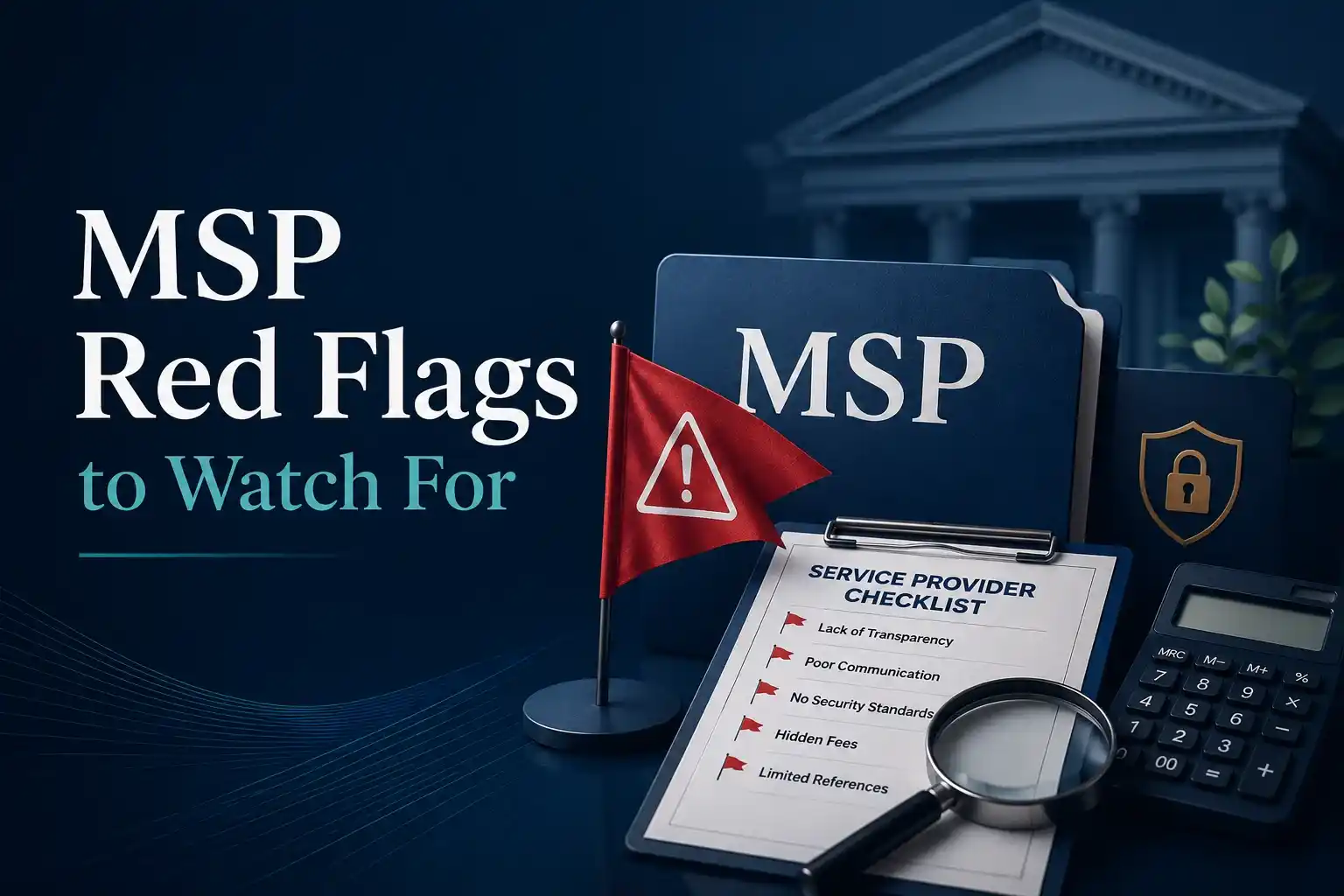
Key Red Flags to Look for When Selecting a Managed Service Provider
Blaise Wabo