

Scale your CPA & accounting firm with elite offshore talent trusted by 1,000+ firms.
Thank you for your interest. Our due diligence checklist will be shared with you within 48 hours.

A new accounting hire clears the interview process, accepts the offer, and shows up on day one to a generic onboarding checklist built for every hire regardless of role. Three weeks later, a manager discovers the same technical gap that first appeared during hiring, except now it appears in live client work instead of in a controlled assessment or interview setting. The gap was known; it simply was not carried into the first ninety-day plan.
Resumes, interview notes, and a manager’s early impressions all shape onboarding decisions, but each one is incomplete on its own. A candidate can interview well and still need real support in a specific technical area, and that need is easy to lose once the hiring decision is made and everyone moves on to the next priority.
When a firm uses MYCPE ONE Assessments before hiring, the results can carry forward into onboarding by showing where a new hire may be ready for responsibility, where closer review is needed, where supervision is appropriate, and where targeted learning should begin.
This guide walks through building a 30-60-90 day onboarding plan around that evidence, so the first ninety days become a deliberate ramp-up rather than a generic checklist repeated for every new hire.
Onboarding research shows that the early employee experience can affect retention, productivity, and expectation alignment.
According to the Enboarder 2025 HR Leader Survey, 29% of HR leaders said their top onboarding challenge was high attrition in the first 90 days, and 60.8% reported that early attrition had increased in the past 12 months. The same survey pointed to pressure around new hire retention, productivity, engagement, and onboarding ownership.
A plan that ignores what the firm already knows about a hire’s specific strengths and gaps is more likely to create expectation gaps and a weaker ramp-up experience.
Before day one, pull together the role’s actual expectations at the appropriate level, any pre-hire assessment evidence, interview observations about communication and judgment, and relevant prior experience. Treat this as building a short onboarding profile for the specific hire, rather than defaulting to the standard packet used for every new hire in the role.
Sort what you know into three groups. Day-one strengths are areas where the person can reasonably take on work with normal supervision right away. Trainable gaps are specific, known weak areas that structured practice and coaching can close within weeks.
Role-critical concerns are gaps in a skill so central to the role that they need close supervision or a deliberate development plan before the person works independently in that area. This sorting should shape the assignments, supervision level, coaching, and checkpoints that follow.

Use the first thirty days for orientation, systems access, firm workflow, and foundational training, alongside controlled assignments in areas of confirmed strength. This builds early confidence and lets the firm observe real work quality, not just onboarding completion, before increasing responsibility.
In the second phase, shift toward supervised practical work in the areas identified as trainable gaps, paired with regular, specific feedback. This is the phase where a documented pre-hire gap should begin showing measurable improvement, not quietly persisting because no one built time for it into the plan.
By the final phase, a hire should be taking on more independent responsibility in areas where evidence, both from onboarding work and from the original assessment, supports it. Use this phase for a readiness review and to set specific development priorities for the next quarter, rather than treating day ninety as a finish line.

Days 1 to 30 focus on reconciliation procedures and firm software, with controlled month-end assignments. Days 31 to 60 add supervised handling of more complex reconciliations, with feedback tied directly to review-note patterns. Days 61 to 90 introduce ownership of a full close cycle for a smaller client, with manager review before finalization and a formal check-in at the ninety-day mark.
Days 1 to 30 cover firm audit methodology and documentation standards, with assignments on lower-risk sections. Days 31 to 60 focus on workpaper documentation and exception handling under closer review. Days 61 to 90 introduce a higher-risk section with a supervised checkpoint before the hire takes on broader sign-off responsibility.
Days 1 to 30 cover firm tax software, workflow, and simpler return types. Days 31 to 60 introduce more complex returns, with targeted practice on any documented gap, such as basis or K-1 work. Days 61 to 90 expand to independent handling of returns in that area, based on how the targeted development phase progressed.
| Phase | Focus | Based On | Manager Checkpoint |
|---|---|---|---|
| Days 1 to 30 | Orientation, systems access, firm workflow, foundational training, and controlled assignments in confirmed-strength areas | Assessment strengths, interview observations, and role expectations | End-of-week check-ins; confirm systems access and initial assignment fit |
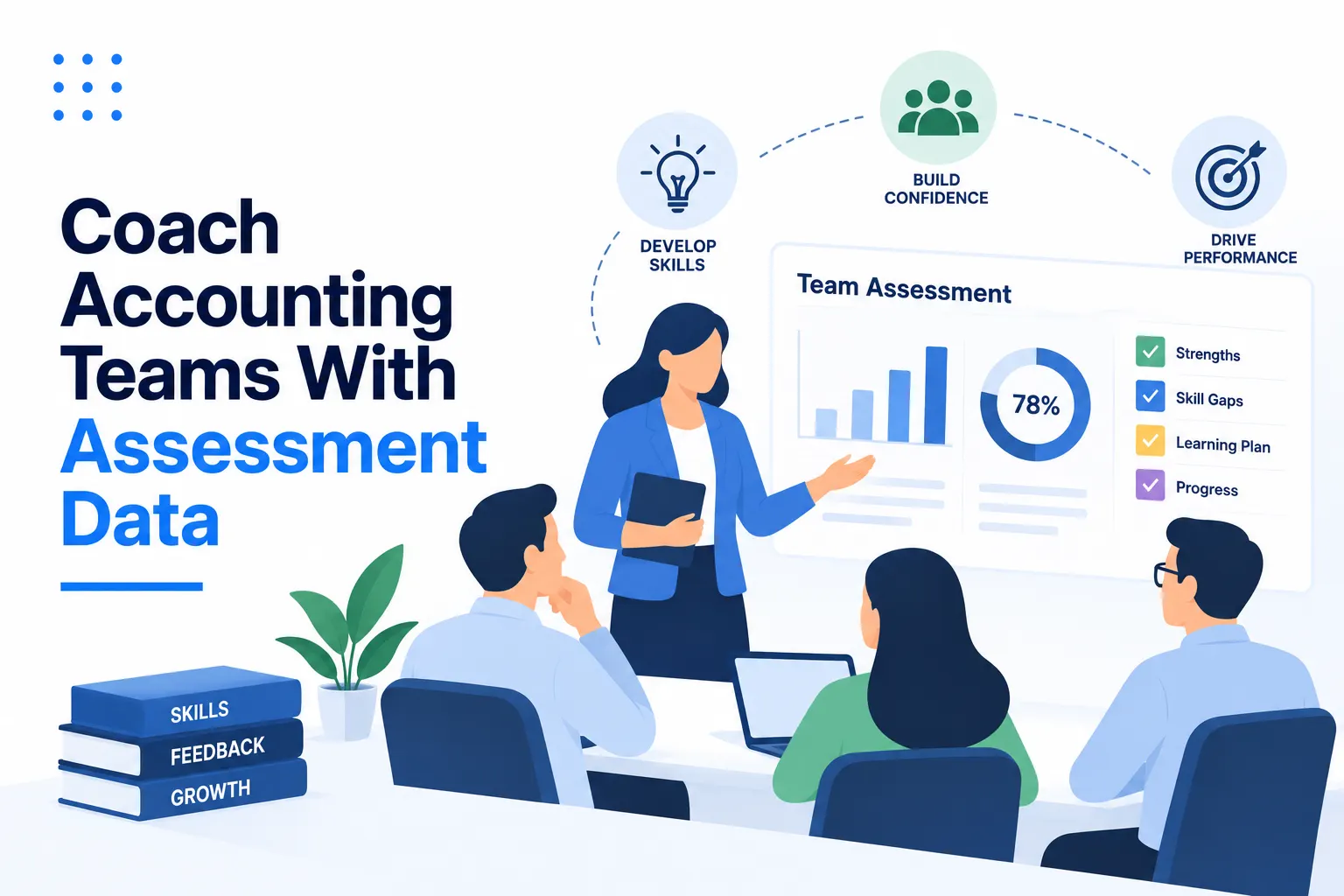
| Days 31 to 60 | Supervised practical work in trainable-gap areas, targeted development, and regular feedback | Trainable gaps identified pre-hire and early on-the-job observations | Midpoint review of specific gap areas; adjust supervision level |
| Days 61 to 90 | Increased ownership, readiness review for less-supervised work, and next-quarter development priorities | Cumulative work quality, resolved gaps, and remaining gaps | 90-day readiness conversation; set goals for the next quarter |
Keep checkpoints observable and specific: a completed reconciliation cycle with no more than an agreed number of review notes, a workpaper section that passes review without major rework, or a return prepared independently and confirmed accurate on review. Avoid vague milestones such as ‘adjusting well,’ since they are difficult to measure and even harder to act on if progress stalls.
Reassessment through a structured tool is most useful at a clear decision point, such as before expanding independent responsibility in a role-critical area, or when onboarding performance seems inconsistent with the original assessment result. In many other cases, observed work quality, review-note patterns, and manager feedback during the ninety days already provide enough evidence to confirm progress without a formal retest.
A practical rule is to reserve reassessment for situations where the stakes of being wrong are high, such as handing over an unsupervised client relationship or a higher-risk audit section, and to rely on ordinary work evidence for lower-stakes, day-to-day progress checks.
Onboarding works best when it starts from what the firm already knows, not from a blank template used for every hire. Carrying pre-hire evidence into the first thirty, sixty, and ninety days turns onboarding into a deliberate ramp-up plan instead of a generic checklist, and gives managers a clear, observable way to track progress.
MYCPE ONE Assessments can support that process by giving firms role- and level-based evidence that can carry from the hiring decision into a targeted onboarding plan.
Yes. Strengths and gaps identified before hiring are useful signals for sequencing supervision and training in the first ninety days, rather than information that stops mattering once the offer is accepted.
Not necessarily. A trainable gap in a non-critical area is a normal onboarding focus, not a hiring mistake. The concern is when a role-critical gap gets no deliberate plan at all.
Ninety days is a common and practical horizon for accounting roles, since it allows enough time to move from orientation through supervised work to a genuine readiness check.
Not automatically. Reassessment is most useful at a specific decision point, such as expanding responsibility in a role-critical area. Otherwise, observed work quality, review-note patterns, and manager feedback are often sufficient.
A standard template treats every hire the same. This approach starts from what the firm already knows about a specific hire’s strengths and gaps and builds the plan around that evidence.

Amrit Singh is a business leader with 10+ years of experience in continuing education. Helping accounting, tax, and finance professionals stay compliant with ease, he began his journey as a consultant. Learning across industries before stepping into a leadership role, he is shaped by both successes and failures. Amrit is passionate about problem-solving, building products, exploring technology, and mentoring future leaders. He is dedicated to transform continuing education, making it simpler, smarter, and more meaningful. Through his blogs and talks, he shares insights on accounting careers, CPA compliance, and the future of continuing education.


Crack the Code: Unleashing Hidden Talents for Workplace Magic


.webp-1717773117 "Understanding Your Talent Development Function")
Understanding Your Talent Development Function


Fundamentals of Managing and Developing Talent

Manager’s Playbook: How to Coach Accounting Teams Using Assessment Data
Amrit Singh





