

Scale your CPA & accounting firm with elite offshore talent trusted by 1,000+ firms.
Thank you for your interest. Our due diligence checklist will be shared with you within 48 hours.

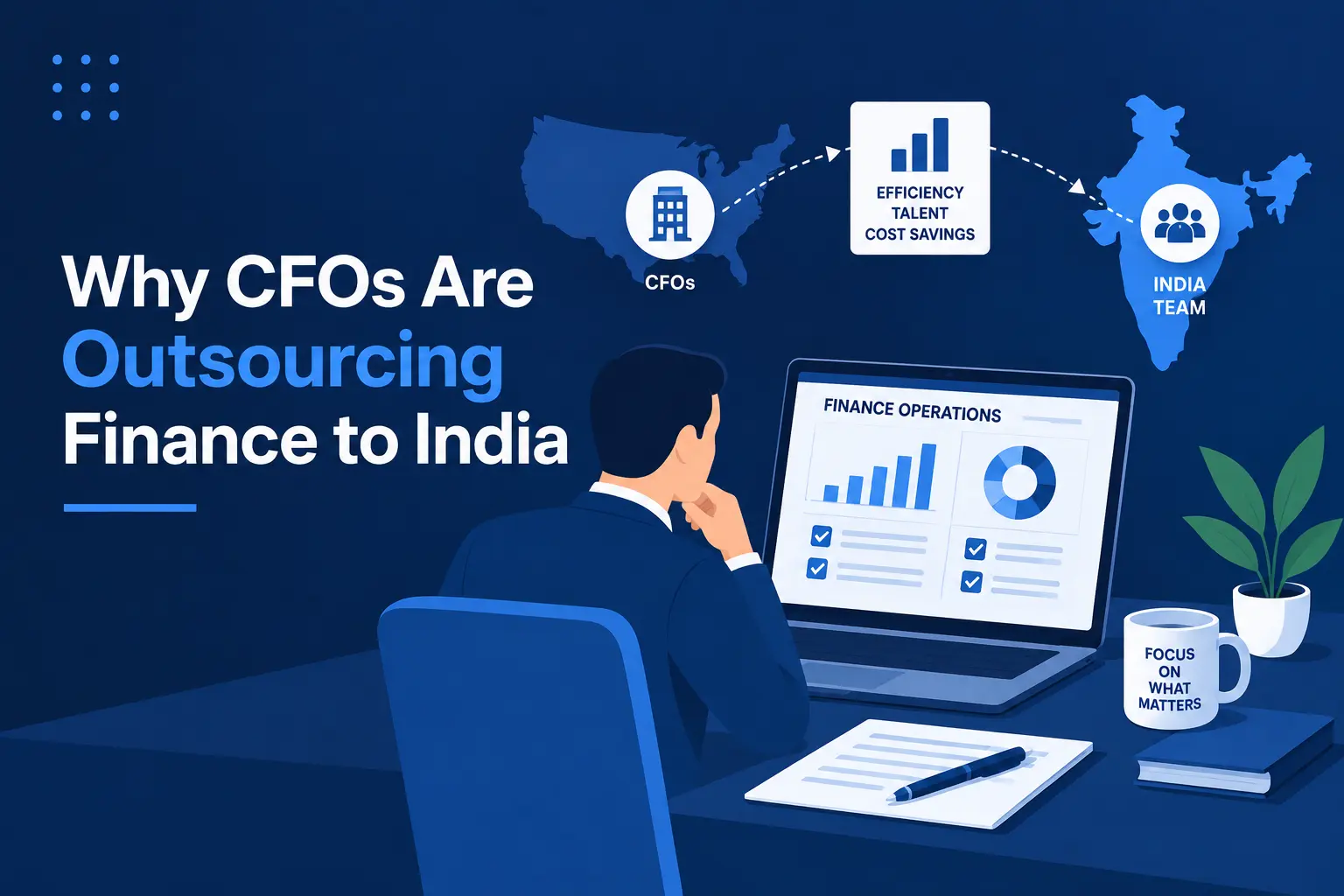
Finance operations outsourcing to India is how a growing number of U.S. companies are closing the gap between the finance work that needs to get done and the shrinking pool of qualified accountants available to do it. By building a dedicated offshore finance team in India, firms get trained accounting talent and lower staffing costs, without a six-month hiring cycle.
Finance operations outsourcing to India means hiring accountants and finance professionals based in India, either through a staffing model or a managed offshore team, to handle bookkeeping, payroll, financial reporting, tax preparation support, and audit assistance.
It is not new. What has changed is the urgency behind it. The Bureau of Labor Statistics projects more than 120,000 accounting and auditing job openings every year, while AICPA and NASBA trend data show CPA exam participation down roughly 30 percent over the past decade. Add a wave of senior retirements, and most finance leaders say qualified candidates are hard to find at any price.
Firms are not doing this because it is trendy. They are doing it because the hiring pipeline is not producing enough people fast enough.
Ask any controller or firm partner what keeps them up at night, and a few themes repeat.
The solution firms are landing on is not "hire faster." It is building a dedicated offshore accounting team in India that absorbs the repeatable, high-volume work so U.S. staff can focus on judgment calls and client relationships.

Picture a mid-size CPA firm that has been turning away new clients every tax season because there is nobody left to do the work. That is a common starting point.
Building an offshore finance team in India generally follows a similar path:

For a fuller walkthrough of each stage, see our step-by-step guide to building an offshore team.
Scaling finance operations offshore means the team grows and contracts with demand instead of being a fixed cost. A firm might start with two offshore bookkeepers, add tax preparers during filing season, and bring on a senior accountant once close volume grows.
This differs from traditional outsourcing, where a vendor is handed a batch of work and returns it. With offshore staffing, the professional works as your employee in every practical sense, following your SOPs and reporting to your management, just from an office in India instead of Ohio.
Common roles handled offshore include bookkeeping, payables and receivables, payroll, month-end and year-end close support, tax return preparation, audit workpaper prep, and increasingly, FP&A support.
The two concerns we hear most often are data security and quality control, and both are solvable with the right partner.
On security, look for providers holding SOC 2 and ISO 27001 certifications and a documented history free of data breaches. On quality, the fix is structural: a dedicated account manager, clear escalation paths for anything outside routine work, and ongoing training so staff stay current on U.S. GAAP and evolving tax rules.
For a deeper look at common pitfalls and how to avoid them, see our guide to accounting outsourcing risks.
Finance operations outsourcing to India is not a stopgap for a hiring cycle that failed. It is how U.S. companies are matching the pace of the work to the reality of a shrinking talent market, without lowering the bar on quality or security.
Firms that treat offshore staffing as a long-term extension of their team, not a one-off vendor engagement, see the biggest gains: lower costs, faster capacity, and senior staff freed up for the work that actually grows the business. For CFOs mapping out a fuller outsourcing strategy, our complete guide to finance and accounting outsourcing walks through the process end to end.
Offshore finance professionals in India typically cost far less than U.S.-based hires with comparable experience, once salary, benefits, and overhead are factored in. Many firms report reducing overall staffing costs by 40 to 70 percent after building an offshore team, though savings vary by role and scope. The bigger long-term value usually comes from redeploying savings and freed-up senior staff time into advisory work.
A staffing-based hire can often be sourced, vetted, and onboarded within a few weeks, since providers typically maintain pre-vetted candidate pipelines. Building a larger, fully managed offshore unit, such as one under a Build-Operate-Transfer structure, takes longer since it involves entity setup and compliance work. Most firms start with one or two roles and scale from there.
Yes, provided the provider maintains recognized security certifications such as SOC 2 and ISO 27001, along with strict data access controls and a verifiable track record. Ask any prospective partner directly about their breach history, data handling policies, and where client data is physically and digitally stored before signing an agreement.
Traditional outsourcing hands a batch of work to a third-party vendor that completes it independently and returns the result. Offshore staffing places a dedicated professional under your direct management, following your processes and reporting to your team, while working from an office abroad. Most firms scaling long-term prefer staffing because it builds institutional knowledge that stays with the firm.
No. Small and mid-size firms, and businesses without a CPA license at all, use offshore finance and accounting support for bookkeeping, payroll, and back-office work. The flexibility to scale up during busy periods and scale down afterward tends to matter even more for smaller teams with less bandwidth to absorb workload spikes.

Nemin Vora, a CA and Tax Attorney, leads Client Relations at MYCPE ONE. With 7+ years of experience at Big 4 and top public accounting firms across America, he helps U.S. firms scale globally through remote talent, offshoring, and cloud operations. Known for his sharp tax insights and practical approach to firm growth, Nemin is a dynamic speaker. He breaks down complex topics such as leadership, AI, global staffing, and practice expansion into relatable lessons that professionals actually enjoy learning. Beyond the strategy decks, Nemin is a learner at heart, a stage actor, and a tech enthusiast.

Medical Practice Accounting: A Complete Guide for Clinics and Provider Groups
CA Nemin Vora
Top Reasons U.S. CFOs Are Moving Finance & Accounting Operations to India
CA Nemin Vora
What Does a Healthcare Virtual Assistant Do? Daily Tasks, Tools and Workflows
CA Nemin Vora





