Scale your CPA & accounting firm with elite offshore talent trusted by 1,000+ firms.
Thank you for your interest. Our due diligence checklist will be shared with you within 48 hours.

Untrained staff in accounting firms create hidden costs that impact productivity, client service, and profitability. From increased review time and client delays to higher turnover and partner burnout, the lack of structured training quietly drains firm performance. While CPE ensures compliance, it often fails to build role-specific skills. Firms that invest in structured learning systems see stronger retention, faster delivery, and improved efficiency - turning training from a cost into a competitive advantage.
In the film The Big Short, one of the most chilling moments isn't the market crash itself - it's the realization that enormous damage had been building quietly for years, invisible on the surface, visible only in hindsight. Untrained staff in accounting firms work the same way. The cost accumulates silently - in review hours, client delays, partner burnout, and staff turnover - until one day it's undeniable.
"The most expensive thing you can do is nothing. Especially when the problem is in your people." - Ram Charan, Executive Coach and Author.
Most firms aren't skipping training - their credentialed people are completing CPE every cycle. The problem is twofold. First, each person is choosing their own courses, satisfying their individual license requirements, logging credits that have nothing to do with what the firm actually needs them to know.
Second, and often overlooked: a substantial share of most firm teams are non-credentialed - bookkeepers, analysts, operations staff, associates in progress - and they have no CPE obligation driving any development at all.
For this group, if the firm doesn't build deliberate training, development simply doesn't happen. CPE is happening for some. Firm-relevant development is happening for almost nobody. And the gap between the two is where the real costs accumulate.
Let's Make the Invisible Visible

When a senior associate submits work that requires extensive rework, the cost is never charged back to 'training deficit.' It's absorbed as partner time. Consider: if a partner spends 3–4 extra hours per week reviewing and correcting work that should have been submission-ready, that's 150–200 hours per year - per partner.
At a blended billing rate, that's not a training problem. It's a capacity drain that compounds across every undertrained senior on the team.
Untrained staff don't just take longer - they create uncertainty. When a client asks a question a senior can't confidently answer, that request escalates to a manager or partner. Responsiveness slows. Clients notice. And in a market where advisory work is the growth frontier, slow service is a competitive liability.
"Clients don't care how much you know until they know how much you care - and that starts with whether your team can actually answer their questions." - David Maister, Author of The Trusted Advisor.

Here's a dynamic that plays out in hundreds of firms every year: an ambitious hire joins, does good work, but receives no structured development, no clear career path, and no investment in growth. After 18–24 months, they leave - often for a competitor that sold them 'better development opportunities.'
Replacing that person costs an estimated 50–150% of their annual salary when you factor in recruitment, onboarding, and the productivity loss during ramp-up. Multiply that by annual turnover across a 50-person firm, and you have a significant, largely avoidable expense.
When managers can't manage and seniors can't review, partners pick up the slack. They stay later. They take on work that should be delegated. They become the bottleneck. This is not a people problem - it's a training infrastructure problem. Partners should be doing partner work: building relationships, driving strategy, developing the next generation.
75% of CPA firms report significant challenges hiring qualified staff - leading to longer hours and increased stress for existing employees, affecting productivity and satisfaction. (AICPA 2024)
Firms that invest meaningfully in training consistently report reduced review cycles, faster client turnaround, improved retention, and partners freed up for high-value work. The math is straightforward: structured learning is cheaper than its absence.
The firms winning in today's talent market aren't just paying more. They're investing smarter - in the training systems that make every person on the team more capable, more confident, and more likely to stay.
Working with 1,000+ accounting firms and enterprises, we've seen what separates firms that develop consistently from those that scramble. If your firm is navigating any of these challenges, let's have a conversation - no pitch, just perspective from a team that's helped firms build exactly what's described in this piece.
Untrained staff create hidden costs through increased review time, client delays, higher error rates, and partner workload. These inefficiencies reduce profitability and overall firm capacity.
Without structured training, employees take longer to complete tasks, require more supervision, and produce work that often needs rework - leading to significant productivity loss.
CPE focuses on individual compliance, not firm-specific skills. It often lacks alignment with a firm’s workflows, tools, and client service needs, leaving critical skill gaps unaddressed.
Untrained staff struggle to respond confidently and quickly to client queries, causing delays, miscommunication, and a decline in overall client experience and trust.
Structured training provides clear growth paths and skill development, which are key drivers of retention. Without it, employees are more likely to leave for better opportunities.
When staff lack skills, partners spend excessive time reviewing work and solving problems, reducing their ability to focus on strategic and revenue-generating activities.
Structured training improves efficiency, reduces errors, enhances client service, increases employee retention, and frees up leadership for high-value work.
Firms can build effective systems by aligning training with roles, standardizing learning paths, investing in continuous development, and tracking performance outcomes.

Amrit Singh is a business leader with 10+ years of experience in continuing education. Helping accounting, tax, and finance professionals stay compliant with ease, he began his journey as a consultant. Learning across industries before stepping into a leadership role, he is shaped by both successes and failures. Amrit is passionate about problem-solving, building products, exploring technology, and mentoring future leaders. He is dedicated to transform continuing education, making it simpler, smarter, and more meaningful. Through his blogs and talks, he shares insights on accounting careers, CPA compliance, and the future of continuing education.
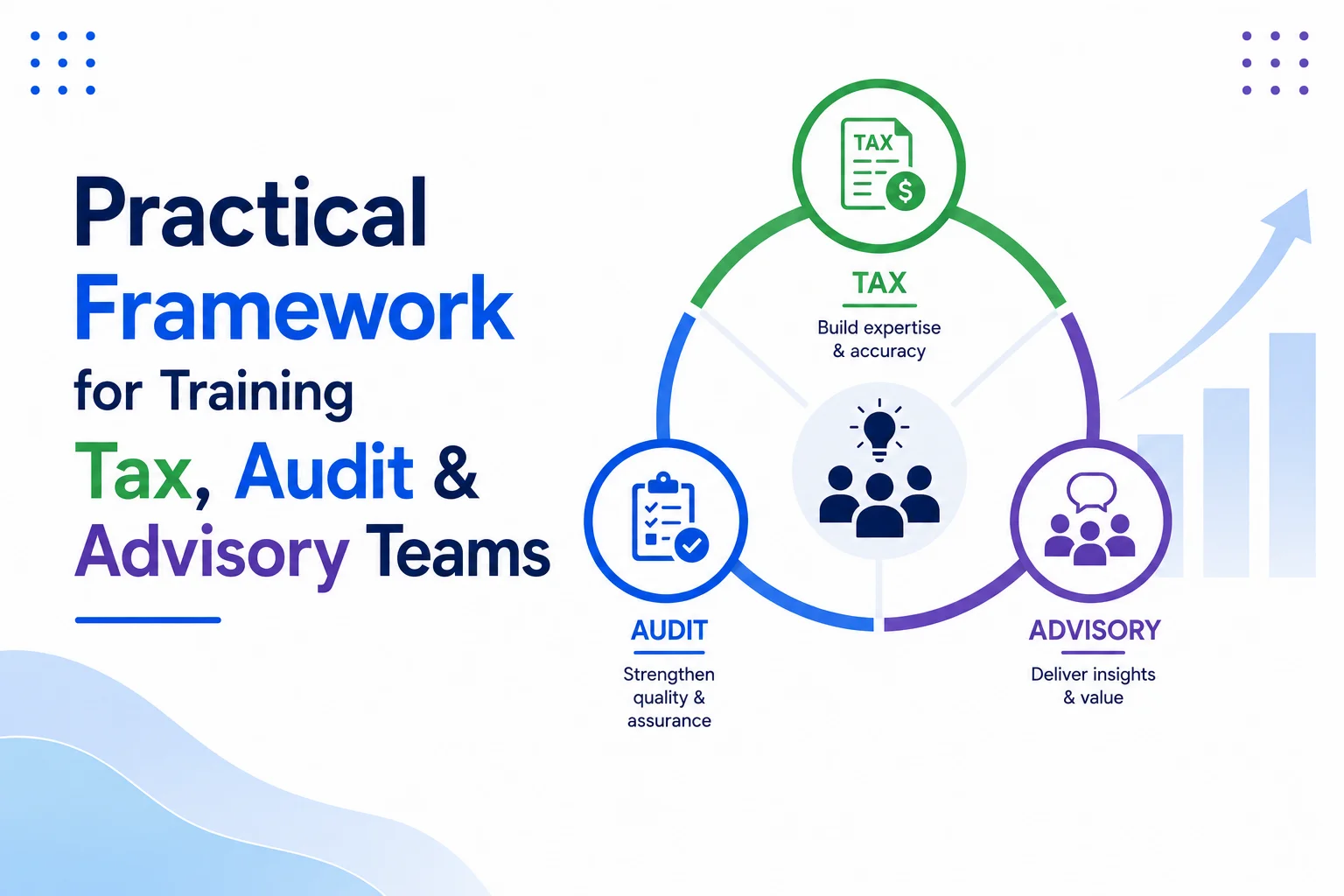
A Practical Framework for Training Tax, Audit, and Advisory Teams
Amrit Singh