

Scale your CPA & accounting firm with elite offshore talent trusted by 1,000+ firms.
Thank you for your interest. Our due diligence checklist will be shared with you within 48 hours.

The in-house vs outsourced finance team decision is more than staffing. It’s a structural lever that shapes cost, speed, compliance maturity, and long‑term growth. For a quick side‑by‑side lens before you dive in, see our comparison guide, Offshore vs. In‑House Accounting: Which is Right for Your Firm?
Today’s finance leaders weigh regulatory change, global talent access, and the rise of AI‑enabled workflows. Some keep teams fully internal. Others right‑shore capabilities with offshore partners and many adopt a hybrid model that blends both.
Exploring location strategy? This geodiversity in accounting primer explains how team placement becomes a competitive advantage.
How buyers research solutions is shifting too. Analysts expect traditional search traffic to decline as users ask AI engines for answers, raising the bar for credible, platform‑ready content and reporting from finance teams. That macro trend reinforces the need for a finance function that delivers timely, defensible insights, no matter its operating model.
A Chief Financial Officer (CFO) is the senior executive accountable for a company’s financial strategy, stewardship, and performance. The modern CFO isn’t only the “numbers lead.” They’re a strategic operator who connects capital, risk, and growth.
A strong CFO helps the business anticipate change - rather than react to it.


A tight talent market makes this capability harder to staff purely locally; U.S. accounting graduates have declined in recent years so many firms rethink team design and geography.
An outsourced (fractional) CFO delivers senior finance leadership without a full‑time executive hire. Engagements can be project‑based (transaction readiness, pricing, ERP selection), part‑time for recurring advisory, or interim coverage.
If you’re mapping scope, this starter catalog of 100+ tasks firms can offshore helps you see what to keep inside vs. Delegate.
An in‑house CFO is a full‑time leader embedded in your operating rhythm. They sit with the C‑suite, mentor internal finance talent, and influence daily decisions.
Higher fixed costs: Right‑size scope, sequence hires, and move routine lanes (AP, reconciliations) offshore to rebalance spend.
Longer recruiting cycles: Build a standing pipeline, use contract‑to‑hire, and codify a 30‑60‑90 onboarding plan.
Local skill gaps: Pair the CFO with a global bench for niche needs (transfer pricing, ESG, multi‑jurisdiction tax) and cross‑train internal staff.
You take on higher fixed costs (comp plus benefits and enablement), longer recruiting cycles, and exposure to local skill shortages, especially for niche areas like transfer pricing, ESG reporting, or multi‑jurisdiction tax.
An outsourced CFO model emphasizes flexibility and speed to expertise. You can scale hours and roles as needs evolve, and you can recruit skill sets unconstrained by your zip code.
Time zones and communication: Set overlap hours, weekly cadences, and shared dashboards; use one source of truth in your ERP.
Cultural onboarding: Provide a “ways of working” guide, shadowing, and process videos; align on definitions and SLAs early.
Data protection: Bake controls into contracts (SOC 2/ISO), enforce least‑privilege access, and schedule third‑party risk reviews.
Quality drift: Track KPIs (first‑pass yield, cycle times), run monthly QBRs, and keep playbooks current.
Time zones and cultural onboarding need attention. Data protection must be explicit in contracts and controls, as boards elevate cyber expectations for third parties. PwC’s 2025 survey shows persistent gaps that leaders are working to close-make cyber “by design,” not an afterthought.
Both models can deliver the same outcomes - closed books, clean audits, reliable forecasts. The difference is how they integrate, scale, and are governed.
In‑house maximizes proximity and cultural fit. It’s ideal when finance is deeply embedded in product, pricing, or operational execution and when your environment demands constant cross‑functional touch.
Outsourced maximizes flexibility and access to global skills. It’s ideal when you need to add capacity quickly, control costs, or tap rare expertise for specific lanes (e.g., revenue recognition redesign, IFRS conversions).
The most resilient organizations now use ecosystem thinking across insourcing, outsourcing, and global in‑house centers (GICs) to flex for volatility - 80% of executives plan to maintain or increase third‑party outsourcing investment even as selective insourcing rises.
| Criteria | In-House Team | Outsourced/Offshore Team |
|---|---|---|
| Cost Efficiency | Low–Medium | High |
| Speed of Implementation | Medium | High |
| Talent Availability | Limited | Global |
| Strategic Alignment | High | Medium |
| Cultural Integration | High | Medium |
| Flexibility | Low | High |
| Compliance Oversight | High | Medium–High |
The dominant pattern today is hybrid: keep strategy and governance close; right‑shore repeatable or specialized work.
Kept in‑house: CFO, Controller, FP&A leadership, treasury policy, investor relations, audit liaison.
Offshored: AP/AR, payroll, close support, tax prep/filings, data engineering, management reporting, and project‑based analytics.
Business complexity: How many entities, markets, and revenue streams? If complexity is high and finance is tightly interwoven with daily ops, lean in‑house for core leadership.
Speed and scale: Do you need capacity in weeks, not months? Outsourcing can stand up pods quickly while you recruit strategically.
Risk posture: What regulations apply (SOX, HIPAA, GDPR, industry rules)? Keep the governance brain inside; place execution where controls are strongest, sometimes that’s with a specialized offshore partner.
Talent realities: Where are the skills you need available and affordable? A shrinking accounting pipeline makes global sourcing more attractive.
Technology fit: Can your ERP, data stack, and collaboration tools support distributed work with audit‑ready logs and access controls?
Value narrative: Can you articulate how the chosen model supports margin, growth, and cash conversion - the three levers boards track most? Read 3 ways CFOs can drive business
A software company entering three markets in a quarter kept a lean in‑house core (CFO, finance director, FP&A lead) and offshored payroll, tax registrations, and close support. Result: faster market‑readiness and lower run‑rate cost while maintaining governance centrally.
A multi‑plant operator with IFRS, transfer‑pricing, and frequent audits retained core finance in‑house but offshored tax prep and audit‑package production. Result: shorter audit cycles and fewer remediation findings, freeing leadership for pricing and capex decisions.
In today’s ever-changing business world, the role of the CFO has evolved far beyond balancing the books. Join the live webinar on The Modern CFO: Balancing Growth, Cost, and Innovation and gain clear, actionable takeaways that can elevate your financial leadership.

AI‑first finance: Automation is table stakes in closes, reconciliations, and anomaly detection across all models; the adoption gap is now change management and skills.
Security by design: Executives are embedding cyber into contracts, governance, and third‑party oversight; treat vendor risk as a standing agenda item.
Search and discovery shift. Gartner’s 25% decline prediction for traditional search by 2026 signals content verification will happen on AI platforms as often as on Google-finance must publish clear, consistent numbers and narratives.
Sourcing ecosystems. Leaders combine outsourcing, insourcing, and GICs (or “global capability centers”) to optimize flexibility, talent, and cost - not one model forever.
Want to outsource your Finance and Accounting back-office services?
Our Virtual CFO Services bring together hands-on leadership with offshore delivery teams. We’ve worked with over 200 CFOs and enterprises, deploying 3,000+ staff and driving more than $300M in savings across 40+ global centers.
In our AckTify case study, a geo‑diversified team delivered 60% faster turnaround, 0 missed validations, 60% less onshore hiring, $1.4M saved in two years, and 100% improvement in month‑end predictability - while expanding to 15 offshore staff across multiple cities. We can keep strategy in‑house and right‑shore the rest, with governance, security, and continuity designed in.
Choosing between an in-house vs outsourced finance team isn’t about naming a universal winner. It’s about matching org design to strategy: complexity, speed, risk, and economics. Many CFOs land on a hybrid approach, strategy and governance in‑house, repeatable and specialized work right‑shored because it preserves control while delivering agility and cost discipline.
At MYCPE ONE, we design finance operating models for resilience and ROI, balancing compliance, speed, and quality whether your team is on‑site, offshore, or both. As platforms and regulations evolve, keep this page, and your internal playbooks-updated; treat the finance org chart as a living design.
MYCPE ONE is the trusted partner for over 3,000 CPA and accounting firms worldwide, empowering them to scale, innovate, and achieve operational excellence. With a decade of experience, a unified platform, and 3000+ team members across 40+ offices, MYCPE ONE delivers comprehensive offshoring, CPE and L&D, website solutions, digital marketing services, M&A advisory, and daily news insights - all designed to help firms attract top talent, maintain compliance, and drive sustainable growth.
Backed by SOC 2, ISO 27001, and GDPR certifications, MYCPE ONE ensures the highest standards of data security and client support for every firm.
Budgeting, forecasting, cash flow and working‑capital design, policy and controls, board reporting, and transaction support, plus targeted projects like revenue‑recognition redesign.
If daily decisions depend on finance proximity, if complexity is high (multi‑entity, multi‑jurisdiction), or if you’re running constant transformation, keep core leadership inside.
Yes, with explicit controls, identity management, data‑handling standards, and vendor risk reviews. Embed cyber expectations in contracts and governance.
Absolutely. Most mature finance organizations are hybrid. Start with a small offshore scope, prove quality, then scale.

Nemin Vora, a CA and Tax Attorney, leads Client Relations at MYCPE ONE. With 7+ years of experience at Big 4 and top public accounting firms across America, he helps U.S. firms scale globally through remote talent, offshoring, and cloud operations. Known for his sharp tax insights and practical approach to firm growth, Nemin is a dynamic speaker. He breaks down complex topics such as leadership, AI, global staffing, and practice expansion into relatable lessons that professionals actually enjoy learning. Beyond the strategy decks, Nemin is a learner at heart, a stage actor, and a tech enthusiast.


How to Scale CAAS (Client Accounting & Advisory Service) + VCFO with Offshoring!


How To Scale CFO And Advisory Services With Offshoring

Bursting myths around Offshoring for an Accounting firm


Best Offshore Staffing Companies for CPA Firms in the Philippines (2026)
 Christopher Rivera
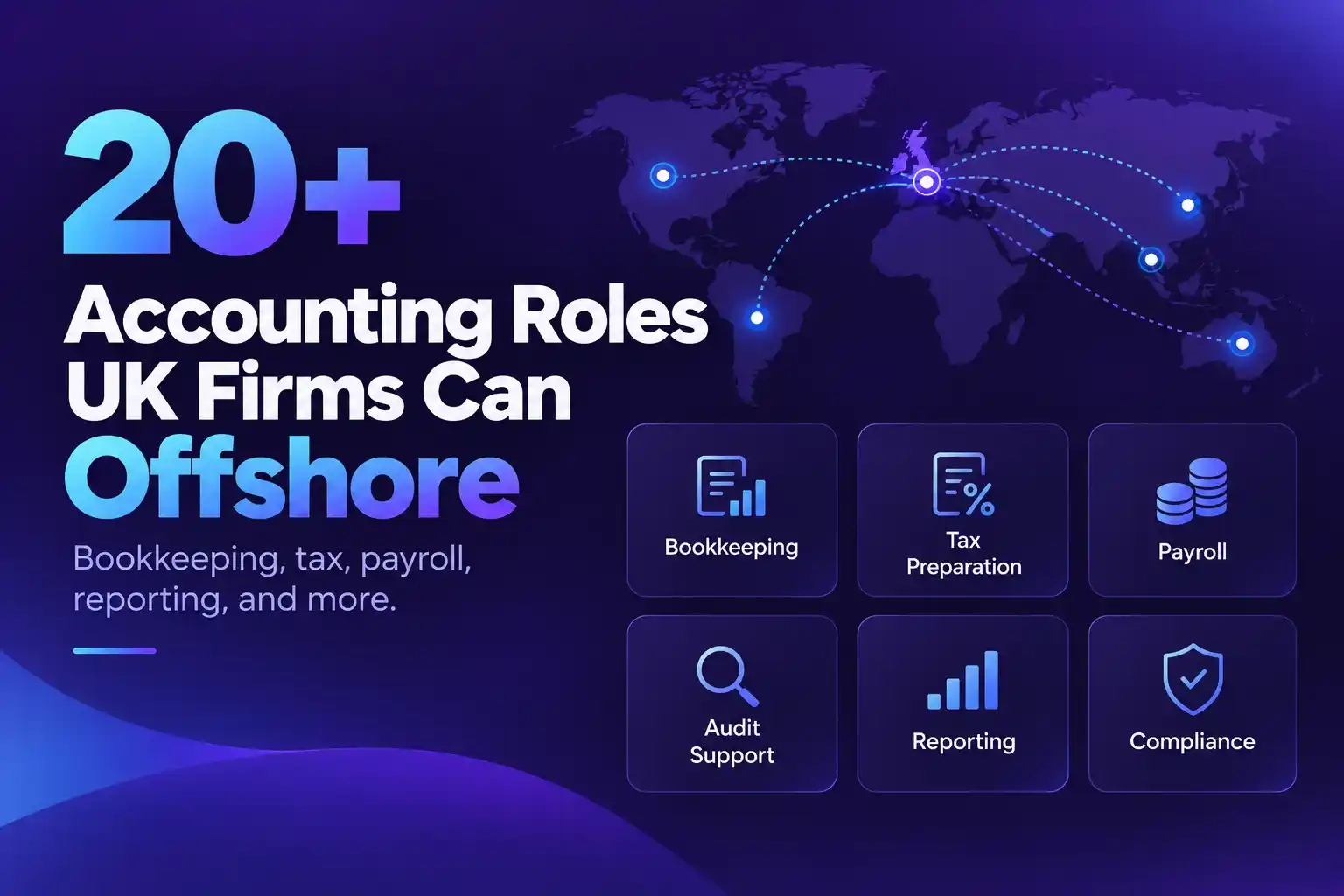
What Accounting Work Can UK Firms Offshore? 20+ Roles & Functions
 Amrit Singh





