
Scale your CPA & accounting firm with elite offshore talent trusted by 1,000+ firms.
Thank you for your interest. Our due diligence checklist will be shared with you within 48 hours.

Offshore teams for business have shifted from a cost-cutting tactic to a genuine growth strategy. This guide covers everything businesses and enterprises need to know, from building your first offshore team to managing it effectively at scale. We explore key functions, hiring models, risk management, and how to make offshore teams a competitive advantage rather than a compliance headache. Whether you're a growing mid-market firm or a large enterprise, this guide gives you a clear, actionable roadmap.
Offshore teams for business have shifted from a cost-cutting tactic to a genuine growth strategy. This guide covers everything businesses and enterprises need to know, from building your first offshore team to managing it effectively at scale. We explore key functions, hiring models, risk management, and how to make offshore teams a competitive advantage rather than a compliance headache. Whether you're a growing mid-market firm or a large enterprise, this guide gives you a clear, actionable roadmap.
Offshore teams are no longer a secret weapon. They are the strategy. Businesses and enterprises across the US have been quietly building offshore teams for years. What started as a way to reduce payroll costs has evolved into something far more strategic. Today, offshore teams help companies scale faster, access specialized talent, and stay competitive, without the overhead that comes with hiring locally for every function.
Remember that line in The Dark Knight - "It's not who I am underneath, but what I do that defines me"? Smart enterprises have applied that same logic to their teams. It doesn't matter where your talent sits. What matters is what they deliver. The firms that figured this out early stopped competing on zip codes and started competing on output.
US companies working with offshore teams typically reduce staffing costs by 40–70% while maintaining, or even improving, output quality. That's not a rounding error. That's a business model shift.
This is where most businesses get stuck. They assume offshoring is only for IT or basic data entry. That assumption is expensive.
Here's what enterprises are successfully running offshore today:
The key insight: offshore teams are not a department replacement; they're a capacity multiplier. Your onshore team focuses on client relationships, strategy, and judgment calls. Your offshore team handles the volume, the process, and the repetitive-but-critical work.
Most companies that struggle with offshore teams make the same mistakes early. They hire fast, skip onboarding, and treat offshore talent as interchangeable contractors rather than embedded team members.

Here's a framework that works:
Be specific. What does this person do on a Tuesday afternoon? If you can't answer that, you're not ready to hire offshore. Vague job descriptions produce misaligned hires - onshore or offshore.
There are three main models for building offshore teams for business:
Staff augmentation currently achieves an 83% success rate and delivers 92–95% retention, significantly outperforming older outsourcing models. For most growing businesses, staff augmentation or managed offshore teams offer the best starting point. They minimize upfront investment while still giving you control over quality and culture fit.
This is the part that separates good offshore teams from great ones. Credentials get you in the door. Culture fit determines whether people stay and grow.
Brief your offshore team on your firm's values. Include them in company meetings. Give them visibility into the bigger picture. Offshore professionals who understand why the work matters tend to do it significantly better.
Read the useful guide: Essential Questions CFOs Ask Before Outsourcing Finance & Accounting
Scaling from a 2-person offshore team to a 20-person one isn't just a headcount decision. It requires systems.
What high-performing enterprises get right:
The compounding effect kicks in after Month 3. Early on, there's a learning curve. After that, a well-structured offshore team often outpaces the productivity of an equivalent onshore hire, because the systems built to manage distance end up making everyone more efficient.
A 2025 study found that businesses using offshore models reported an average 40% decrease in operational expenses within the first year, with those savings then reinvested into growth, marketing, and innovation.
Every strategy has risk. Offshore teams are no different. The key is knowing what the risks actually are, not the ones people assume.
Use encrypted platforms, sign proper NDAs, and ensure your offshore partner follows SOC 2 or ISO 27001 equivalent compliance standards. Leading offshore providers now treat enterprise-grade security as standard practice, not a premium add-on. This is table stakes, not a differentiator.
Time zone differences can work for you (overnight processing, follow-the-sun support) or against you if not managed. Build overlap windows and async communication rhythms deliberately.
This usually traces back to unclear expectations, not offshore talent quality. Define deliverables, review regularly, and give feedback fast.
Cross-train within your offshore team. If a single person holds too much institutional knowledge, that's a business continuity problem, regardless of where they sit.
Read the useful guide: How CFOs Can Win with Offshore Teams: Real-World Success Strategies
The talent market hasn't gotten easier. The US Bureau of Labor Statistics projects 124,200 new accountant and auditor openings every year through 2034 far more than the domestic pipeline can fill. The same talent pressure applies across tech, marketing, and back-office operations.
Meanwhile, the global IT outsourcing market alone is projected to reach $731 billion by 2025, driven primarily by cost savings and access to specialized skills, a clear signal that enterprises globally are doubling down on offshore teams, not pulling back.
AI tools have made remote collaboration more seamless than at any point in history. The infrastructure problem that once made offshore teams difficult has largely been solved.
The firms building offshore teams today are not cutting corners. They are building resilience.
They're creating capacity that allows their onshore leadership to focus on what only they can do: client relationships, advisory work, and strategic growth, while offshore teams handle execution at scale.
Building offshore teams for business isn't a one-size-fits-all exercise. But the fundamentals are consistent: be specific about roles, invest in onboarding, manage for outcomes, and treat your offshore team like the real part of your organization that it is.
Finding the right talent is becoming more challenging than ever, especially in a world where firms increasingly need professionals who are not just technically strong, but also AI-savvy and adaptable to modern workflows. At MYCPE ONE, we help CPA firms, accounting firms, businesses, and enterprises build high-quality offshore teams across accounting, tax, audit, advisory, back-office functions, digital marketing, sales, IT, tech, and several other functions.
If you'd like to explore more, feel free to schedule a call.
An offshore team is a group of full-time professionals hired in another country who work as an integrated extension of your business. They handle defined roles - accounting, IT, marketing, back-office operations, and more, using your tools, processes, and workflows. Unlike a freelancer or a one-off project vendor, an offshore team operates on a recurring basis with dedicated accountability. Most businesses manage their offshore teams through daily standups, shared project management platforms, and overlapping work hours. The result is a team that functions like an in-house department at a fraction of the cost.
The savings vary by function and location, but the data is consistent. Businesses typically reduce staffing costs by 40–70% when building offshore teams compared to equivalent US-based hires. For context, a mid-level US accountant costs $104,000–$110,000 annually when you include salary, benefits, and overhead, based on BLS and Robert Half 2025 data. An offshore equivalent in the same role can cost a fraction of that. For enterprises running multiple offshore functions simultaneously, those savings compound quickly and can be redirected into growth, technology, or client service improvements.
Almost any function with defined processes and measurable outputs can be offshored successfully. The highest-performing offshore functions today include accounting and bookkeeping, tax preparation, audit support, software development, QA testing, digital marketing, data entry, HR administration, and customer support. The common thread is clarity - roles where you can document the workflow, define the output, and measure quality objectively tend to transition offshore most smoothly. Functions that require constant in-person client interaction or real-time local judgment calls are better kept onshore, at least initially.
Quality and communication don't happen by accident - they're designed. High-performing businesses manage their offshore teams with overlapping work hours (typically 3–4 hours of real-time overlap per day), weekly video syncs, shared project management tools like Asana or Monday, and clearly documented SOPs for every process. KPIs should mirror what you'd hold an onshore employee to, not softer targets. A 2025 study found that 65% of companies using offshore solutions reported improved scalability, with the ability to adjust team size in as little as two weeks- a sign that well-managed offshore teams are highly responsive, not rigid.
Yes, when the right safeguards are in place. Reputable offshore partners and platforms operate under NDAs, role-based access controls, encrypted communication channels, and compliance frameworks like SOC 2 or ISO 27001. Enterprise-grade security is now standard practice among leading offshore providers, not an optional upgrade. For accounting, tax, and financial functions specifically, you should verify that your offshore partner follows data handling protocols aligned with IRS and AICPA guidelines. Always vet the security posture of any offshore partner before sharing access to client or financial data.
Most businesses can have an offshore team hired, onboarded, and operational within four to eight weeks, depending on the function and the hiring model. Staff augmentation through a marketplace like MYCPE ONE typically moves faster than building from scratch, since pre-vetted professionals are already available. The first 30 days involve role orientation, tool access, and process walkthroughs. By Day 60, most offshore team members are operating independently on core tasks. The compounding returns - higher output, lower cost, reduced onshore burden, typically become visible by the end of Month 3.

Nemin Vora, a CA and Tax Attorney, leads Client Relations at MYCPE ONE. With 7+ years of experience at Big 4 and top public accounting firms across America, he helps U.S. firms scale globally through remote talent, offshoring, and cloud operations. Known for his sharp tax insights and practical approach to firm growth, Nemin is a dynamic speaker. He breaks down complex topics such as leadership, AI, global staffing, and practice expansion into relatable lessons that professionals actually enjoy learning. Beyond the strategy decks, Nemin is a learner at heart, a stage actor, and a tech enthusiast.

Medical Practice Accounting: A Complete Guide for Clinics and Provider Groups
CA Nemin Vora

How U.S. Companies Scaled Finance Ops with Offshore Teams in India
CA Nemin Vora
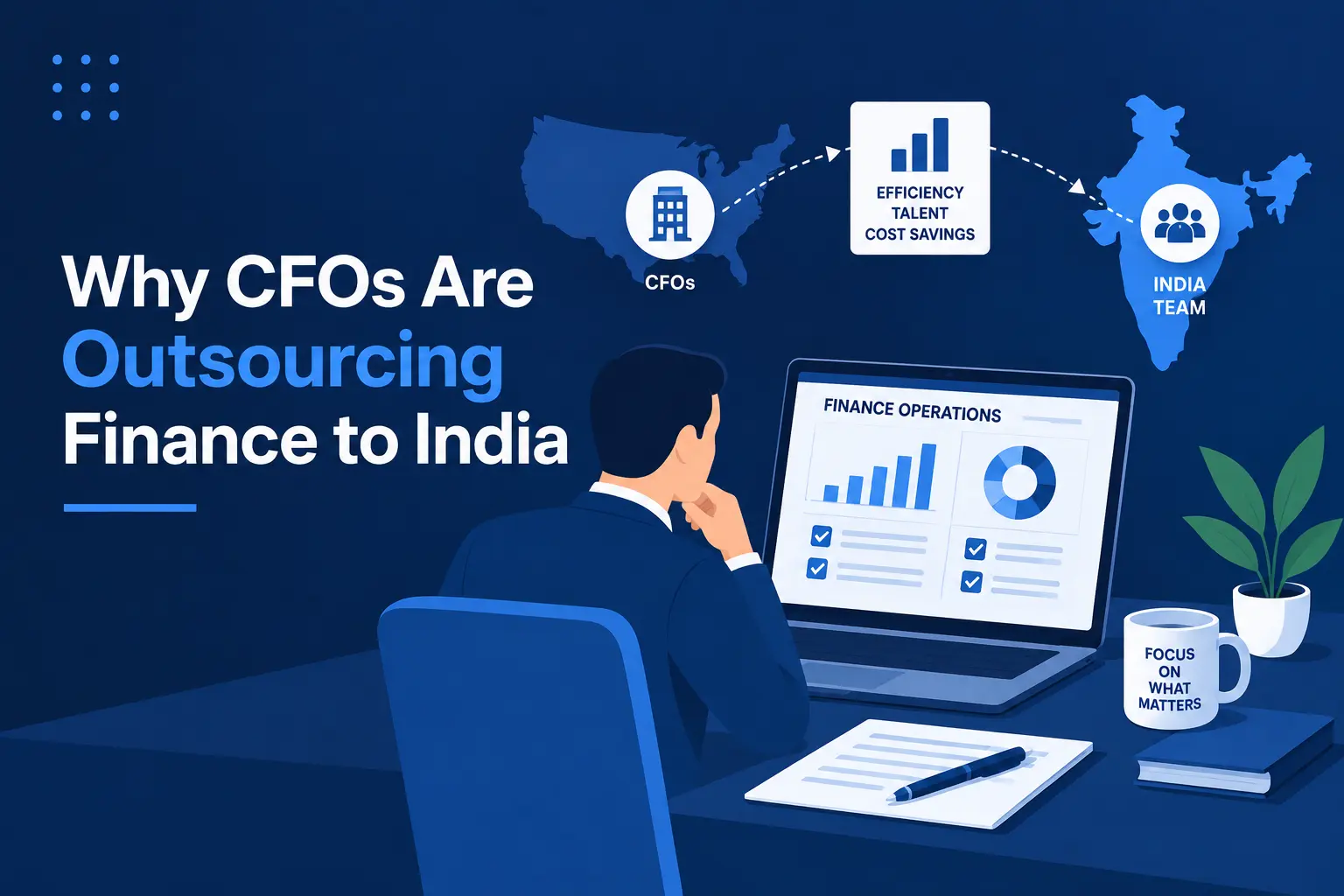
Top Reasons U.S. CFOs Are Moving Finance & Accounting Operations to India
CA Nemin Vora