

Scale your CPA & accounting firm with elite offshore talent trusted by 1,000+ firms.
Thank you for your interest. Our due diligence checklist will be shared with you within 48 hours.

Yes, Canadian CPA firms can legally send client data offshore under PIPEDA, as long as the firm stays accountable for that data's protection no matter where it's processed. That means consent language covers offshore processing, the vendor holds real security certifications like SOC 2 Type II and ISO 27001:2022, and a breach notification plan is in writing before any data crosses the border.
Firms serving Quebec clients carry one extra step: a Privacy Impact Assessment under Law 25 before the transfer happens. Get those pieces in place, and offshoring is compliant, not risky.
A partner at a mid-size Toronto firm put it simply during a recent call: "I want the cost savings from offshoring. I just don't want to end up explaining a data breach to the Privacy Commissioner." That worry is fair, and it is the single biggest reason Canadian CPA firms hesitate before building an offshore team, even when the talent shortage makes offshoring look like the obvious answer.
The good news is that PIPEDA does not prohibit sending client data offshore. It simply requires firms to stay accountable for that data no matter where it physically sits. Firms that understand this distinction offshore with confidence. Firms that skip it end up exposed.
The Personal Information Protection and Electronic Documents Act, or PIPEDA, is Canada's federal private-sector privacy law. According to the Office of the Privacy Commissioner of Canada, it governs how organizations collect, use, and disclose personal information in the course of commercial activity, and it remains fully in force across Canada today.
For a CPA firm, "personal information" covers almost everything a client hands over during tax season: SINs, income details, banking information, business financials.
Under PIPEDA compliance offshore accounting Canada rules, a firm stays legally accountable for that information even after it moves to a third-party processor, including an offshore accounting team. Handing data to an offshore provider does not transfer the legal risk. It only transfers the work.
This is the part firms miss. PIPEDA's accountability principle means your firm, not your offshore vendor, answers to the Office of the Privacy Commissioner if something goes wrong.
Most compliance gaps show up in three places:
None of these risks are reasons to avoid offshoring. They are reasons to choose an offshore partner that treats Canadian privacy law accounting outsourcing as a shared responsibility, not an afterthought.

Firms with Quebec clients carry an extra layer of obligation. Quebec's Law 25, rolled out in stages since September 2022 and enforced by the Commission d'accès à l'information du Québec, is stricter than PIPEDA in several ways that matter directly for Quebec Law 25 outsourcing arrangements:

If your firm serves clients anywhere in Quebec, a PIPEDA-only compliance checklist is not enough. The offshore agreement needs to hold up against Law 25 specifically, and that assessment should happen before onboarding an offshore team, not after.
Reliable cross-border data transfer Canada compliance rests on a handful of practical controls:
A firm we work with in Ontario delayed its offshore rollout by six weeks specifically to get these five items in writing. That delay felt slow at the time. It also meant the firm had a clean answer ready the first time a client asked, "Where exactly does my data go?"
Before signing with any offshore accounting provider, confirm the following:
Firms that can check every box are not just compliant. They are also better positioned to answer client questions directly, which builds the kind of trust that keeps clients from asking in the first place.
As CPAs and accounting professionals ourselves, we built MYCPE ONE's offshore delivery model around the assumption that Canadian firms would ask exactly these questions, because they should. Our offshore teams operate under SOC 2 Type II and ISO 27001:2022 certified environments, with role-based access controls and documented data handling agreements built into every engagement.
We work with firms serving Quebec clients to structure engagements that account for Law 25's stricter transfer requirements from day one, rather than retrofitting compliance after the fact.
More than 1,000 CPA firms, including over 40 Top 200 firms, currently rely on this structure to offshore accounting, tax, and bookkeeping work without carrying the compliance burden alone.
Finding the right talent is becoming more challenging than ever, especially in a world where firms increasingly need professionals who are not just technically strong, but also privacy-aware and compliant with Canadian data protection standards.
At MYCPE ONE, we help CPA firms, accounting firms, businesses, and enterprises build high-quality offshore teams across accounting, tax, bookkeeping, advisory, back-office functions, digital marketing, sales, IT, tech, and several other functions, all within a framework built for PIPEDA and Law 25 compliance from the start. If you'd like to explore how this works for your firm, schedule a call with us.
No. PIPEDA does not ban offshore data processing. It requires the firm to remain accountable for that data's protection regardless of where it is processed, which means client consent, vendor safeguards, and breach protocols all need to be in place before data crosses the border.
No. Law 25 is Quebec's provincial privacy law and is stricter than PIPEDA in several areas, including mandatory Privacy Impact Assessments before transferring data outside Quebec and a requirement that the receiving party offer equivalent protection, not just reasonable protection.
Look for SOC 2 Type II and ISO 27001:2022 certification at minimum. These confirm that security controls have been independently audited rather than simply described in a sales pitch.
Your firm remains responsible under PIPEDA, since accountability for personal information does not transfer along with the outsourced work. This is why the data processing agreement and breach notification timeline need to be settled before the engagement begins, not after.
Timelines vary, but firms that complete vendor due diligence and consent documentation upfront typically onboard an offshore team within four to six weeks, including any required Privacy Impact Assessment for Quebec clients.

Nemin Vora, a CA and Tax Attorney, leads Client Relations at MYCPE ONE. With 7+ years of experience at Big 4 and top public accounting firms across America, he helps U.S. firms scale globally through remote talent, offshoring, and cloud operations. Known for his sharp tax insights and practical approach to firm growth, Nemin is a dynamic speaker. He breaks down complex topics such as leadership, AI, global staffing, and practice expansion into relatable lessons that professionals actually enjoy learning. Beyond the strategy decks, Nemin is a learner at heart, a stage actor, and a tech enthusiast.


How to Scale CAAS (Client Accounting & Advisory Service) + VCFO with Offshoring!


How To Scale CFO And Advisory Services With Offshoring

Bursting myths around Offshoring for an Accounting firm


Best Offshore Staffing Companies for CPA Firms in the Philippines (2026)
 Christopher Rivera
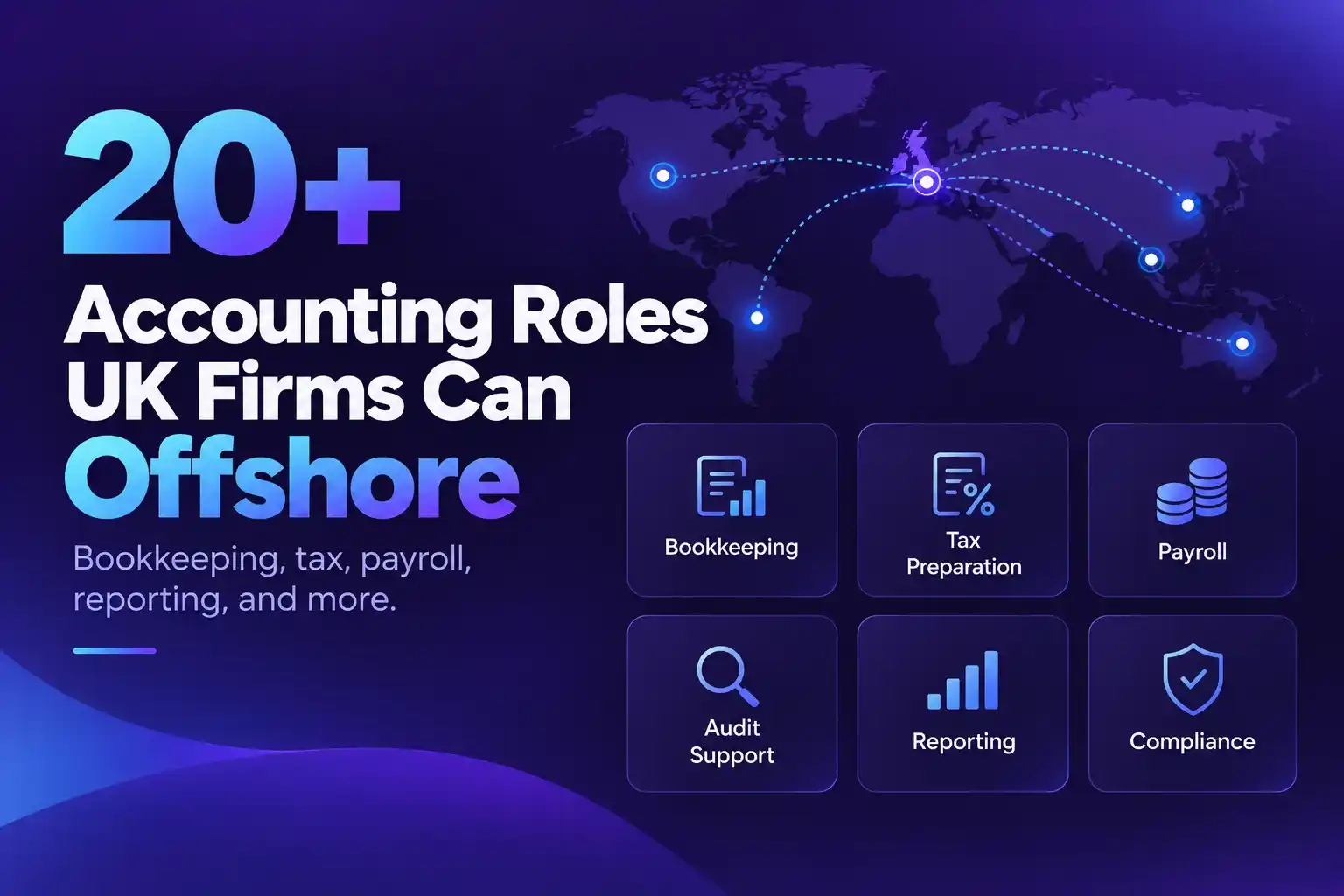
What Accounting Work Can UK Firms Offshore? 20+ Roles & Functions
 Amrit Singh





