Scale your CPA & accounting firm with elite offshore talent trusted by 1,000+ firms.
Thank you for your interest. Our due diligence checklist will be shared with you within 48 hours.

CPE compliance keeps accounting firms licensed, but it doesn’t drive growth. Firms that scale successfully align learning with strategic goals, develop advisory skills, and invest in training for both credentialed and non-credentialed staff. By focusing on communication, leadership, and technology adoption, they unlock higher advisory revenue, stronger client relationships, and better talent retention - turning learning into a competitive advantage rather than just a compliance requirement.
In the movie Ratatouille, Gusteau's restaurant had technically compliant food - every dish safe, every license current, every inspector satisfied. But it was Remy's ambition to create something extraordinary that transformed the restaurant. CPE compliance is Gusteau's baseline. Strategic learning is Remy. One keeps the lights on. The other builds a legacy.
Effective leadership is not about making speeches or being liked; leadership is defined by results not attributes.
Most firms aren't neglecting CPE - their credentialed people complete their hours every cycle. The gap is in two places. First, what those hours are doing: when each person selects CPE independently, the firm's credits get logged but the firm's capabilities don't grow.
Second, and often entirely invisible: non-credentialed staff - bookkeepers, analysts, operations team members, associates not yet licensed - have no CPE obligation at all. No compliance clock is ticking for them. So in many firms, they receive no structured development whatsoever.
The growth firms have figured out something important: a firm's training strategy has to cover both populations. For credentialed staff, CPE course selection is aligned to firm objectives so required credits and real development happen in the same motion.
For non-credentialed staff, structured training fills the gap that no compliance framework ever would. One unified learning system. Everyone growing.
Fragmented firms ask: 'Did our credentialed people complete their hours?' Aligned firms ask: 'Is every person on our team - licensed or not - developing the capabilities we need to serve clients at the highest level?' Those are completely different questions - and they lead to completely different outcomes.

The shift from compliance to advisory is the defining strategic move for mid-market firms right now. But you cannot pivot to advisory without training people in advisory skills: business analysis, financial modeling for client decisions, strategic conversation facilitation, and proactive insight delivery. These skills are not built through tax update courses.
Technical accuracy earns trust. Communication builds relationships. The ability to explain complex issues clearly, anticipate client concerns, and be present as a strategic partner - these are learnable skills that most firms leave entirely to chance.
The art of communication is the language of leadership.
The most urgent capability gap in most growing firms is management. Technically excellent people get promoted and then struggle because no one trained them to manage, delegate, give feedback, or develop a team. This is not a hiring problem. It's a development gap.
AI is reshaping the accounting profession faster than most firms are adapting. Training staff on new tools, automating workflows, and thinking critically about where technology adds value versus where human judgment is irreplaceable - this is now core professional development, not a bonus.
When firms invest in the full range of development - not just CPE compliance - they see measurable results: higher advisory revenue, stronger client retention as relationships deepen, better talent retention as people see a development path, and partners leveraged more effectively as managers grow.
CPE compliance keeps licenses active. Strategic learning builds the firm. The most effective firms do both - but never confuse one for the other.
Working with 1,000+ accounting firms and enterprises, we've seen what separates firms that develop consistently from those that scramble. If your firm is navigating any of these challenges, let's have a conversation - no pitch, just perspective from a team that's helped firms build exactly what's described in this piece.

CPE ensures accountants stay compliant and updated on regulations, but it often lacks alignment with firm strategy. Many firms treat CPE as a checkbox activity rather than a growth driver, which limits capability building and competitive advantage.
Firms need to invest in advisory, communication, leadership, and technology skills. As the profession shifts toward strategic guidance and client advisory, non-technical skills like critical thinking and collaboration are becoming essential for growth.
Strategic learning helps firms increase advisory revenue, improve client relationships, and boost profitability. Upskilled teams can deliver higher-value services and better meet evolving client expectations, leading to stronger long-term growth.
Non-credentialed staff often lack structured learning requirements, creating a major capability gap. Firms that invest in training across all roles build a more aligned, skilled workforce that supports scalability and consistent service quality.
Firms should move from individual, ad hoc CPE selection to a structured learning strategy aligned with firm goals. This includes curated training paths, mentorship, and integrating technical and non-technical skills development to drive measurable outcomes.

Amrit Singh is a business leader with 10+ years of experience in continuing education. Helping accounting, tax, and finance professionals stay compliant with ease, he began his journey as a consultant. Learning across industries before stepping into a leadership role, he is shaped by both successes and failures. Amrit is passionate about problem-solving, building products, exploring technology, and mentoring future leaders. He is dedicated to transform continuing education, making it simpler, smarter, and more meaningful. Through his blogs and talks, he shares insights on accounting careers, CPA compliance, and the future of continuing education.
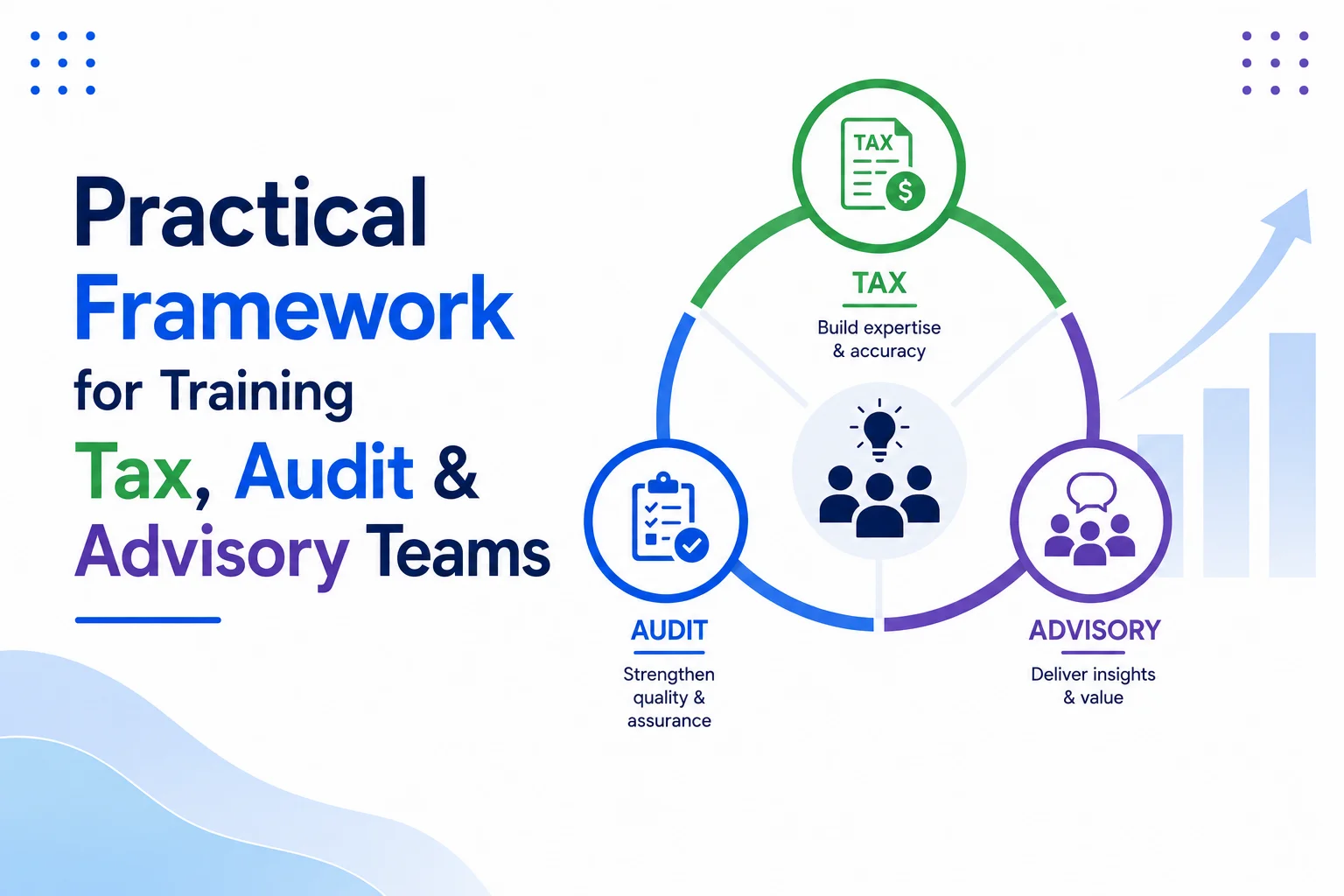
A Practical Framework for Training Tax, Audit, and Advisory Teams
Amrit Singh