Scale your CPA & accounting firm with elite offshore talent trusted by 1,000+ firms.
Thank you for your interest. Our due diligence checklist will be shared with you within 48 hours.

Most providers can show you impressive candidate profiles, attractive pricing, modern offices, testimonials and a polished sales presentation. But those things don't necessarily tell you what happens after you sign — what happens when your assigned accountant leaves, how sensitive client information is protected, how quickly a replacement arrives, who takes responsibility when quality drops, and what you'll actually pay in Year 2 and Year 3.
Before signing with any offshore provider, accounting firms should conduct proper operational, security, talent and contractual due diligence. Here are ten questions worth asking — each with a way to verify the answer yourself.
Offshoring isn't simply about finding an accountant — it's about keeping good people long enough for them to understand your clients, systems, processes, expectations and firm culture. Every unexpected departure creates a hidden cost:
Even when the offshore provider pays for recruitment, your managers and senior staff absorb much of that operational cost:
If the response is mostly about a "great culture" or "happy employees," ask for the underlying numbers. Ask for evidence, not adjectives.
See MYCPE ONE's staff retention data↗️
Accounting firms routinely handle highly sensitive information — Social Security numbers, tax returns, payroll records, banking information, financial statements, employee information, client documents. Security deserves significantly more scrutiny than a logo on a provider's website.
Ask whether your IT or security team can review the provider's relevant certifications and security documentation. Depending on the engagement, due diligence may also cover:
You should also understand how your staff will actually access your systems: where information is stored, whether employees can download files locally or print documents, whether they can connect personal devices, and what happens the moment an employee leaves.
See MYCPE ONE's SOC 2 & ISO 27001 documentation↗️
Finding a candidate isn't the same as making that candidate productive. Ask the provider to walk you through onboarding step by step:
Then establish ownership: who handles background checks, who provisions technology, who coordinates access, who trains the employee, who monitors the first 30 days, and who contacts your firm when onboarding gets stuck? And what's the realistic timeline from candidate selection to productive work?
See MYCPE ONE's onboarding process↗️
No provider can guarantee zero employee turnover. What matters is what happens next.
See how MYCPE ONE handles replacement & transition↗️
Your first engagement should validate more than technical ability — it should test the entire working relationship. Can the employee communicate effectively? Does the provider respond when you need help? Does your technology work smoothly? Are your SOPs detailed enough? Does your US team give timely feedback? Can the employee operate with increasing independence?
A structured pilot can help evaluate technical capability, communication, responsiveness, work quality, productivity, software proficiency, ability to follow SOPs, ability to receive feedback, cultural alignment, and provider support.
You may discover the largest constraint isn't talent at all — it may be undocumented processes, unclear ownership, inconsistent review, delayed feedback, or inadequate internal training. Finding that out with one employee is much easier than discovering it after hiring ten.
"Experienced accountant" is too broad. An accountant may have excellent technical knowledge but no experience with your firm's actual technology stack. Before interviewing candidates, map the applications your team uses across:
Then ask: "How many available candidates have actually used our core applications in a professional environment?"
Understand which one you're actually hiring.
See MYCPE ONE's tools & technology expertise↗️
Errors happen onshore and offshore. The real test is what happens after an error occurs.
A good quality process shouldn't automatically assume every problem is an employee problem. The root cause could sit anywhere along this chain:
Strong operations identify the cause and fix the system, rather than simply changing the person closest to the mistake.
See MYCPE ONE's quality escalation process↗️
Hourly rates make offshore providers easy to compare — they can also make them dangerously easy to compare incorrectly. Imagine receiving three quotes: Provider A at the lowest hourly rate, Provider B slightly higher, Provider C the highest. It's tempting to conclude Provider A is cheapest. You don't know that yet.
A provider increasing rates over time isn't necessarily a problem — salaries and operating costs change. Unexpected increases are the problem. You want predictability.
See MYCPE ONE's 3-year pricing model↗️
Time-zone overlap directly shapes how a role works day to day, so it's worth asking any provider to spell out exactly what you'd get — not just that "overlap is available."
See MYCPE ONE's overlap policy↗️
Software fluency isn't the only thing that determines whether an offshore hire performs well from day one. Communication style, cultural context, and professional polish matter just as much and those are things a provider should be actively training for, not leaving to chance.
See MYCPE ONE's training facility↗️
The hourly rate is one line item. The actual economics of an offshore relationship are broader:
A provider that costs slightly less per hour but experiences high turnover may consume considerably more management time. A provider with inadequate infrastructure may create operational or security risk. A provider without a strong replacement mechanism may leave your firm short-staffed at exactly the wrong time. And a provider that looks inexpensive in Year 1 may look very different after contractual increases and additional charges.
The objective isn't finding the lowest hourly rate. It's understanding exactly what your firm receives for that rate.
| When they say... | Ask for... |
|---|---|
| "We have excellent retention." | The number. |
| "We have enterprise-grade security." | Documentation. |
| "Our onboarding is seamless." | The onboarding plan. |
| "Our accountants are highly experienced." | To interview them. |
| "We provide excellent support." | The escalation structure. |
| "Our pricing is transparent." | What you'll pay over three years. |
And when someone gives a vague answer, keep asking until you understand it. Due diligence isn't about trying to catch a provider doing something wrong — it's about understanding exactly who you're trusting before you give them access to your firm.
| Question | What You're Evaluating |
|---|---|
| What is your annual staff retention rate? | Workforce stability |
| Can I review your SOC 2 and ISO 27001 documentation? | Security maturity |
| What does onboarding look like? | Operational readiness |
| What happens if my professional leaves? | Business continuity |
| Can we start with a pilot or trial? | Ability to validate the relationship |
| Which tools does your team actually know? | Technology readiness |
| How are quality issues escalated? | Accountability |
| What happens to pricing in Years 2 and 3? | Long-term cost predictability |
| What overlap time would I get? | Day-to-day collaboration & role design |
| Do you have an in-house training facility? | Staff readiness & service quality |
That question alone can change the quality of your due diligence.
At MYCPE ONE, we work with accounting firms evaluating offshore talent across different roles, experience levels and delivery locations and we understand that firms shouldn't simply take an offshore provider's claims at face value, including ours.
That's why we encourage firms to conduct proper due diligence before making a decision. Our offshore infrastructure is designed around the areas accounting firms should be evaluating: talent, data security, compliance, physical infrastructure, technology controls, workforce management, onboarding, continuity and ongoing support. Where applicable, our team is prepared to provide relevant documentation and walk firms through the controls and processes behind the service, rather than asking them to rely solely on marketing claims.
If your firm is currently evaluating offshore accounting, bookkeeping, tax, audit, payroll, CAS or other accounting talent, don't start by asking us for a sales presentation. Bring your due diligence questions — about infrastructure, security, compliance, onboarding, talent, replacement, pricing, and how the model actually works after the contract is signed. Our objective is to help you understand the operating model before you make the decision.

Amrit Singh is a business leader with 10+ years of experience in continuing education. Helping accounting, tax, and finance professionals stay compliant with ease, he began his journey as a consultant. Learning across industries before stepping into a leadership role, he is shaped by both successes and failures. Amrit is passionate about problem-solving, building products, exploring technology, and mentoring future leaders. He is dedicated to transform continuing education, making it simpler, smarter, and more meaningful. Through his blogs and talks, he shares insights on accounting careers, CPA compliance, and the future of continuing education.


How to Scale CAAS (Client Accounting & Advisory Service) + VCFO with Offshoring!


How To Scale CFO And Advisory Services With Offshoring

Bursting myths around Offshoring for an Accounting firm
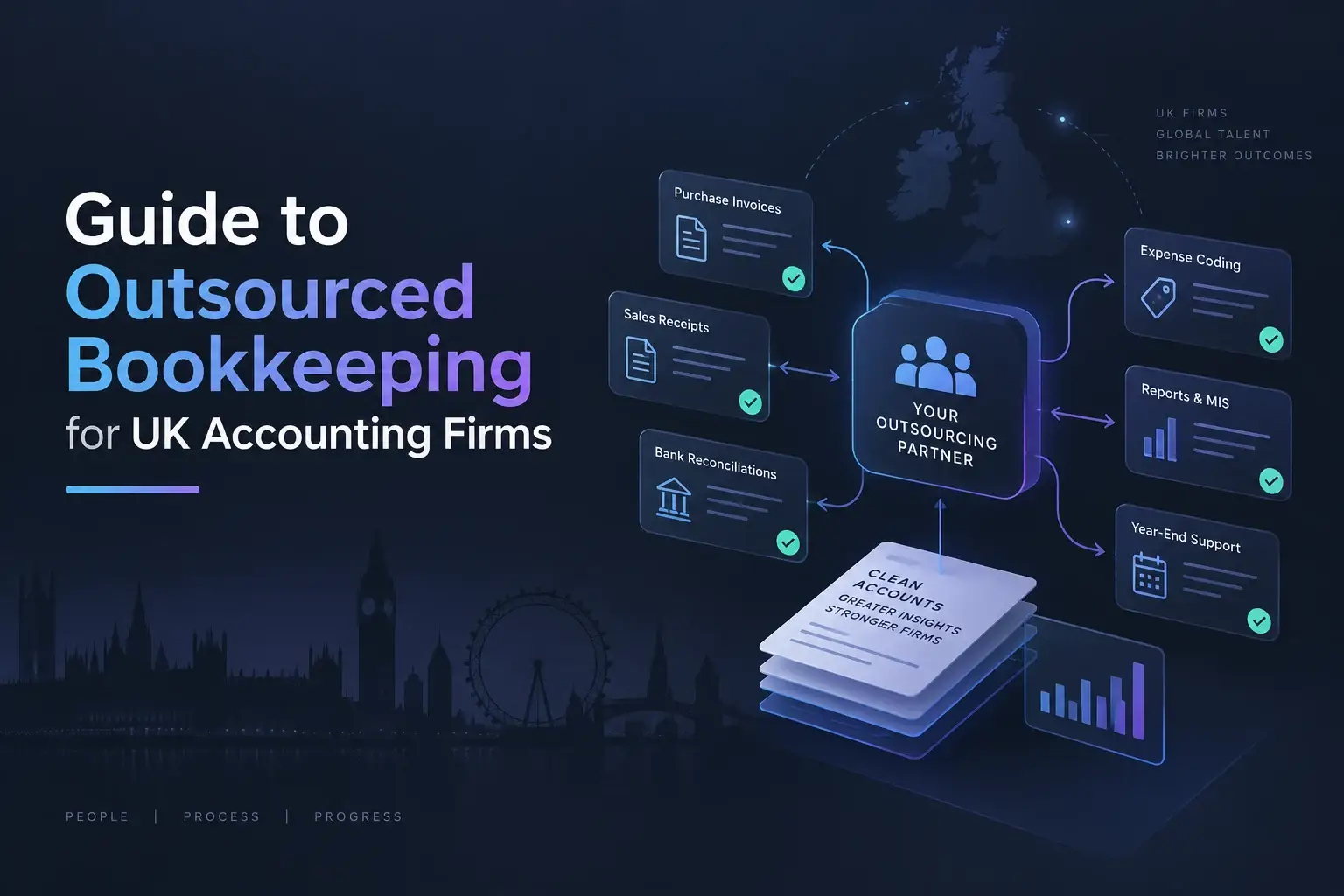
Complete Guide to Outsourced Bookkeeping Services for UK Accounting Firms
 CA Nemin Vora