
Scale your CPA & accounting firm with elite offshore talent trusted by 1,000+ firms.
Thank you for your interest. Our due diligence checklist will be shared with you within 48 hours.

Businesses across the US and Canada are struggling to fill open roles while payroll costs keep climbing. This blog breaks down the benefits of offshore teams, how they solve real hiring gaps in operations, finance, and support, and why companies report offshore team cost savings of 60-70% without cutting quality. It also covers how MYCPE ONE builds and manages these teams so business owners can scale without the hiring headache.
Hiring has stopped being a growth activity. For a lot of businesses right now, it is a survival activity.
You post a role. You wait weeks. You interview candidates who ghost you after the offer. You finally hire someone, and six months later they leave for a $5,000 raise somewhere else. Meanwhile the work is piling up, deadlines are slipping, and your best people are doing the job of three people just to keep things moving.
This is not a one-off problem. It is the new normal for businesses trying to hire skilled talent in the US and Canada. Government data backs this up too. According to the Bureau of Labor Statistics' JOLTS report, job openings in the US were still sitting at 7.6 million as of May 2026, a clear sign that unfilled roles remain a persistent drag on businesses, not a temporary blip. And it is exactly why more companies are building offshore teams instead of fighting an unwinnable local hiring battle.
An offshore team is a group of skilled professionals, based in another country, who work as an extension of your in-house staff. They are not freelancers picking up random tasks. They work your hours, follow your processes, and report to your team like any other employee, just from a different location.
Offshore teams handle everything from bookkeeping and data entry to customer support, IT, marketing, and administrative operations. The work gets done. The reporting lines stay the same. The only thing that changes is where the person sits. For a deeper breakdown of how this model works end to end, see our complete guide to offshore teams for businesses and enterprises.
Three things are colliding at once.
The result is a business owner stuck choosing between overpaying for a hire who might not stay, or leaving critical roles unfilled and hoping the team can absorb it.

The benefits of offshore teams go beyond just saving money, though that is usually what gets a business owner's attention first.
You get access to a much bigger talent pool. Instead of competing for the same 50 candidates in your city, you can choose from thousands of pre-vetted professionals across India, the Philippines, and Mexico. These are trained specialists, not entry-level generalists.
You fill roles in weeks, not months. Because the talent pool is already built and vetted, offshore staffing partners can place a qualified professional in your team far faster than a traditional local search.
You build a stable, long-term team. Offshore professionals working through a structured staffing model tend to stay longer, because the role is treated as a real career, not a temporary gig.
You free up your leadership team. Your managers stop spending their week screening resumes and start spending it running the business.
This is where the numbers do the talking. Businesses working with offshore teams typically see offshore team cost savings of 60-70% compared to hiring the same role locally. If you want a full line-item breakdown of what drives that number, we cover it in detail in how much it costs to build an offshore team for businesses.
Here's a simple example. A mid-sized business hiring an operations coordinator locally might pay $55,000 to $65,000 a year once you factor in salary, benefits, payroll taxes, and overhead. An offshore professional handling the same responsibilities, working through a staffing partner like MYCPE ONE, can start at rates as low as $11 an hour, fully managed, with no separate benefits or infrastructure cost on your end.
Multiply that across five or ten roles, and the savings stop being a small line item. They become enough to fund a new product line, an extra marketing push, or simply a healthier bottom line at the end of the year.
The math is simple. The impact is not. Lower cost per role means more roles filled, which means less burnout on your existing team and more capacity to actually grow.
Schedule a Call and Learn How Offshore Teams Can Cut Your Costs.
This is exactly the gap MYCPE ONE was built to close.
MYCPE ONE has helped 300+ businesses build offshore teams that function like an in-house department, not an outsourced vendor. Every professional is sourced, vetted, trained, and managed end to end, so business owners are not left figuring out payroll, compliance, or onboarding in a country they have never operated in.
A few things set the process apart:
You are not renting a name on a resume. You are getting a real team member who shows up, does the work, and stays.

Take a business struggling to keep up with customer support tickets during peak season. Local hiring would mean a rushed search, a higher salary to attract anyone available quickly, and a real risk of turnover once the busy season ends.
With an offshore support specialist in place instead, the business gets full-time coverage, a trained professional who understands the workflow, and a cost structure that makes sense whether it is peak season or not. No panic hiring. No burnout on the existing team. Just steady, reliable support.

The talent shortage is not going away, and local hiring costs are not going down. Businesses that keep waiting for the hiring market to get easier are going to keep losing time, money, and momentum.
Offshore teams are not a shortcut. They are a structural fix to a problem that local hiring alone cannot solve anymore. Businesses that build offshore teams the right way get access to skilled people faster, spend less doing it, and free up their leadership to focus on growth instead of recruiting.
Know more at https://my-cpe.com/businesses/services/build-offshore-teams
Not when the team is structured correctly. Most offshore professionals working with US and Canadian businesses adjust their hours to overlap with your working day, so communication happens in real time. Staffing partners also set up clear reporting structures and regular check-ins, so managing an offshore hire feels the same as managing someone down the hall.
Outsourcing usually means handing off a project to a third party that owns the process and the output. Offshore staffing means a dedicated professional joins your team, follows your systems, and reports directly to you. You keep full control of how the work gets done. The person is simply based in another country.
Businesses commonly offshore roles in bookkeeping, data entry, customer support, IT support, digital marketing, administrative operations, and back-office processing. Any role that can be done remotely and does not require physical presence is generally a strong fit for an offshore model.
Offshore professionals working through a structured staffing partner go through vetting, skills assessment, and training before they are placed on a team. Many come with years of relevant experience in their field. The difference is location and cost, not capability.

Nemin Vora, a CA and Tax Attorney, leads Client Relations at MYCPE ONE. With 7+ years of experience at Big 4 and top public accounting firms across America, he helps U.S. firms scale globally through remote talent, offshoring, and cloud operations. Known for his sharp tax insights and practical approach to firm growth, Nemin is a dynamic speaker. He breaks down complex topics such as leadership, AI, global staffing, and practice expansion into relatable lessons that professionals actually enjoy learning. Beyond the strategy decks, Nemin is a learner at heart, a stage actor, and a tech enthusiast.

Medical Practice Accounting: A Complete Guide for Clinics and Provider Groups
CA Nemin Vora

How U.S. Companies Scaled Finance Ops with Offshore Teams in India
CA Nemin Vora
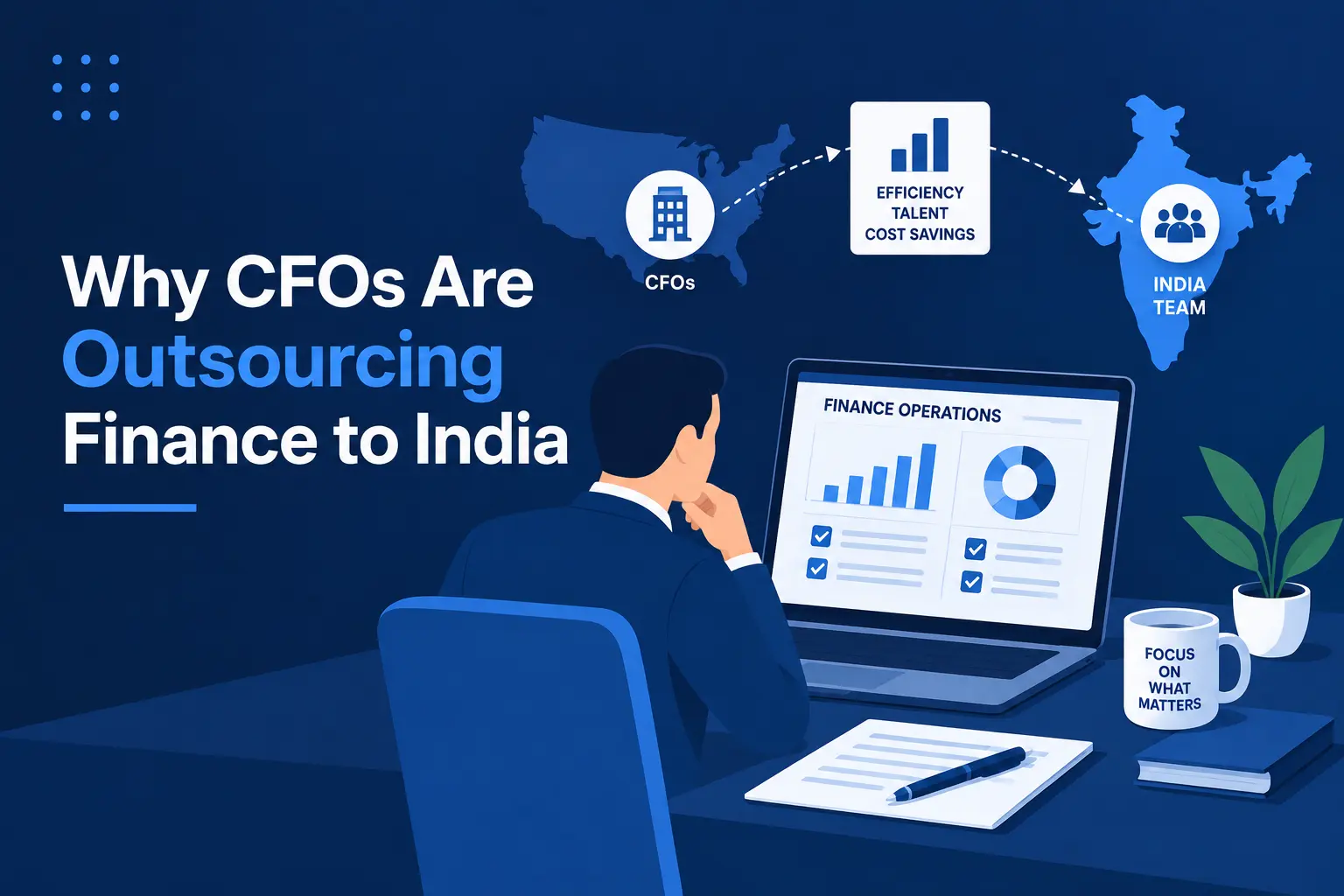
Top Reasons U.S. CFOs Are Moving Finance & Accounting Operations to India
CA Nemin Vora